
The term ‘quiet quitting,’ prevalent in early 2020s workplace discourse, represents more than a social media trend. The phenomenon it describes—withdrawing discretionary effort—is an expression of a crisis in the labor-capital relationship.1 To understand its philosophical and ethical dimensions, one must deconstruct the term beyond simplistic labels. The ambiguity of ‘quiet quitting’ is a central feature, revealing a schism in the unwritten rules of the modern workplace. It signifies a rupture in the assumed consensus of employee-employer obligations, prompting a re-examination of the foundational pact of work.
From TikTok Trend to Labor Zeitgeist
The phrase ‘quiet quitting’ entered the lexicon rapidly, propelled by a March 2022 TikTok video [1]. User Zaid Khan’s articulation resonated globally: “You’re not outright quitting your job, but you’re quitting the idea of going above and beyond… you’re no longer subscribing to the hustle culture mentality that work has to be your life” [3]. This occurred during the “Great Resignation,” as post-pandemic workers felt overwhelmed and disconnected, sparking a conversation about work’s role in life [4]. The novelty of the term is deceptive; the practice is old. Withdrawing effort as protest or self-preservation is a constant in labor relations. It is seen in Herman Melville’s character Bartleby the Scrivener, whose refusal “I would prefer not to” is a powerful act of disengagement [6]. It is also a core tactic in organized labor known as “work-to-rule”—adhering strictly to a contract to show the volume of uncompensated labor normally performed [3]. The contemporary phenomenon is distinguished by the scale of the conversation and its emergence as an individualized response to modern workplace pressures [6]. The pandemic was a catalyst, prompting reflection that led many to “reassess their priorities,” questioning the centrality of career ambition [6].
A Spectrum of Definitions: Boundary-Setting vs. Disengagement
The intense debate surrounding quiet quitting stems from a fundamental disagreement over its definition and, consequently, its moral valence. The term has been bifurcated into two primary interpretations, which are not merely different but often diametrically opposed in their assumptions about the nature of the employment relationship.
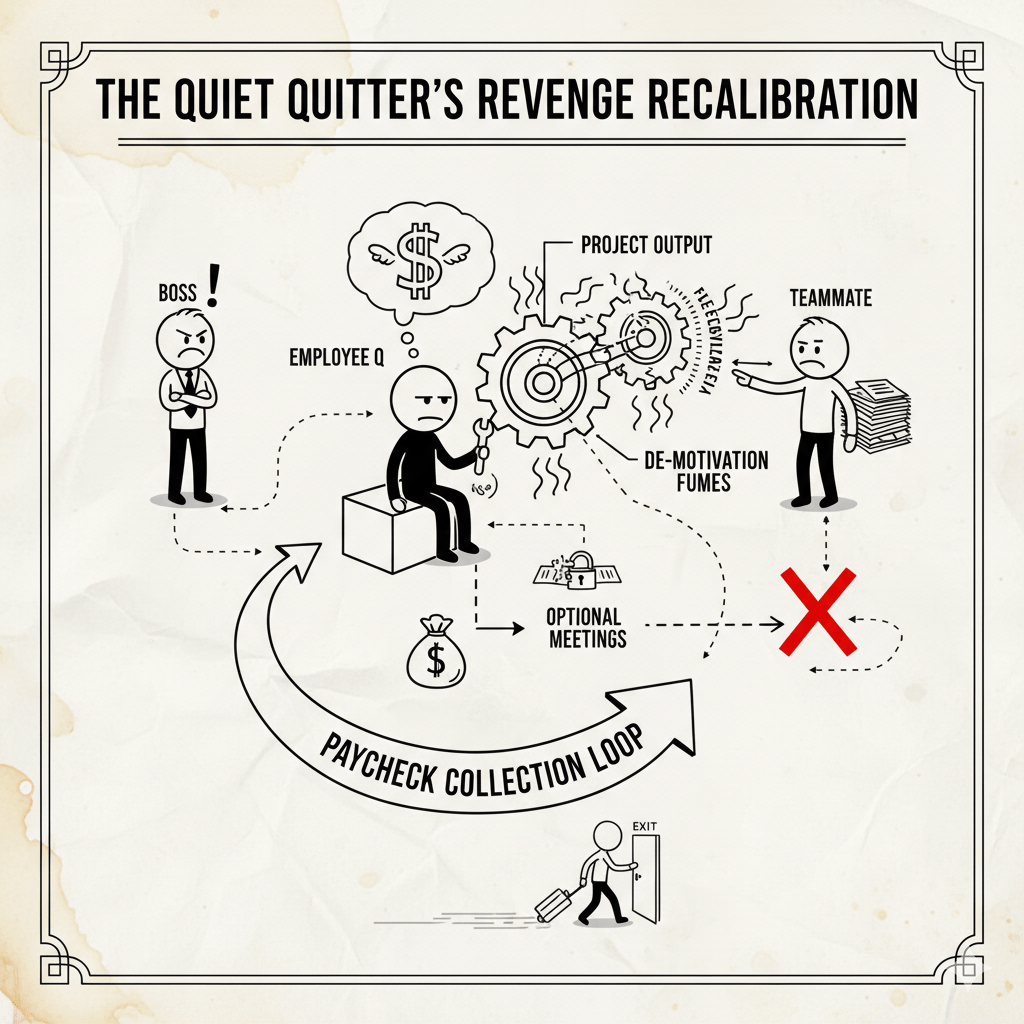
The first, and more pejorative, definition frames quiet quitting as a form of neglectful disengagement. From this perspective, a quiet quitter is an employee who is “doing the bare minimum” required to avoid termination, continuing to “collect a paycheck” while their motivation and productivity decline, eventually leading to their departure or dismissal.4 This interpretation focuses on the negative behavioral indicators: a gradual disinvestment in tasks, reduced communication, avoiding non-mandatory meetings, missing deadlines, and a general withdrawal from the social and collaborative aspects of the workplace.1 In this view, quiet quitting is a “silent protest” or a prelude to an actual resignation, an act of “revenge recalibrating” where an employee takes advantage of the employer by not working to their full potential.4
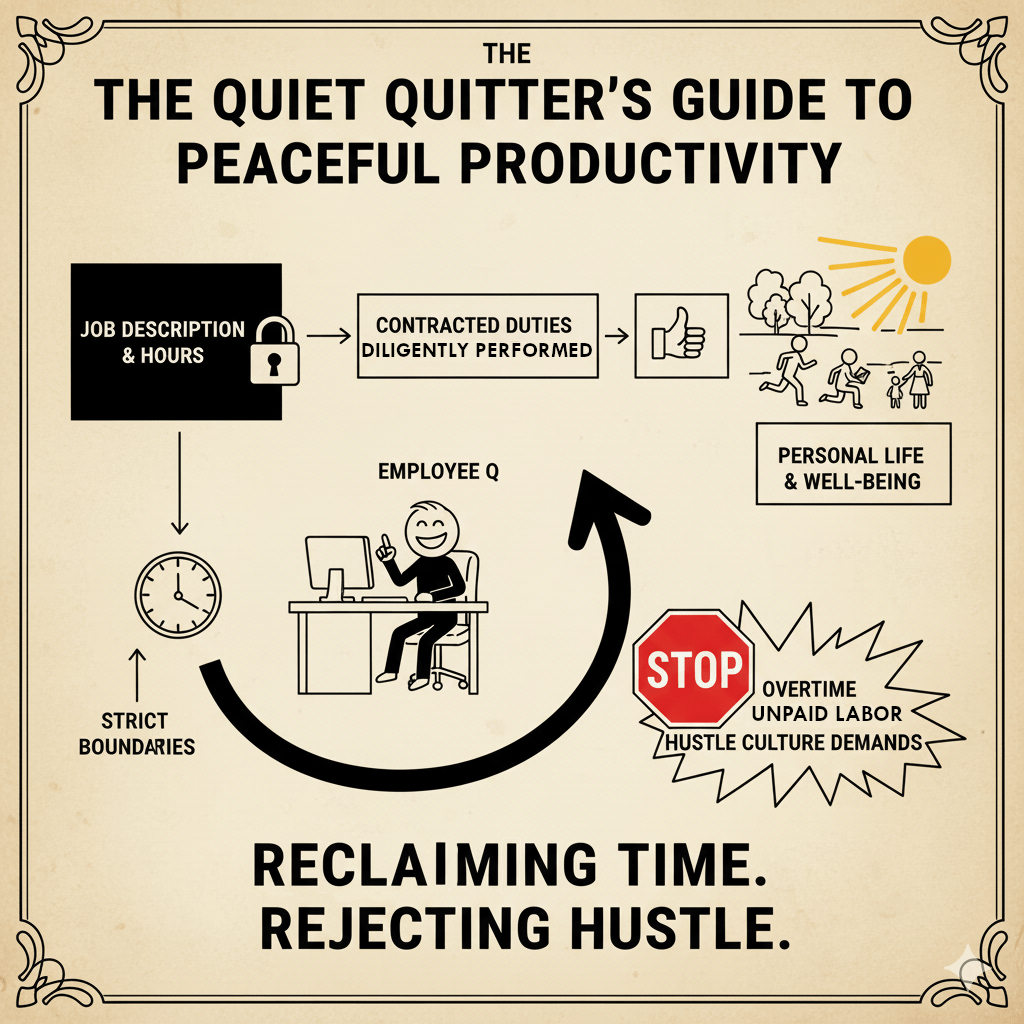
The second, more affirmative, definition portrays quiet quitting as a healthy and necessary act of establishing boundaries. Proponents of this view, including many who identify as quiet quitters, see it as a conscious rejection of the “hustle culture” that demands total devotion to one’s career.3 It is understood as the practice of adhering strictly to one’s job description and working hours, thereby reclaiming time and energy for one’s personal life.8 One survey found that 24% of respondents defined the practice as “setting firmer boundaries at work”.4 From this perspective, quiet quitting is not about slacking off but about performing one’s contracted duties diligently and then disengaging, refusing to provide the uncompensated, discretionary labor that has become a widespread expectation in many professional environments.5
This definitional schism reveals a deeper philosophical conflict over the nature of the employment agreement. The negative framing assumes a relational pact where employees are implicitly expected to demonstrate “organizational citizenship behaviors”—such as staying late or helping colleagues—that go beyond their formal duties.1 The positive framing, by contrast, asserts a purely transactional relationship: the contract is an exchange of a specified amount of labor for a specified amount of pay, and nothing more is owed. The controversy surrounding quiet quitting arises precisely because employees are unilaterally reverting to a transactional interpretation, often after they perceive that the employer has failed to uphold its end of the relational bargain. The term’s viral spread indicates a widespread questioning of the legitimacy of the employer’s claim to an employee’s discretionary effort.
The Scope of the Phenomenon
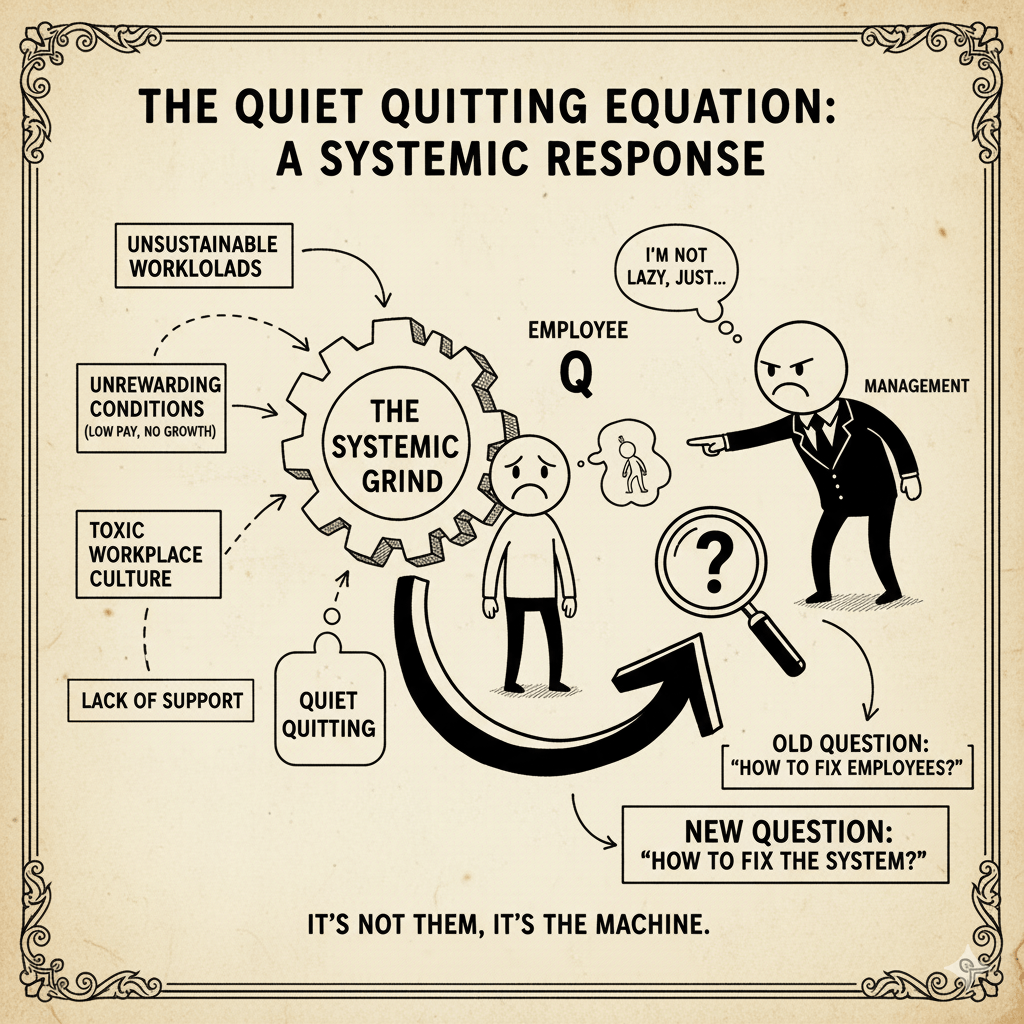
The resonance of quiet quitting suggests it is not a niche phenomenon. A 2023 Gallup report stated that 59% of the global workforce could be classified as quiet quitters, with other estimates suggesting that at least half of the U.S. workforce falls into this category.1 This widespread disengagement is not attributable to a single cause but rather a confluence of systemic issues within the modern workplace, indicating that quiet quitting is more of a symptom of organizational dysfunction than a disease of individual employee malaise.
The causal factors identified in extensive surveys and analyses can be grouped into several key areas:
- Economic and Transactional Failures: A primary driver is the perception of an unfair economic exchange. This includes frustrations over compensation that is below market rate or has not kept pace with inflation and increased productivity.4 A profound lack of recognition is also a critical factor; when employees feel their contributions are not acknowledged or appreciated, they become disengaged.4 The feeling of being undervalued is a powerful catalyst for withdrawing the extra effort that was once freely given.
- Organizational and Structural Dysfunctions: The structure and culture of the workplace itself are often to blame. Poor work-life balance, characterized by excessive workloads and long hours, leads directly to employee burnout, a key precursor to quiet quitting.4 A toxic work culture—defined by micromanagement, favoritism, a lack of psychological safety, or poor management—drives employees to disengage as a protective measure.4 Furthermore, a lack of clear opportunities for career growth and development can make employees feel stagnant, removing the incentive to invest in a future with the organization.4
- The Post-Pandemic Re-evaluation: The COVID-19 pandemic acted as a profound societal and individual catalyst. It forced a global re-evaluation of priorities, blurring the lines between work and home and prompting many to consciously rebuild those boundaries.6 This period of reflection on the “fragile nature of humanity” led to a greater emphasis on personal well-being, family, and life outside of work, often at the expense of career ambition.6
The consistent appearance of these external, organizational triggers across numerous studies strongly refutes the notion that quiet quitting is simply a matter of individual laziness or a generational attitude problem. Instead, it emerges as a rational and predictable response to working conditions that are unsustainable, unrewarding, or psychologically damaging. The phenomenon is a powerful signal, a form of feedback from the workforce that the existing terms of the employment relationship are no longer acceptable. This reframes the essential question for organizations from “How do we fix our quiet quitting employees?” to the more challenging and productive question, “How do we fix the systemic conditions that are compelling our employees to quietly quit?”
The Workplace as a Polity: Applying Rousseau’s Social Contract
To fully grasp the philosophical gravity of quiet quitting, it is instructive to turn to one of the foundational texts of modern political thought: Jean-Jacques Rousseau’s The Social Contract. Published in 1762, Rousseau’s treatise on legitimate political authority provides a surprisingly potent framework for analyzing the employer-employee relationship. By transposing his concepts of consent, sovereignty, and the “general will” from the state to the workplace, we can understand the modern organization as a form of micro-polity, governed by an unwritten social contract. Within this framework, quiet quitting ceases to be a mere human resources issue and becomes a profound political act: a crisis of legitimacy and a withdrawal of consent from a governing power that has violated its pact with its citizens.
Rousseau’s Foundational Principles
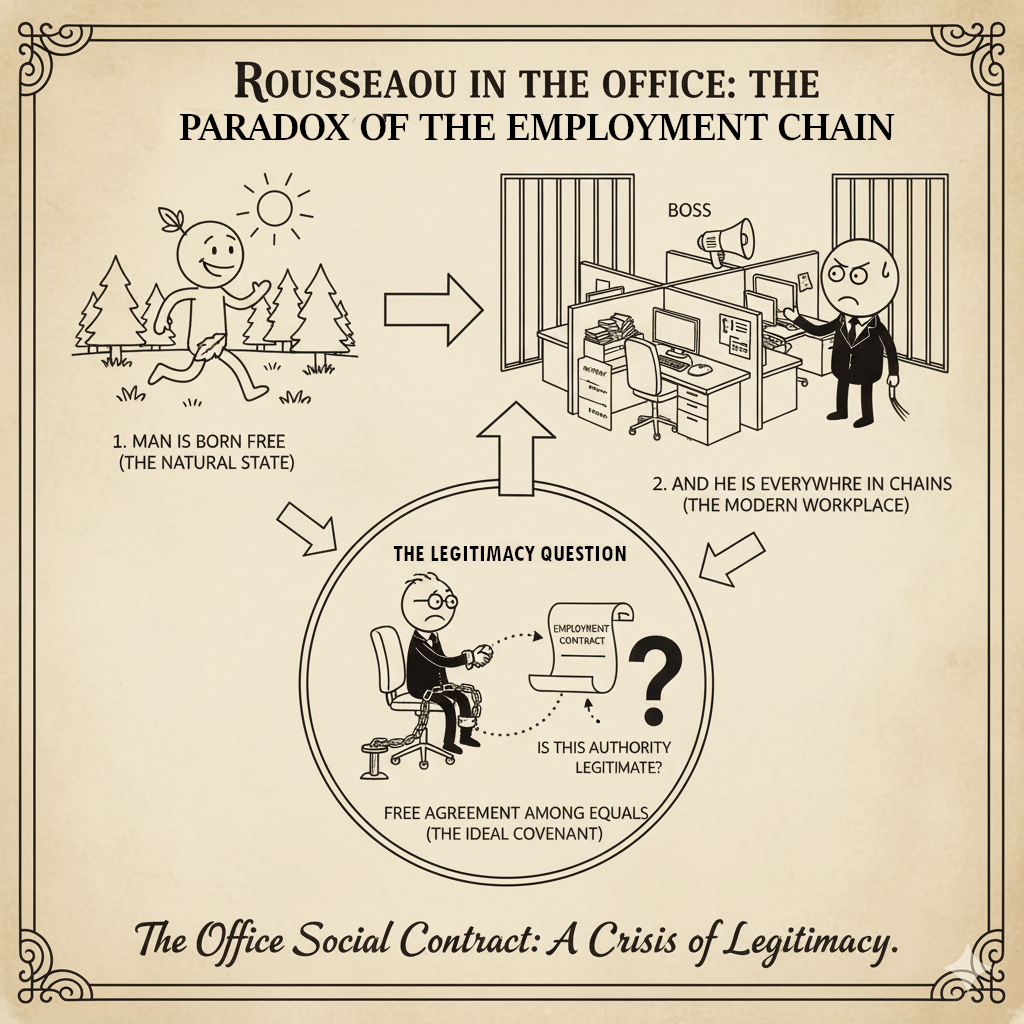
Rousseau’s political philosophy begins with a powerful and paradoxical observation: “man is born free, and he is everywhere in chains”.12 He argued that the development of society and civilization had corrupted humanity’s natural state of goodness and freedom, leading to systems of inequality and oppression.14 His central problem was to determine whether any form of political authority could be legitimate—that is, compatible with the individual freedom that is the basis of all human rights.13 He rejected the notion that authority could be based on force or divine right, concluding instead that “all legitimate authority” must be “based on covenants,” or free agreements among equals.13
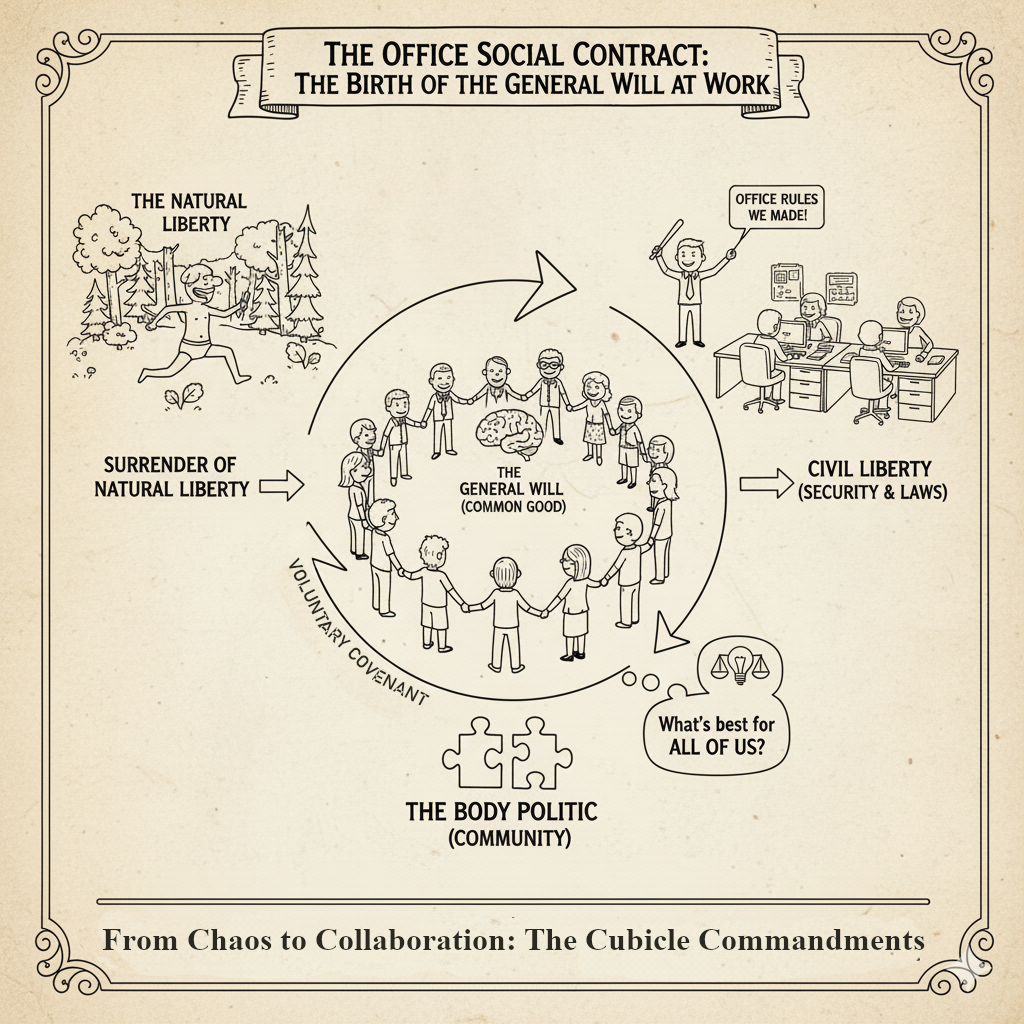
This free agreement is the social contract. In this act, individuals voluntarily come together to form a community, or “body politic”.13 Each person surrenders their “natural liberty”—the freedom to do whatever one’s power allows—to the community as a whole.14 In return, they gain “civil liberty,” which is the security and freedom that come from living under laws that they themselves have helped to create.17 The directing principle of this body politic is the “general will” (la volonté générale). The general will is not the simple sum of individual private interests; rather, it is the collective will of the citizenry aimed always at the common good.12 It reflects a public spirit in which citizens, guided by reason and a love of justice, seek what is best for the community as a whole.14
For Rousseau, true sovereignty—the supreme authority to legislate—always resides with the people, exercising this general will.14 The government is merely an executive agent, tasked with administering the laws created by the sovereign people.15 This creates a profound reciprocity: individuals are simultaneously citizens, participating in the creation of law, and subjects, obligated to obey those laws.13 Because they are obeying laws they have consented to, they “obey [themselves] alone, and remain as free as before”.17 This is the essence of legitimate authority. If the government ever usurps the sovereign’s role and acts against the general will, it breaks the social contract, and the people are no longer obligated to obey it.15
The ‘Psychological Contract’: Transposing Rousseau to the Workplace
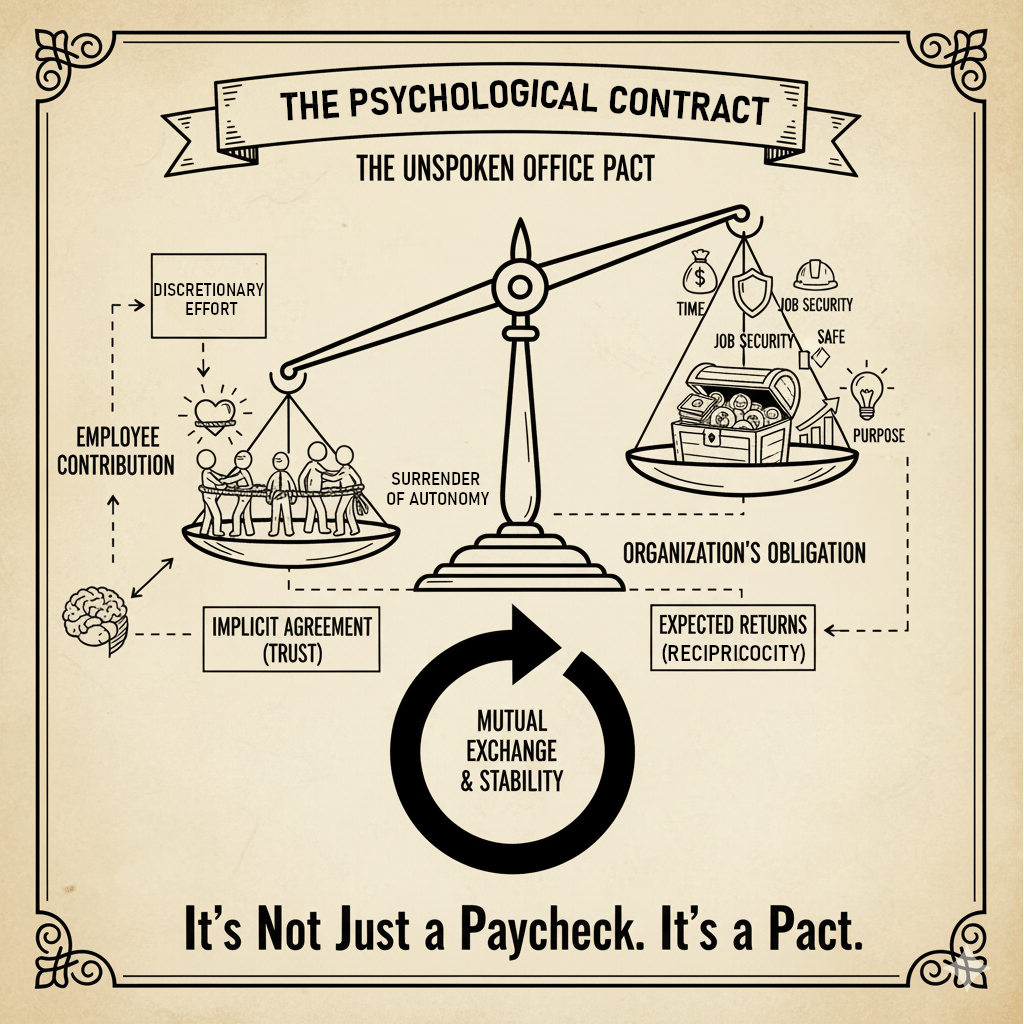
The relationship between an employee and an employer can be understood as a parallel social contract. The formal, written employment agreement—detailing salary, hours, and basic duties—is analogous to a state’s written constitution. It sets out the legal framework of the relationship.18 However, the day-to-day functioning and the true health of this relationship are governed by a far more powerful, albeit unwritten, set of rules known in organizational psychology as the “psychological contract”.19
The psychological contract is defined as the set of individual beliefs and unwritten expectations regarding the mutual obligations between an employee and their organization.18 It is the implicit “unspoken pact” that governs the behavior of both parties beyond the letter of the law.22 Just as Rousseau’s citizens trade natural freedom for civil liberty, an employee enters into this psychological contract by implicitly agreeing to contribute their time, skills, loyalty, and discretionary effort—surrendering a degree of personal autonomy—in exchange for more than just a paycheck.23 They expect fair compensation, but also job security, a safe and respectful environment, opportunities for professional growth and development, and a sense of purpose.20 This mutual exchange of trust and reciprocity forms the bedrock of a stable and productive workplace relationship.22
The ‘General Will’ of the Organization and the Legitimacy of Authority
Within this framework, the “general will” of the organization can be understood as its shared purpose, mission, and collective well-being. A healthy workplace social contract exists when the private interests of both management and individual employees are aligned with this common good.22 Managerial authority, like the authority of Rousseau’s government, is legitimate only insofar as it serves this organizational general will. This means that for managers to have a rightful claim to their employees’ engagement and commitment, their decisions must be perceived as fair, inclusive, transparent, and aimed at the benefit of the entire organizational “community”.23
When management violates this pact—for instance, by demanding excessive overtime without additional compensation, overlooking employees for promotion without clear cause, fostering a toxic culture, or making decisions that prioritize short-term executive bonuses over long-term employee well-being—it ceases to act in service of the general will. Instead, it begins to govern based on its own “private will”.12 In Rousseau’s terms, such a government becomes tyrannical and loses its legitimacy. In the workplace, such management loses its moral authority to lead. It breaks the psychological contract, creating feelings of betrayal and injustice that dissolve the bonds of trust and loyalty.22
This transposition of Rousseau’s theory provides a powerful lens through which to view quiet quitting. When an employer consistently violates the psychological contract, they are, in effect, breaking the workplace’s social contract. The employee’s subsequent withdrawal of discretionary effort is not an act of laziness or petulance; it is a rational and political response to a crisis of sovereignty. It is a passive, non-violent form of dissent, a declaration that the employer’s authority to command anything more than the bare minimum stipulated in the formal contract has been de-legitimized. The employee is effectively stating: “You have broken the terms of our unwritten pact. Therefore, while I will continue to fulfill the letter of the law—my formal job duties—I no longer recognize your moral authority to ask for my passion, my creativity, or my personal time. My consent to be a fully engaged ‘citizen’ of this organization is hereby withdrawn.” This reframes the act from a personal failing to a principled, political stance within the micro-polity of the workplace, an assertion of individual freedom against an authority that has become illegitimate.
The Crisis of Meaning: David Graeber’s Critique of ‘Bullshit Jobs’
While Rousseau’s framework illuminates the structural and political breakdown of the workplace contract, the late anthropologist David Graeber’s theory of “bullshit jobs” provides a crucial lens for understanding its existential and psychological dimensions. Graeber’s work addresses a specific, potent, and increasingly common driver of employee disengagement: the profound spiritual damage inflicted by performing work that is perceived, even by the person doing it, as utterly pointless. If quiet quitting is a response to a broken contract, Graeber’s theory explains what happens when the contract itself is a fraud from the outset—a pact built not on a shared purpose, but on a shared pretense.
Defining the ‘Bullshit Job’
In a 2013 essay that later became a 2018 book, Graeber introduced his now-famous thesis: a significant and growing percentage of employment in modern, affluent societies consists of “bullshit jobs”.25 He offered a precise and critical definition: “a form of paid employment that is so completely pointless, unnecessary, or pernicious that even the employee cannot justify its existence even though, as part of the conditions of employment, the employee feels obliged to pretend that this is not the case”.27
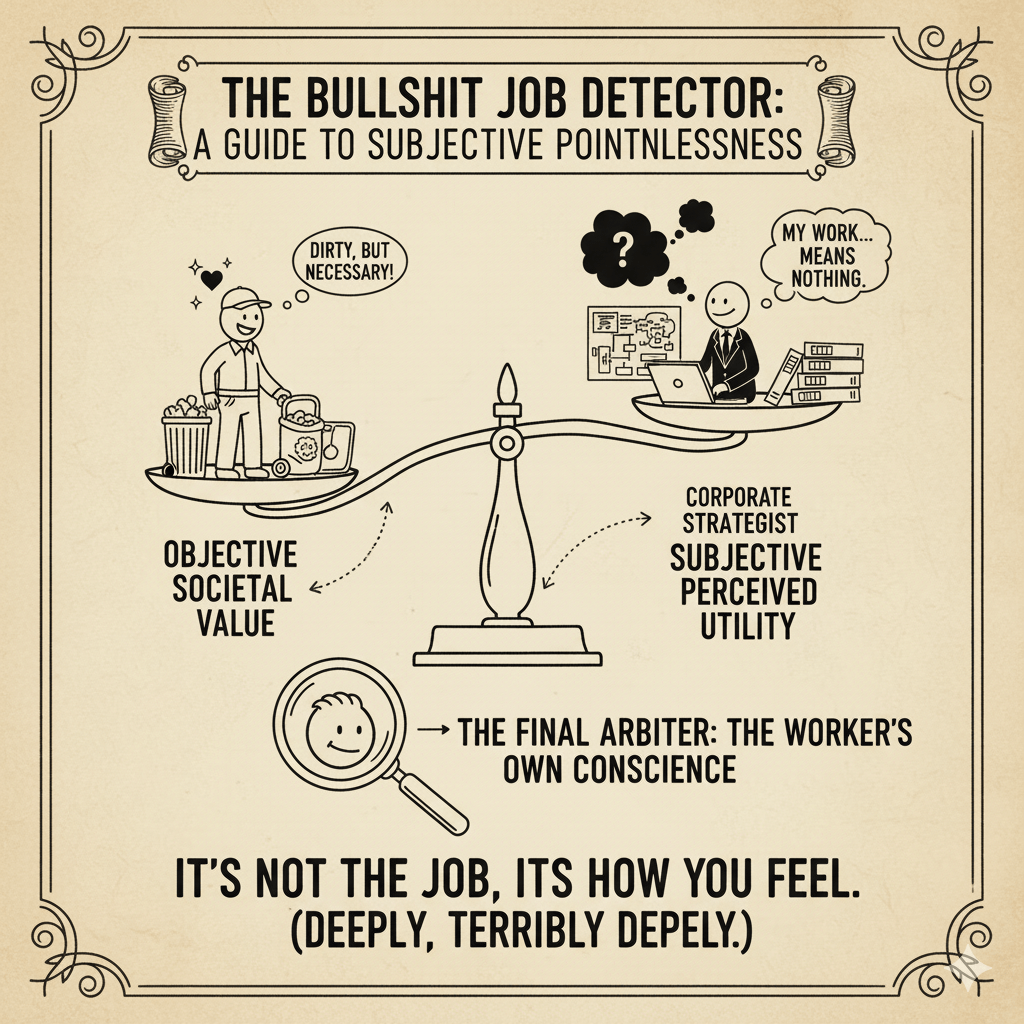
Two elements of this definition are paramount. First is the subjective criterion. A job is only a bullshit job if the person performing it secretly believes it to be so.27 A garbage collector, whose work is of immense societal value, might feel their job is thankless, but they know it is necessary. Conversely, a corporate strategist who spends their days creating PowerPoint presentations for meetings that result in no action may be highly paid and respected, but if they privately believe their work serves no real purpose, they are in a bullshit job.28 The worker’s own perspective is the final arbiter.
Second is the element of pretense or fraud. The employee is not only forced to perform meaningless tasks but must also participate in the charade that this work is important and valuable.27 This performative aspect is what inflicts a unique form of psychological violence, forcing a constant state of cognitive dissonance and inauthenticity.28
A Typology of Pointlessness
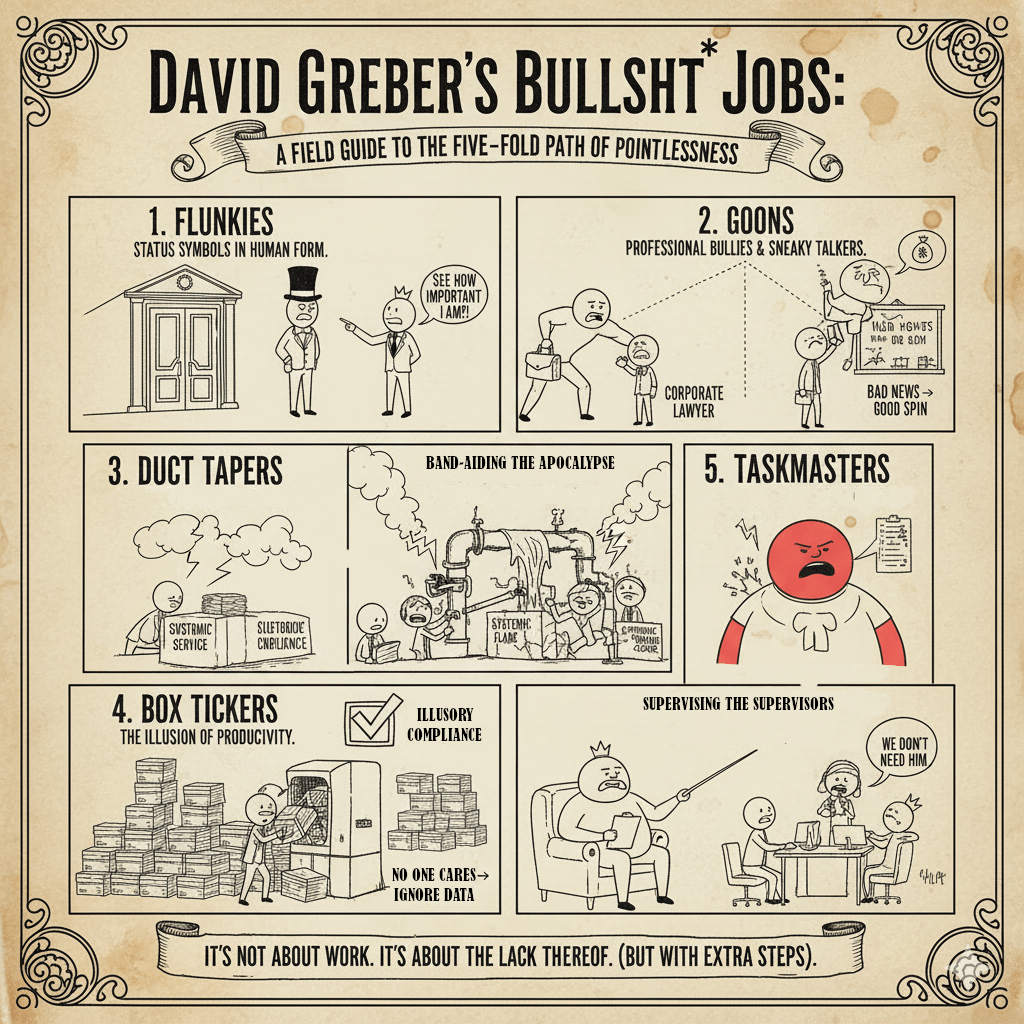
Graeber systematically categorized these roles into five distinct types, providing a vocabulary to identify different forms of meaningless labor 25:
- Flunkies: These jobs exist primarily to make someone else look or feel important. Their function is largely symbolic, serving as markers of status for their superiors. Examples include doormen at buildings that do not require them or receptionists tasked with answering a phone that rarely rings.27
- Goons: This category comprises jobs that have an aggressive or deceptive element and exist only because other people or companies employ them. Their net effect on society is often neutral or negative. Classic examples include corporate lawyers whose primary role is to intimidate competitors, lobbyists, public relations specialists crafting spin, and telemarketers.28
- Duct Tapers: These roles are dedicated to fixing problems that should not exist in the first place. They are temporary patches for deeper, systemic flaws that the organization is unwilling or unable to address permanently. This includes programmers who spend their days fixing shoddy, legacy code or customer service agents whose job is to calm angry customers frustrated by a predictably faulty product or service.25
- Box Tickers: These employees engage in activities that allow an organization to claim it is doing something that, in reality, it is not. Their work is performative, creating reports that are never read, administering surveys whose data is ignored, or running in-house magazines that no one reads. This creates an illusion of industry and compliance without any substantive outcome.25
- Taskmasters: This category includes two sub-types: those who assign unnecessary work to others and those who supervise people who do not need supervision. They are the unnecessary layers of middle management who create bullshit tasks, demand pointless reports, and micromanage capable, autonomous teams.25
The Psychological and Societal Harm
The core of Graeber’s argument is that forcing human beings to spend their lives engaged in tasks they know to be pointless inflicts “profound psychological violence” and “a scar across our collective soul”.28 This stands in direct opposition to the deeply ingrained work ethic that equates labor with self-worth and moral virtue.25 To be denied the opportunity to make a meaningful contribution to the world is to be denied a fundamental aspect of one’s humanity, leading to feelings of depression, anxiety, and self-loathing.27
Graeber argued that the proliferation of these jobs defies economic logic, especially in a capitalist system that should, in theory, be ruthlessly efficient. He proposed that the explanation is not economic but moral and political. He coined the term “managerial feudalism” to describe a corporate logic where power and importance are demonstrated not by efficiency but by the number of underlings one controls, leading to the creation of entire hierarchies of flunkies and taskmasters.28 Furthermore, he contended that the ruling class has a vested interest in keeping the population occupied, citing a “fear of the mob”—the anxiety that a “happy and productive population with free time on their hands is a mortal danger”.25
This analysis leads to a dark inversion of Rousseau’s social contract. Where Rousseau envisioned a polity united by a collective pursuit of the common good (the general will), the world of bullshit jobs is built upon a collective, unspoken pretense. The shared understanding is not one of purpose but of fraud. The psychological contract offered to an employee in a bullshit job is therefore void on arrival. Any promise of “interesting, challenging work” or “making an impact” is fundamentally dishonest.20 To demand engagement, passion, or discretionary effort in such a role is not merely a breach of contract; it is an ethically bankrupt request to invest one’s soul in a charade. Quiet quitting, in this context, is not just a reasonable response; it is an act of profound sanity and self-preservation.
Quiet Quitting as a Rupture in the Workplace Social Contract
By integrating the political philosophy of Jean-Jacques Rousseau with the anthropological critique of David Graeber, a more nuanced and powerful understanding of quiet quitting emerges. It is not a monolithic phenomenon but a multifaceted response to different forms of failure in the workplace’s unwritten social contract. This synthesis allows for the development of a bifurcated model: in roles with inherent potential for meaning, quiet quitting is a form of dissent against a broken contract. In roles that are fundamentally pointless, it is an act of self-preservation against a false contract. This distinction is critical for diagnosing the root causes of disengagement and for understanding the profound ethical questions at stake.
Model A: Quiet Quitting as Dissent Against a Broken Contract
This model applies to the vast number of jobs that are, in principle, meaningful and productive but have become exploitative or unrewarding due to organizational failures. These are the roles of teachers, nurses, engineers, craftspeople, and administrators whose work contributes tangible value to society but who find themselves in environments that violate the terms of their psychological contract.2
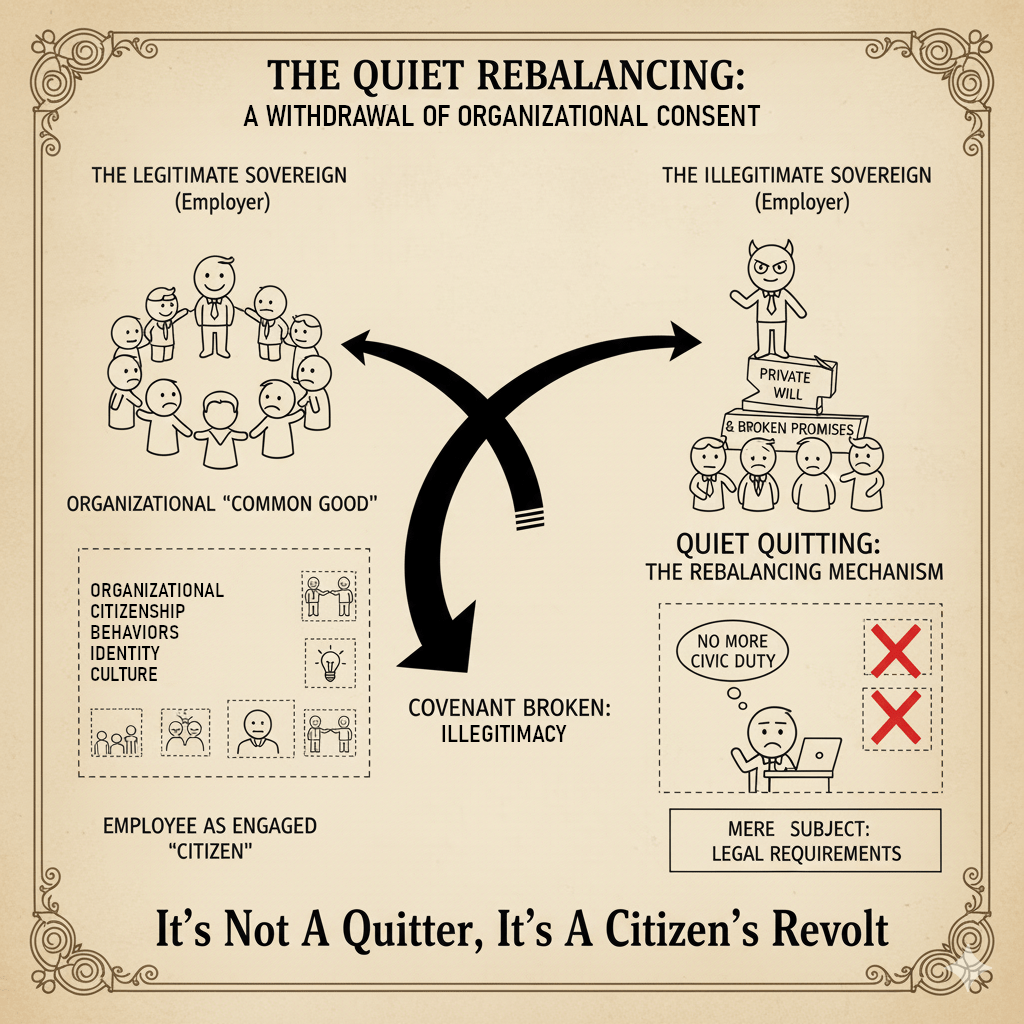
In this context, quiet quitting is a direct and rational consequence of a perceived betrayal. The psychological contract is built on the principle of reciprocity; employees provide discretionary effort, loyalty, and engagement in the expectation of receiving recognition, respect, fair compensation, and opportunities for growth.20 When the employer fails to uphold its end of this bargain—through overwork, underpayment, or a toxic culture—the employee experiences a psychological contract violation.2 Trust is broken, and the perceived inequity demands a rebalancing of the scales.24
Quiet quitting becomes the primary mechanism for this rebalancing. It is the employee’s recourse when the “sovereign” (the employer) has proven itself to be illegitimate by failing to govern in the interest of the organizational “common good.” The employee, feeling their “citizenship” has been devalued, withdraws their civic contributions. These contributions are the “organizational citizenship behaviors” that are not formally required but are essential for a thriving workplace: helping colleagues, volunteering for new projects, sharing innovative ideas, and being an ambassador for the company.1 By ceasing these activities, the employee reverts from the role of an engaged “citizen” to that of a mere “subject,” fulfilling only the minimum legal requirements of their formal contract.13 This is not an act of laziness but a calculated withdrawal of consent, a silent protest against a governing body that has broken its covenant.
Model B: Quiet Quitting as Self-Preservation Against a False Contract
This second model applies directly to the “bullshit jobs” identified by David Graeber. Here, the problem is not that a once-fair contract has been broken, but that the contract was predicated on a falsehood from the very beginning. For an employee who comes to the realization that their work is fundamentally pointless, unnecessary, or pernicious, the entire social contract of the workplace is revealed as a pretense.32
In this scenario, quiet quitting is not a protest aimed at reforming the system; it is a coping mechanism, an act of psychological self-preservation against the “moral and spiritual damage” of performing meaningless labor.25 The demand to “go above and beyond” in a bullshit job is a demand to invest emotionally in a charade. It requires the performance of a second layer of labor: not just the pointless tasks themselves, but the emotional labor of feigning enthusiasm and purpose.32
Quiet quitting, in this context, is an act of radical honesty. It is the employee’s refusal to participate in the pretense any longer.32 It represents an acceptance of the purely transactional nature of the arrangement: the employee provides their time in exchange for money, and that is the full extent of the relationship.32 It is a sane and logical response to an absurd situation. As one analysis puts it, “If you are in one of Graeber’s many bullshit jobs then quiet quitting makes a lot of sense. Why run around like crazy doing stuff for the sake of doing stuff?”.33 It is a quiet rejection of the demand to find one’s identity and self-worth in a role that offers neither.
The Interplay and Escalation
These two models are not mutually exclusive and often intersect in the modern workplace. A once-meaningful job can undergo a process of “bullshitization,” where increasing layers of bureaucracy, pointless administrative tasks, and metric-driven “box-ticking” exercises are imposed upon it.27 A teacher who entered the profession to educate children may find they spend a majority of their time on paperwork that serves no pedagogical purpose. A doctor’s ability to care for patients may be hampered by insurance compliance tasks of spurious value.25 In these cases, what begins as a broken contract (Model A), where the employee is overworked and under-supported, can transform into a false contract (Model B), where the core purpose of the job itself feels lost in a sea of meaningless activity.
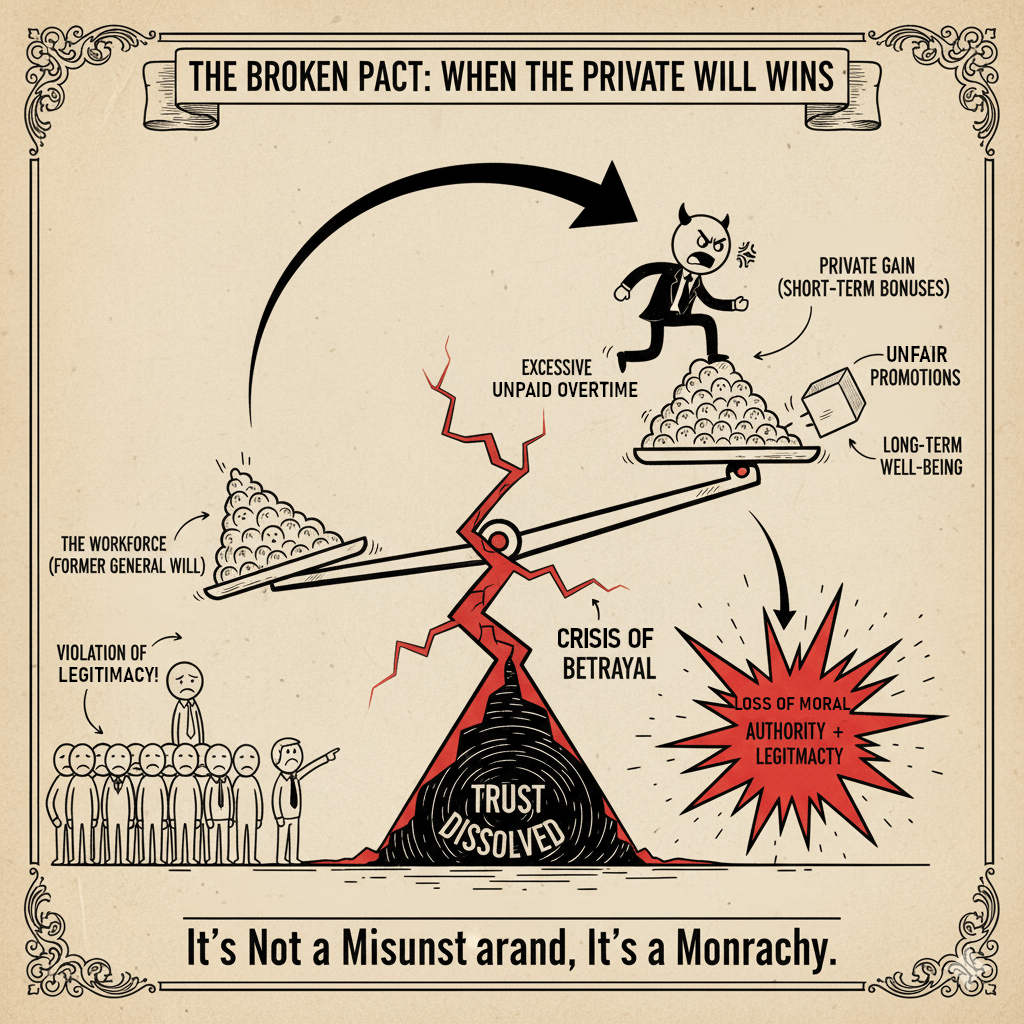
This dynamic is often exacerbated by the employer’s own form of contract violation, a phenomenon that has been termed “quiet firing.” This involves managers deliberately making a job unrewarding and unpleasant—by withholding feedback, passing the employee over for promotions, or assigning them tasks beneath their skill level—in the hopes that the employee will resign, thus avoiding the need for termination and severance.1 Quiet firing is a profound act of bad faith and a clear breach of the psychological contract, which often triggers quiet quitting as a defensive precursor to an eventual departure.
| Dimension | The Rousseauian Ideal Contract | The Broken Psychological Contract | The Graeberian ‘Bullshit’ Contract |
| Basis of Legitimacy | Mutual consent; alignment with the “General Will” (shared purpose/common good). | Based on relational expectations of reciprocity, trust, and fairness. | Managerial feudalism; perpetuation of a moral code that values work for its own sake. |
| Employee’s Role | Dual role: “Citizen” (participating in sovereignty) and “Subject” (obeying legitimate rules). | “Organizational Citizen” who provides discretionary effort in exchange for relational rewards. | A “vassal” who must perform pointless tasks and feign loyalty to justify their existence. |
| Employer’s Obligation | To govern in service of the general will; to protect rights and foster freedom and equality. | To provide recognition, growth opportunities, psychological safety, and fair compensation. | To provide a salary in exchange for the employee’s time and their participation in a pretense. |
| Nature of Work | Meaningful activity that contributes to the common good of the polity. | Potentially meaningful work that has become exploitative or unrewarding. | Inherently pointless, unnecessary, or pernicious activity. |
| Employee’s Rational Response to Failure | Right to withdraw consent and replace the sovereign (revolution). | Quiet Quitting (as Dissent): Withdrawal of discretionary effort; reversion to a transactional relationship. | Quiet Quitting (as Self-Preservation): Rejection of the pretense; honest adherence to a purely transactional exchange. |
This comparative framework distills the core argument of this analysis. It demonstrates that quiet quitting is not a simple act but a complex response whose meaning and justification are contingent upon the specific nature of the workplace social contract and the manner in which it has failed.
The Ethical Calculus
The philosophical analysis of quiet quitting through the lenses of Rousseau and Graeber inevitably leads to a direct examination of ethics. The formal employment contract, while legally binding, is an ethically insufficient document for governing the complexities of the modern workplace. A stable, productive, and humane work environment depends on a set of reciprocal, unwritten moral obligations that form the core of the psychological contract. The phenomenon of quiet quitting forces a re-evaluation of these duties, questioning what employers and employees truly owe each other and under what conditions those debts are voided.
Employer’s Ethical Obligations
The ethical responsibilities of an employer extend far beyond the legal requirements of paying wages and adhering to safety regulations.35 In the context of the modern workplace social contract, these obligations are foundational to establishing the legitimacy required to earn employee engagement and loyalty.
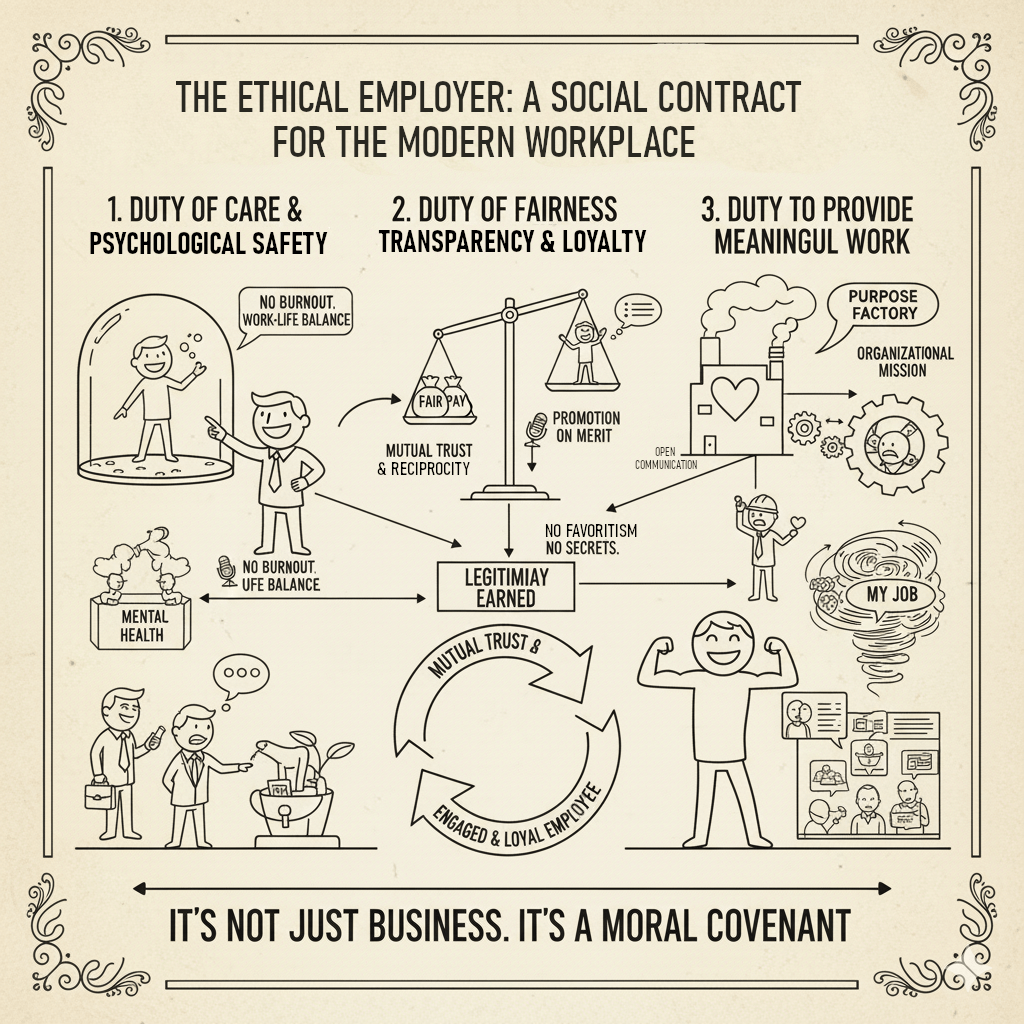
- Duty of Care and Psychological Safety: A primary ethical obligation is the provision of a psychologically safe work environment. This means creating a culture where employees feel secure, respected, and free from the fear of harassment, bullying, or retribution.6 It involves actively preventing employee burnout by ensuring workloads are manageable and that a healthy work-life balance is not just permitted but encouraged.4 An employer who presides over a toxic culture or pushes employees to the point of mental and physical exhaustion has committed a profound ethical failure.
- Duty of Fairness and Transparency: This duty encompasses multiple domains. It requires equitable compensation structures that reward contributions fairly and transparently.23 It demands that the allocation of work, recognition, and opportunities for promotion be based on merit, not favoritism, and be free from discrimination.23 Furthermore, it obligates management to communicate openly and honestly about decisions, expectations, and organizational challenges. Ambiguity and opacity breed distrust and a sense of injustice, directly eroding the psychological contract.22
- Duty to Provide Meaningful Work: This represents a higher-order, yet critical, ethical obligation. Drawing directly from Graeber’s critique, an employer has a moral responsibility to design work that is as purposeful and valuable as possible. Knowingly creating or perpetuating “bullshit jobs” is an ethical lapse because it inflicts demonstrable psychological harm on employees by trapping them in a state of pointless pretense.25 While not all jobs can be world-changing, an ethical employer has a duty to minimize “bullshitization” and to connect every role, however small, to the larger, meaningful purpose of the organization
Employee’s Ethical Obligations
The ethical obligations of employees are reciprocal, but they are also contingent upon the employer’s fulfillment of its duties.
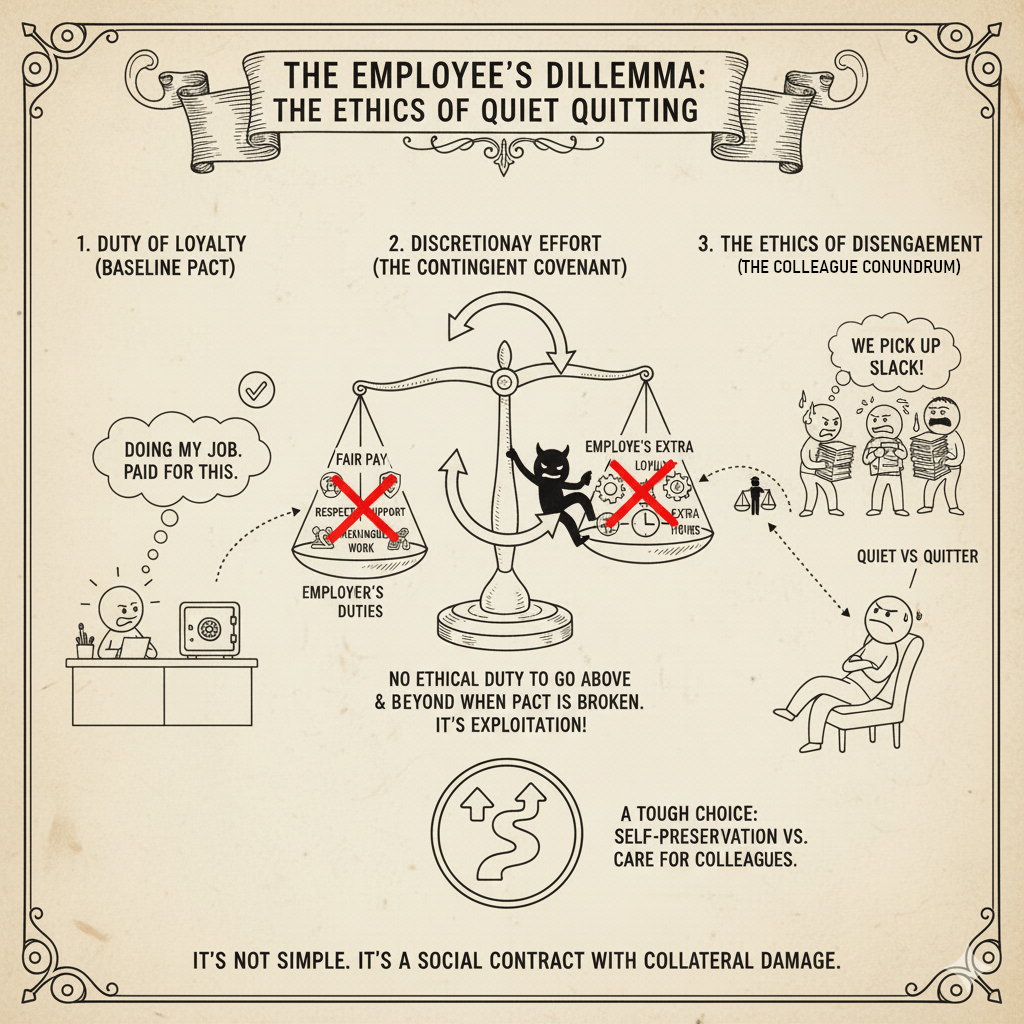
- Duty of Loyalty and Good Faith: A standard tenet of business ethics is that an employee owes their employer a duty of loyalty. This means acting in the firm’s best interests, performing assigned duties to the best of their ability, protecting confidential information, and refraining from conduct that would cause harm to the employer.37 This duty forms the baseline of the employment relationship. Quiet quitting, when defined as simply fulfilling one’s job description, does not necessarily violate this core duty, as the employee is still performing the work for which they are paid.
- The Contingent Nature of Discretionary Effort: The central ethical question surrounding quiet quitting is whether an employee has a moral obligation to “go above and beyond.” The analysis presented in this report leads to the conclusion that this is not an absolute duty but a contingent one. Discretionary effort—the “organizational citizenship” that includes extra hours, creativity, and initiative—is the employee’s contribution to a healthy, reciprocal psychological contract. It is ethically owed only when the employer is upholding its end of the bargain by providing a fair, respectful, and supportive environment. To demand extra effort from an employee who is underpaid, disrespected, or burned out is not a reasonable business expectation; it is an unethical act of exploitation.
- The Ethics of Disengagement: While quiet quitting can be a justified response to a broken contract, it is not without its own ethical complexities. The act of withdrawing effort can have negative externalities, particularly on one’s colleagues. When one team member reduces their output to the bare minimum, others may be forced to “pick up the slack,” leading to increased workloads and resentment within the team.10 This can damage team morale, reduce collaboration, and create a toxic dynamic among peers.9 The quiet quitter thus faces an ethical dilemma: they must weigh their legitimate need for self-preservation against their duty of care to their fellow workers.
Pragmatic Consequences as an Ethical Consideration
A complete ethical analysis must also consider the pragmatic, long-term consequences for all parties. For the organization, widespread quiet quitting leads to tangible negative outcomes, including reduced productivity, a decline in innovation, lower quality of service, and increased employee turnover as disengagement eventually leads to departure.38
For the individual employee, while quiet quitting may provide short-term relief, it carries significant long-term risks. Persistently operating at a minimum level can lead to a stagnant skillset, as the employee misses out on challenging projects and opportunities to learn.41 It can foster a negative reputation that may hinder future career advancement, as employers are less likely to promote or invest in those perceived as uncommitted.11 Most paradoxically, long-term disengagement can deepen feelings of job dissatisfaction, leading to a loss of confidence and a sense of alienation from one’s own work and potential.11 An ethical decision to quiet quit must therefore account for these potential self-harming consequences, balancing the immediate need to escape a negative situation with the long-term project of building a fulfilling career and life.
Ultimately, the ethical calculus of the workplace is profoundly shaped by an asymmetry of power. The employer designs the system, sets the wages, and shapes the culture. Therefore, the primary ethical burden for creating and maintaining a just and legitimate social contract rests with the employer. An employee’s decision to quietly quit is almost always a reaction to a prior and more significant ethical failure on the part of the organization. To demand loyalty and engagement without first creating a trustworthy and meaningful environment is to demand unilateral fealty, a position that is ethically untenable in any free society.
Conclusion: Towards a New, More Legitimate Workplace Contract
The phenomenon of quiet quitting should not be dismissed as a passing trend or a generational quirk. It is a profound and pervasive signal from the global workforce, a “loud call for a better social contract at work”.43 The analysis of this phenomenon through the complementary lenses of Rousseau’s political theory and Graeber’s labor critique reveals that the issue is not one of employee laziness, but of institutional illegitimacy and existential meaninglessness. The widespread withdrawal of discretionary effort is the logical consequence of workplace social contracts that are either broken by exploitation or rendered fraudulent by pointlessness. The path forward does not lie in demanding more from disengaged employees, but in fundamentally rebuilding the workplace pact on the principles of genuine consent, shared purpose, and mutual respect.
Recapitulation of the Core Argument
This report has sought to move beyond the surface-level debate on quiet quitting to uncover its deeper philosophical and ethical foundations. It began by deconstructing the term, revealing a definitional schism that reflects a fundamental conflict over the unwritten rules of work. By applying Rousseau’s The Social Contract, the modern workplace was framed as a micro-polity, and quiet quitting was interpreted as a political act—a withdrawal of consent from an illegitimate authority that has violated its psychological contract with its “citizens.” David Graeber’s theory of “bullshit jobs” provided a second, crucial layer of analysis, exposing how the crisis of meaning in pointless work makes the workplace contract a pretense, rendering quiet quitting an act of profound self-preservation. The synthesis of these frameworks produced a bifurcated model, distinguishing between quiet quitting as dissent against a broken contract and as a sane rejection of a false one. Finally, this led to an ethical re-evaluation of the mutual obligations of employers and employees, concluding that the primary moral responsibility for maintaining the contract lies with the employer, who holds the asymmetrical power to shape the work environment.
From Implicit to Explicit: Renegotiating the Contract
The central challenge highlighted by quiet quitting is the failure of the implicit, assumed psychological contract. The old pact, where lifetime loyalty was traded for lifetime security, is long dead, and the subsequent pact, where discretionary effort was traded for meaningful work and career growth, is now fracturing.20 The most crucial step toward a more stable and productive future is to make the unwritten pact written, to move from an assumed contract to an explicit and continuously negotiated one.
This requires a commitment to radical transparency. Organizations must engage in open and honest communication about mutual expectations from day one.20 This includes using realistic job previews that detail not only the benefits but also the challenges of a role, and establishing clear, mutually agreed-upon performance indicators that also respect work-life boundaries.20
Furthermore, legitimacy must be built through the co-creation of the ‘general will.’ In a Rousseauian sense, employees must be seen as “citizens” with a voice, not just “subjects” who obey. This means actively involving them in shaping the policies, practices, and culture that affect their well-being and productivity.23 When employees have a genuine stake in the collective enterprise, their commitment is earned, not commanded. This process should be dynamic, involving what some have called a continuous process of “re-recruiting” employees—regularly checking in to ensure the arrangement remains mutually beneficial, rather than assuming the initial terms are static.6
The Manager as Statesperson and the War on ‘Bullshit’
The burden of enacting this new contract falls most heavily on frontline managers. Their role must evolve from that of a “taskmaster,” in Graeber’s typology, to that of a Rousseauian “statesperson” or “lawgiver”—a facilitator of meaning, a builder of community, and a protector of the team’s well-being.13 This requires a profound shift in how organizations select, train, and evaluate their leaders. The primary skills are no longer just project management and execution, but empathy, trust-building, and the ability to support and empower a team.1
A core function of this new managerial role must be to wage a relentless war on “bullshit.” Organizations must empower managers and teams to conduct “bullshit audits”—to systematically identify and courageously eliminate the pointless meetings, redundant reports, and bureaucratic procedures that add no value and actively destroy morale and engagement. This is the most direct and practical application of Graeber’s critique. It is an act of profound respect for employees’ time and intelligence, and it is a prerequisite for creating an environment where meaningful work can flourish.
A Final Reflection on Freedom and Meaning
In the final analysis, the debate over quiet quitting is a debate about the nature of freedom and the search for meaning in the modern world. A workplace that relies on the implicit threat of precarity to extract uncompensated labor is, in Rousseau’s terms, a system of chains. A workplace that requires employees to feign purpose while performing pointless tasks is, in Graeber’s view, a site of profound psychological violence. A truly successful, resilient, and ethical organization in the 21st century cannot be built on coercion or pretense. It must strive to be a voluntary association of individuals united by a shared and genuinely meaningful purpose. Quiet quitting is the silent, pervasive, and powerful evidence of how far many of our contemporary institutions are from this ideal. The challenge it presents is not to find new ways to monitor and discipline a disengaged workforce, but to have the courage to build organizations that people no longer feel the need to quit, quietly or otherwise.
References
- What Is Quiet Quitting—and Is It a Real Trend? – Investopedia, accessed October 8, 2025, https://www.investopedia.com/what-is-quiet-quitting-6743910
- Modelling the significance of organizational conditions on quiet quitting intention among Gen Z workforce in an emerging economy – PMC, accessed October 8, 2025, https://pmc.ncbi.nlm.nih.gov/articles/PMC10507021/
- QUIET QUITTING Definition & Meaning – Merriam-Webster, accessed October 8, 2025, https://www.merriam-webster.com/dictionary/quiet%20quitting
- What Is Quiet Quitting and Can It Be Prevented? | Paychex, accessed October 8, 2025, https://www.paychex.com/articles/human-resources/quiet-quitting
- quiet quitting Meaning & Origin | Slang by Dictionary.com, accessed October 8, 2025, https://www.dictionary.com/e/slang/quiet-quitting/
- What is ‘quiet quitting’? – JHU Hub, accessed October 8, 2025, https://hub.jhu.edu/2022/09/12/what-is-quiet-quitting/
- www.paychex.com, accessed October 8, 2025, https://www.paychex.com/articles/human-resources/quiet-quitting#:~:text=Quiet%20quitting%20is%20defined%20as,finally%20leave%20or%20are%20terminated.
- Quiet quitting can signal a new job – MyJobsi.co.uk, accessed October 8, 2025, https://www.myjobsi.co.uk/page/quiet-quitting-can-signal-a-new-job
- How to Prevent Quiet Quitting With Whole Brain® Thinking – Herrmann International, accessed October 8, 2025, https://www.thinkherrmann.com/whole-brain-thinking-blog/how-to-prevent-quiet-quitting-with-performance-management
- How to Prevent Quiet Quitting: Causes, Signs and 9 Strategies – ActivTrak, accessed October 8, 2025, https://www.activtrak.com/blog/how-to-prevent-quiet-quitting/
- Is It Bad to Quiet Quit? Pros, Cons, and What You Should Know – ResumeSpice, accessed October 8, 2025, https://resumespice.com/is-it-bad-to-quiet-quit-pros-cons-and-what-you-should-know/
- The Social Contract by Rousseau | Summary, Analysis & Author – Lesson – Study.com, accessed October 8, 2025, https://study.com/academy/lesson/the-social-contract-summary-author.html
- The Social Contract by Jean-Jacques Rousseau Plot Summary | LitCharts, accessed October 8, 2025, https://www.litcharts.com/lit/the-social-contract/summary
- Rousseau Publishes The Social Contract | Research Starters – EBSCO, accessed October 8, 2025, https://www.ebsco.com/research-starters/history/rousseau-publishes-social-contract
- The Social Contract – Wikipedia, accessed October 8, 2025, https://en.wikipedia.org/wiki/The_Social_Contract
- www.litcharts.com, accessed October 8, 2025, https://www.litcharts.com/lit/the-social-contract/summary#:~:text=Rather%2C%20Rousseau%20concludes%2C%20%E2%80%9Call,contract%E2%80%94made%20by%20its%20citizens.
- What was Rousseau’s theory of the social contract? : r/askphilosophy – Reddit, accessed October 8, 2025, https://www.reddit.com/r/askphilosophy/comments/2kwywc/what_was_rousseaus_theory_of_the_social_contract/
- Psychological Contracts and the Employment Relationship – Oxford Research Encyclopedias, accessed October 8, 2025, https://oxfordre.com/psychology/display/10.1093/acrefore/9780190236557.001.0001/acrefore-9780190236557-e-556?d=%2F10.1093%2Facrefore%2F9780190236557.001.0001%2Facrefore-9780190236557-e-556&p=emailAmHUvLNbh2WlA
- The individual-organization relationship: The psychological contract | Request PDF, accessed October 8, 2025, https://www.researchgate.net/publication/285900999_The_individual-organization_relationship_The_psychological_contract
- Five Ways Managers Can Help Prevent Quiet Quitting, accessed October 8, 2025, https://sloanreview.mit.edu/article/five-ways-managers-can-help-prevent-quiet-quitting/
- Future of Work, Social Contract, Employee Engagement – Thinkers360, accessed October 8, 2025, https://www.thinkers360.com/tl/blog/members/social-contract-or-employee-contract
- The Social Contract at Work – New Metrics, accessed October 8, 2025, https://www.newmetrics.net/insights/the-social-contract-at-work/
- “The Social Contract at Work: Rousseau’s Theory and Its Application …, accessed October 8, 2025, https://thomasperry.ca/2025/03/22/the-social-contract-at-work-rousseaus-theory-and-its-application-to-employee-relations-and-conflict-management/
- Quiet quitting: The loud message behind the silence – Luppa App, accessed October 8, 2025, https://luppa.app/blog/quiet-quitting-the-loud-message-behind-the-silence/
- Books: Bullsh*t Jobs. The Rise of Pointless Work and What We Can …, accessed October 8, 2025, https://pmc.ncbi.nlm.nih.gov/articles/PMC8813110/
- pmc.ncbi.nlm.nih.gov, accessed October 8, 2025, https://pmc.ncbi.nlm.nih.gov/articles/PMC8813110/#:~:text=In%202013%20an%20anthropology%20professor,are%20inherently%20useless%20or%20pointless.&text=They%20waste%20time%20and%20resources%2C%20and%20produce%20nothing%20of%20value.
- Book Summary: Bullshit Jobs – A Theory by David Graeber – To Summarise, accessed October 8, 2025, https://www.tosummarise.com/book-summary-bullshit-jobs-a-theory-by-david-graeber/
- Bullshit Jobs – Wikipedia, accessed October 8, 2025, https://en.wikipedia.org/wiki/Bullshit_Jobs
- Bullshit Jobs – Soul sucking jobs that add little value – PeopleShift, accessed October 8, 2025, https://people-shift.com/articles/bullshit-jobs-soul-sucking-jobs-that-add-little-value/
- Review of Bullshit Job: A Theory – Medium, accessed October 8, 2025, https://medium.com/@Luharion/review-of-bullshit-job-a-theory-b04fcb20bf35
- On the Phenomenon of Bullshit Jobs: A Work Rant – David Graeber, accessed October 8, 2025, https://davidgraeber.org/articles/on-the-phenomenon-of-bullshit-jobs-a-work-rant/
- The Pandemic Proved Graeber’s BS Argument – The Button Drawer, accessed October 8, 2025, https://jgourlay.com/?p=174
- bstulberg.medium.com, accessed October 8, 2025, https://bstulberg.medium.com/the-truth-about-quiet-quitting-b4f90d5d1b94#:~:text=If%20anything%2C%20it’s%20the%20sane,the%20sake%20of%20doing%20stuff%3F
- 4 Harmful Effects of Quiet Quitting and Quiet Firing – HCM DIALOGUE, accessed October 8, 2025, https://hcmdialogue.ca/articles/4-harmful-effects-of-quiet-quitting-and-quiet-firing/
- Employee Rights and Employer Obligations: A Comprehensive …, accessed October 8, 2025, https://www.promptpersonnel.com/employee-rights-and-employer-obligations-a-comprehensive-guide/
- Ethics at work: An employer’s guide – CIPD, accessed October 8, 2025, https://www.cipd.org/en/knowledge/guides/ethics-work-guide/
- Standard IV(A) Loyalty – CFA Institute, accessed October 8, 2025, https://www.cfainstitute.org/standards/professionals/code-ethics-standards/standards-of-practice-iv-a
- 6 Ways Quiet Quitting Is Affecting The Workplace – Peoplelink Group, accessed October 8, 2025, https://www.peoplelinkgroup.com/2023/02/15/6-ways-quiet-quitting-is-affecting-the-workplace/
- Quiet Quitting: Why It’s Relevant in Today’s Society – INTOO, accessed October 8, 2025, https://www.intoo.com/us/blog/what-is-quiet-quitting/
- Quiet Quitting: How It Affects Workplace Productivity – SpeedExam, accessed October 8, 2025, https://www.speedexam.net/blog/quiet-quitting-how-it-affects-workplace-productivity/
- Why Quiet Quitting Can Harm Your Career Growth: Top 5 Negative Consequences and Pro-Active Steps to Take – DAVRON, accessed October 8, 2025, https://www.davron.net/why-quiet-quitting-can-harm-your-career-growth-top-5-negative-consequences-and-pro-active-steps-to-take/
- The hidden costs of quiet quitting, quantified | McKinsey & Company, accessed October 8, 2025, https://www.mckinsey.com/uk/our-insights/the-mckinsey-uk-blog/the-hidden-costs-of-quiet-quitting-quantified
- Why ‘Quiet Quitting’ Is A Loud Call For A Better Social Contract At Work – Forbes, accessed October 8, 2025, https://www.forbes.com/councils/forbesbusinesscouncil/2022/11/23/why-quiet-quitting-is-a-loud-call-for-a-better-social-contract-at-work/