
The contemporary world of work is undergoing a seismic transformation, moving from the stable, linear career path toward more fluid, fragmented, and individualized models. At the forefront is the “portfolio career,” where individuals curate a collection of roles, projects, and income streams, often simultaneously and across diverse industries [1]. The portfolio career is not merely an economic adaptation to the gig economy but represents a profound cultural and philosophical phenomenon. It serves as a catalyst for re-evaluating the relationship between work, personal identity, and stability in modern life.
The emergence of this new career model is a structural consequence of late-stage capitalism, accelerated globalization, and pervasive technological disruption [7]. The historical social contract, where an employer provided a stable, socially legible professional identity for loyalty, has been eroded [9]. As this framework for identity conferral dissolves, a widespread professional identity crisis becomes an inevitable societal condition. This crisis is not a sign of individual failure but a systemic outcome demanding a new philosophical lens to understand the self in relation to work. Examining the portfolio career through Heraclitus and Sartre explores whether a career is a fixed identity to be discovered or a fluid creation to be perpetually built, illuminating the new psychological and philosophical landscape of the modern working self.
Deconstructing Career Models: Ladder vs. Cable
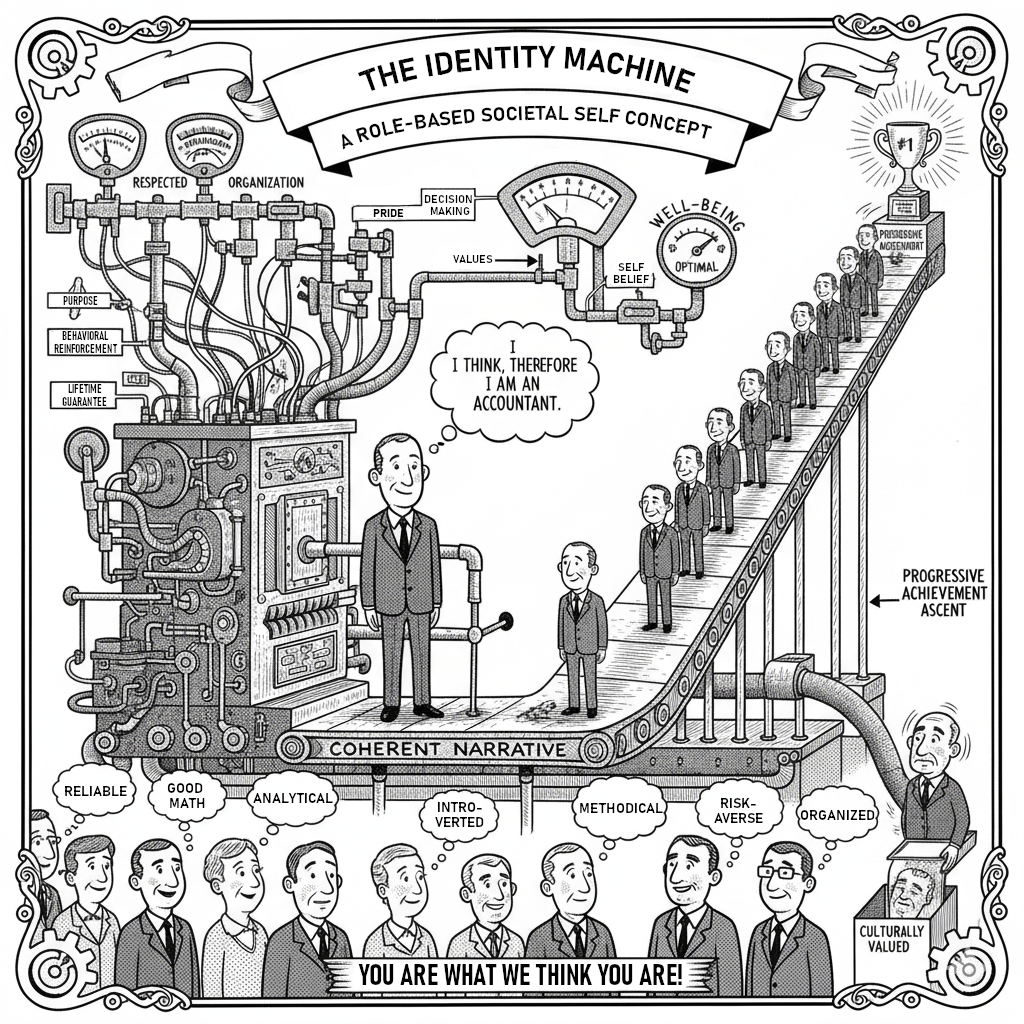
For much of the modern era, the traditional career served as a primary source of social and personal identity. Structured as a linear, predictable, and often lifelong commitment to a single organization or profession, it provided a clear, socially legible answer to “What do you do?” [2]. This answer, “I am an accountant at XYZ Corp.,” was more than a job description; it was a role-based identity that shaped an individual’s self-concept, values, and behavioral frameworks [9].
Historically, “professional identity” was understood as a “stable and enduring constellation of attributes, beliefs, values, motives, and experiences” used to define oneself professionally [9]. This identity was not self-generated but acquired through formal education, training, certification, and socialization into a profession’s norms [9]. Once attained, this identity served as an “organizing framework for an individual’s self-concept,” providing a focal point for their sense of self and life’s purpose [9]. The career path was akin to a “ladder,” with a clear, upward trajectory within a single hierarchy [1].
This externally conferred identity carried significant psychological benefits. Associating with a respected profession or stable organization became an important source of well-being, esteem, and pride [9]. The role’s stability and the path’s clarity provided predictability and security, anchoring the individual within a defined social and economic structure [12]. This professional identity provided clear behavioral guidance, shaping work attitudes and influencing moral decision-making [9]. The organization provided not just a job but a ready-made identity, a coherent narrative of linear ascent and achievement that was personally reassuring and culturally valued [3].
A ‘Woven Cable’ of Selves
In contrast to the traditional model’s linear ladder, the portfolio career is a multi-faceted, non-linear, and self-curated construct. Charles Handy, who popularized the term, envisioned it as a collection of different paid and unpaid works, a “portfolio” of activities constituting a person’s professional life [3]. This model resists a single identity label. William Bridges offered a powerful analogy, contrasting the traditional career’s “chain” of sequential jobs with the portfolio career’s “woven cable,” made of separate, bound strands [12]. These strands can include part-time jobs, temporary employment, freelance projects, consulting gigs, and entrepreneurial ventures, often pursued simultaneously [2].
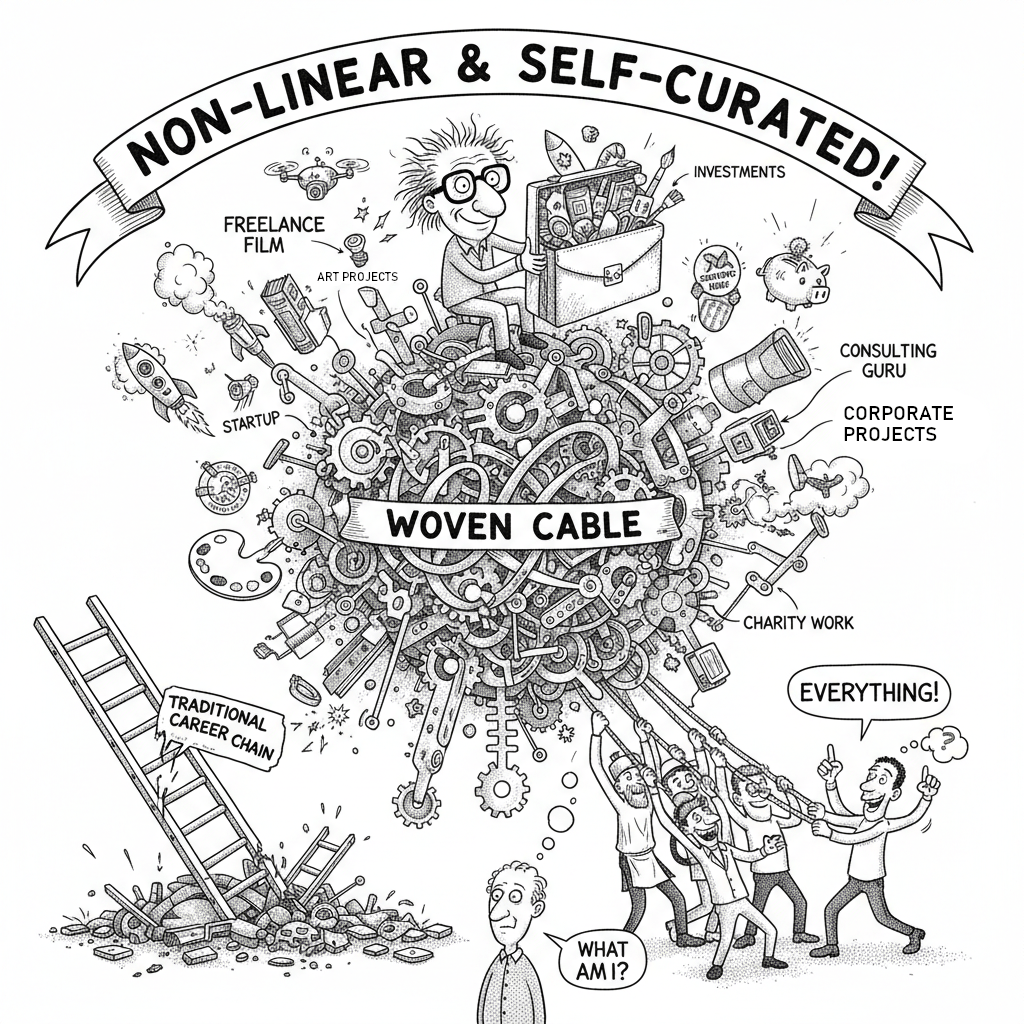
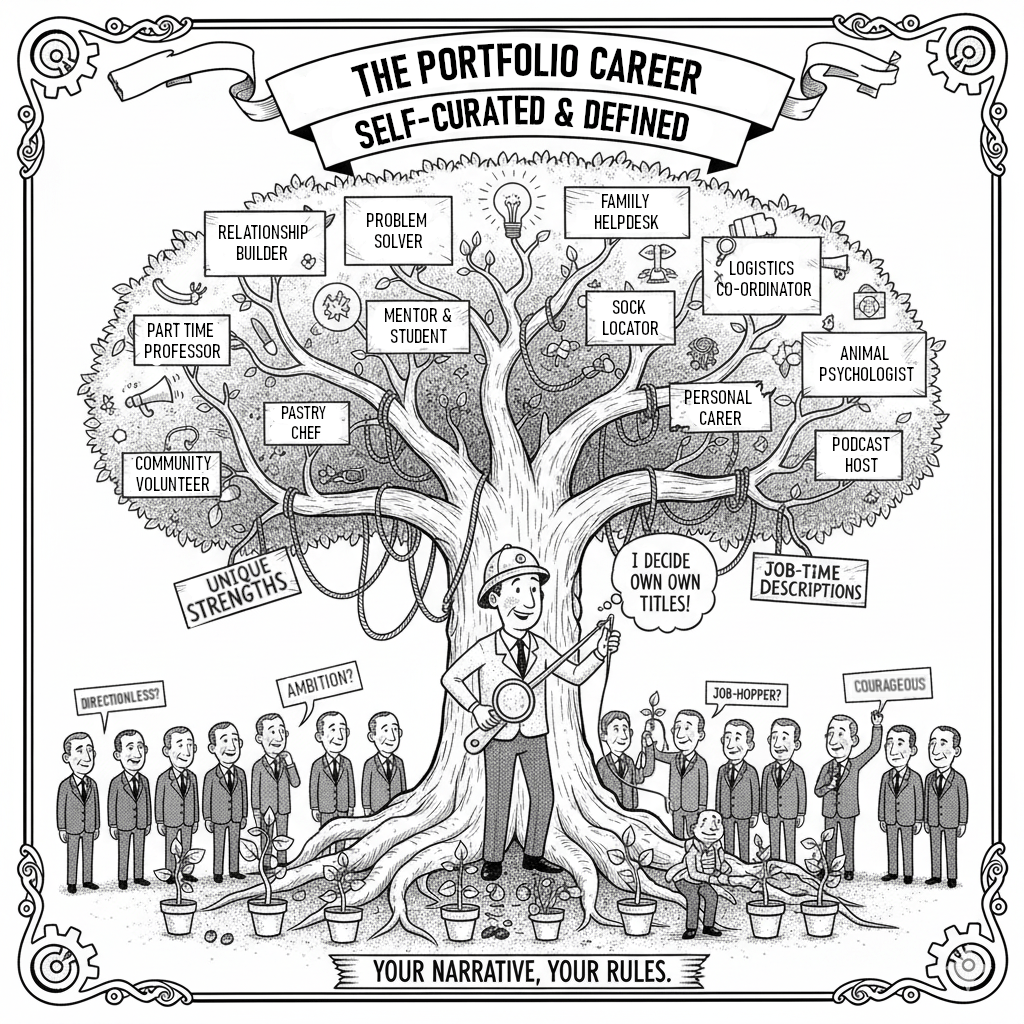
The structure of a portfolio career is non-linear, more akin to a “tree where the branches are the different jobs and skills” than a ladder [1]. It is a “nomadic career” [15] or a “tapestry of eclectic employment experiences” [16] empowering the individual to combine talents across various fields [11]. This model requires the individual to weave seemingly random or contradictory experiences into a coherent whole [17]. It reframes the “job-hopper” as a “career explorer,” whose diverse experiences yield unique strengths, greater resourcefulness, and a distinct strategic perspective [17]. The identity of a portfolio careerist is not conferred by an external organization but is actively constructed by the individual from their varied work. They “decide the job titles and job descriptions,” basing them on their unique combination of skills, interests, and experiences [1].
The Paradox of Stability
The shift from a traditional to a portfolio model entails profound psychological adjustments and introduces a central paradox regarding professional stability. The portfolio model offers unprecedented freedom and autonomy, but it also presents significant challenges to identity and security.
One frequently cited disadvantage is the “lack of career identity” [3]. As Professor Herminia Ibarra notes, “There is no easy label, no shorthand” [3]. The individual often explains their professional self with a “laundry list” of activities, contrasting with the culturally expected “progressive narrative” of linear ascent [3]. This ambiguity can lead to feeling one lacks a “real profession,” creating psychological dissonance and social illegibility [7]. The transition can be unsettling, experienced as a time of “confusion, loss, insecurity, and struggle” as old, stable identities are shed for a more fluid, uncertain way of being [18]. This path demands a high tolerance for uncertainty, a strong internal locus of control, and relentless self-motivation [2].
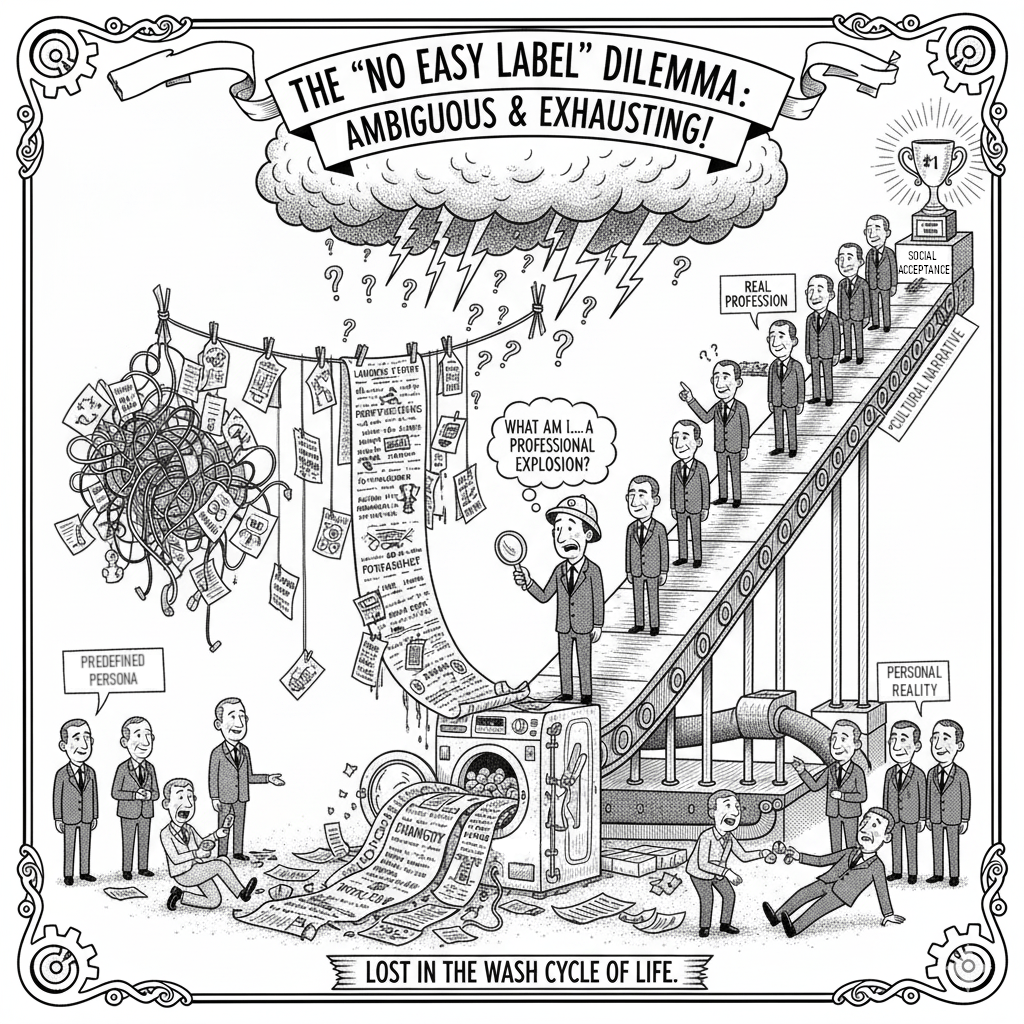
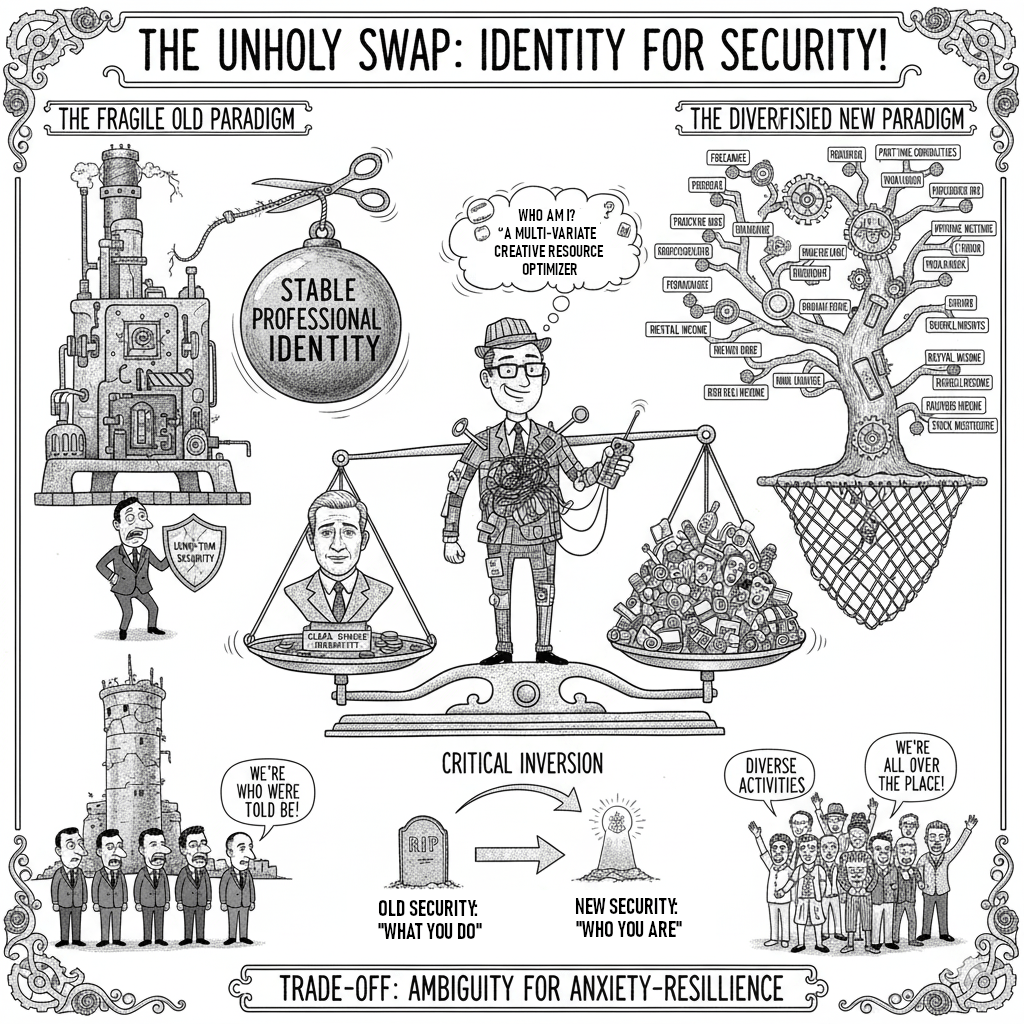
This identity challenge is intertwined with a paradox of stability. The traditional career, once offering a stable identity and long-term security, is now increasingly perceived as financially precarious. Relying on a single employer in an unstable market represents a single point of failure; redundancy can mean the loss of one’s entire income [1]. Conversely, the portfolio career, which generates identity ambiguity, is now seen as offering greater financial resilience. Its multiple, diversified income streams create a “safety net,” providing a more robust financial foundation in a volatile economy [2].
The modern professional landscape has severed this link. The source of traditional security, the single employer, has become a source of anxiety. The portfolio model’s diversification strategy has emerged as the new paradigm for financial security. This diversification strategy inherently fragments professional identity, making a single, stable role difficult to articulate. The modern professional is often forced into a trade-off: embrace a fluid, ambiguous identity for financial resilience, or cling to a clear but fragile identity tied to a single income source. A “secure career” has shifted from the stability of “what you do” to the diversity of “how many things you do.”
| Feature | Traditional Career Model | Portfolio Career Model |
| Core Structure | Linear, hierarchical (“Ladder”) [1] | Non-linear, networked (“Woven Cable,” “Tree”) [1] |
| Source of Identity | External (conferred by organization, profession, job title) [9] | Internal (curated by the individual from diverse experiences) [1] |
| Psychological State | Seeks stability, predictability, belonging [12] | Thrives on variety, autonomy, uncertainty [2] |
| Locus of Control | Primarily external (career path defined by employer) [1] | Primarily internal (career path designed by the individual) [7] |
| Primary Risk | Redundancy, skill obsolescence (single point of failure) [1] | Income inconsistency, burnout, identity fragmentation [2] |
| Underlying Philosophical Assumption | Essentialism (Identity is a fixed state to be discovered or assigned) | Existentialism/Process Philosophy (Identity is a fluid process of creation) |
The Heraclitean Self: Professional Flux
The portfolio career, with its dynamism and resistance to static definition, finds a philosophical antecedent in the pre-Socratic thought of Heraclitus of Ephesus. The essence of Heraclitus’s philosophy is captured in the dictum panta rhei, or “everything flows” [22]. For Heraclitus, the universe is not static substances but a dynamic process of ceaseless change. Permanence is an illusion; change is the fundamental reality [23]. His most famous metaphor is that one “cannot step into the same river twice,” for both the river and the person are in constant flux [24]. This ancient metaphysical insight aptly describes the portfolio career.
The portfolio career is a professional life lived in a Heraclitean river of experience. It is defined not by a fixed position but by a continuous flow of projects, clients, skills, and roles. It is a “nomadic career” [15] involving constant switching between tasks, industries, and collaborative environments [2]. The portfolio careerist is perpetually in motion, acquiring new skills, adapting to new contexts, and evolving their offerings in response to market demands and personal interests [15]. Like the river, the composition of the portfolio careerist’s work is ever-changing. Projects begin and end, clients come and go, and income streams ebb and flow [3]. To resist this flow, to insist on permanence, is to resist the nature of this working life [26]. The portfolio career demands an acceptance of flux as the baseline condition, not a temporary deviation from a stable norm.
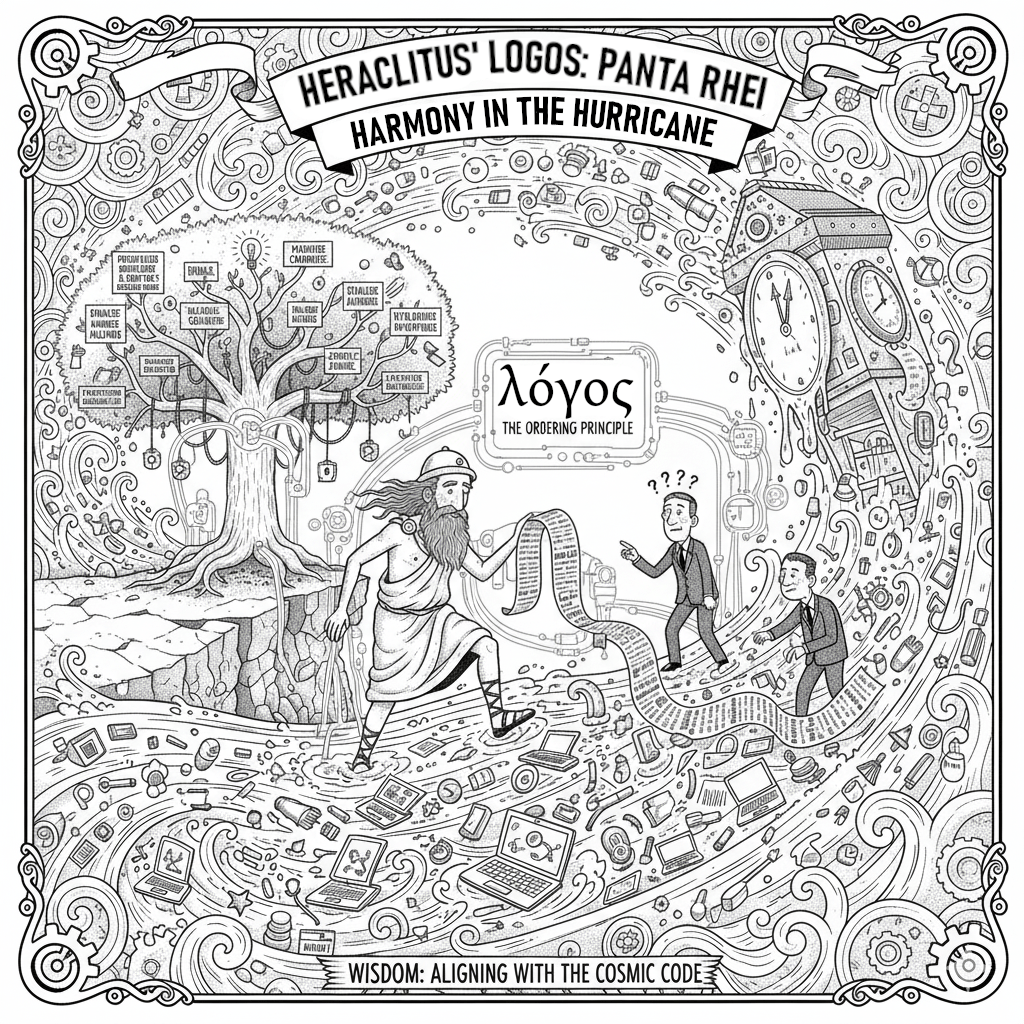
Logos of the Portfolio
A crucial element of Heraclitus’s philosophy is that this universal flux is not pure chaos. It is governed by an underlying universal, rational principle he termed the Logos [24]. The Logos is the ordering principle ensuring change occurs within a coherent framework, maintaining a hidden unity amidst apparent multiplicity [24]. For Heraclitus, wisdom consisted in apprehending and aligning with this cosmic order.
This concept of the Logos provides a lens to understand a critical task for the portfolio careerist. Faced with a seemingly chaotic collection of disparate roles, the successful portfolio professional must construct their own professional Logos. This takes the form of a “coherent narrative that explains how each seemingly disparate experience contributes to the whole” [17]. This narrative is more than a marketing tool or resume structure; it is a profound act of meaning-making. It is the individual’s imposition of order and purpose onto the Heraclitean flux of their professional life. By identifying a “common thread” [27] or overarching theme connecting their activities, be it a core skill, passion, or mission, the portfolio careerist transforms “gigs” into a purposeful, strategic career portfolio [17]. The “personal brand” of the portfolio careerist becomes a personalized Logos, the self-articulated rational principle bringing unity to a life of professional multiplicity.
Heraclitean Virtues: Adaptability and Resilience
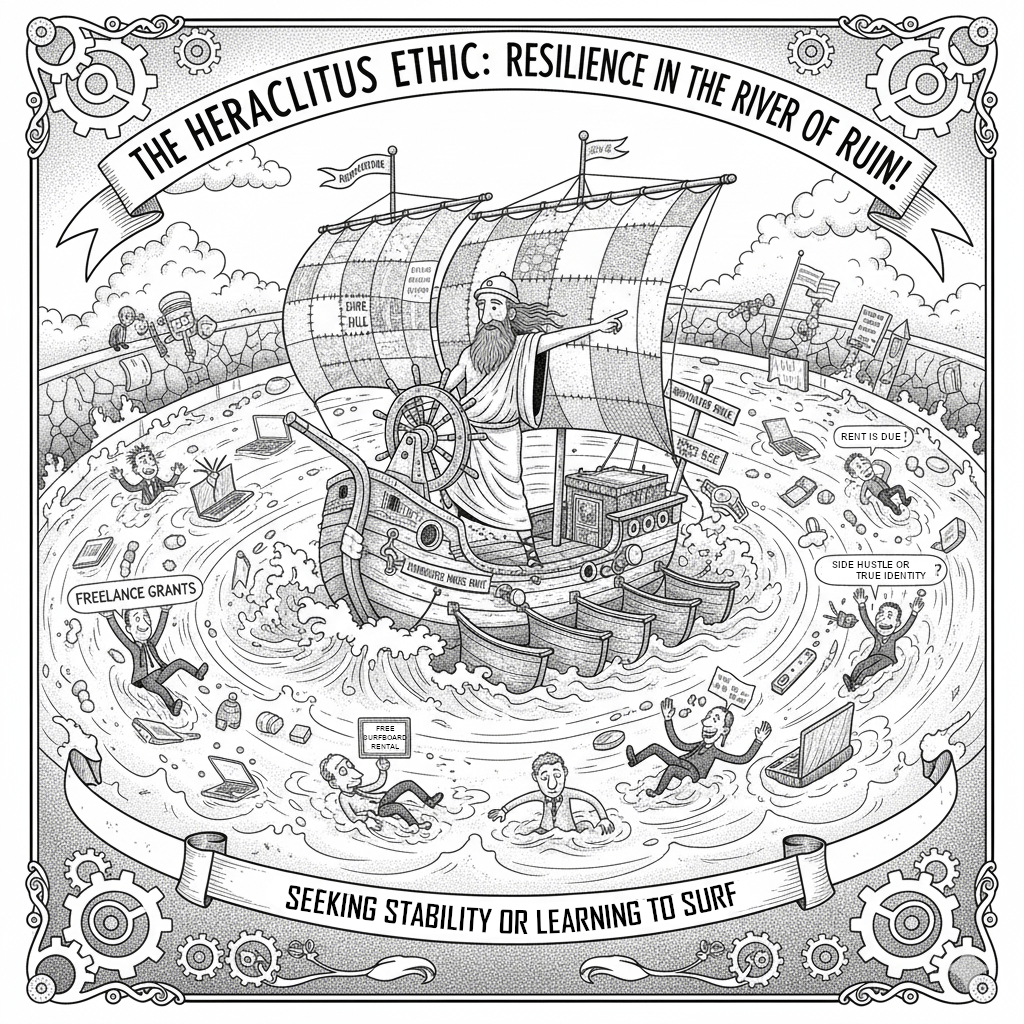
If professional life is a river of constant change, the cardinal virtues are those enabling navigation of its currents. Heraclitus’s ethical philosophy emphasizes adaptability and resilience, embracing the dynamic, paradoxical nature of reality rather than clinging to a false stability [24]. These ancient virtues are the core practical competencies for success in a portfolio career.
The modern portfolio careerist must embody Heraclitean wisdom. Adaptability is paramount, as the work demands shifting between projects, industries, and mindsets with agility [2]. A comfort with uncertainty is a prerequisite for survival, as income fluctuates and future work is never guaranteed [2]. This environment necessitates continuous learning and upskilling, as today’s skills may not be tomorrow’s [14].
Together, these traits cultivate “career resilience,” the ability to “bounce back and thrive in the face of workplace and life adversities” [28]. By diversifying skills and income sources, the portfolio careerist builds a professional life more resilient to shocks than one dependent on a single employer [8]. The loss of one client is not disaster but a change in the river’s flow. The portfolio career is a lived practice of Heraclitean ethics. It is a model for those who understand that in a world of flux, stability is found not in a fixed position but in the dynamic capacity to adapt, learn, and endure.
Sartrean Architect: The Career as Self-Creation
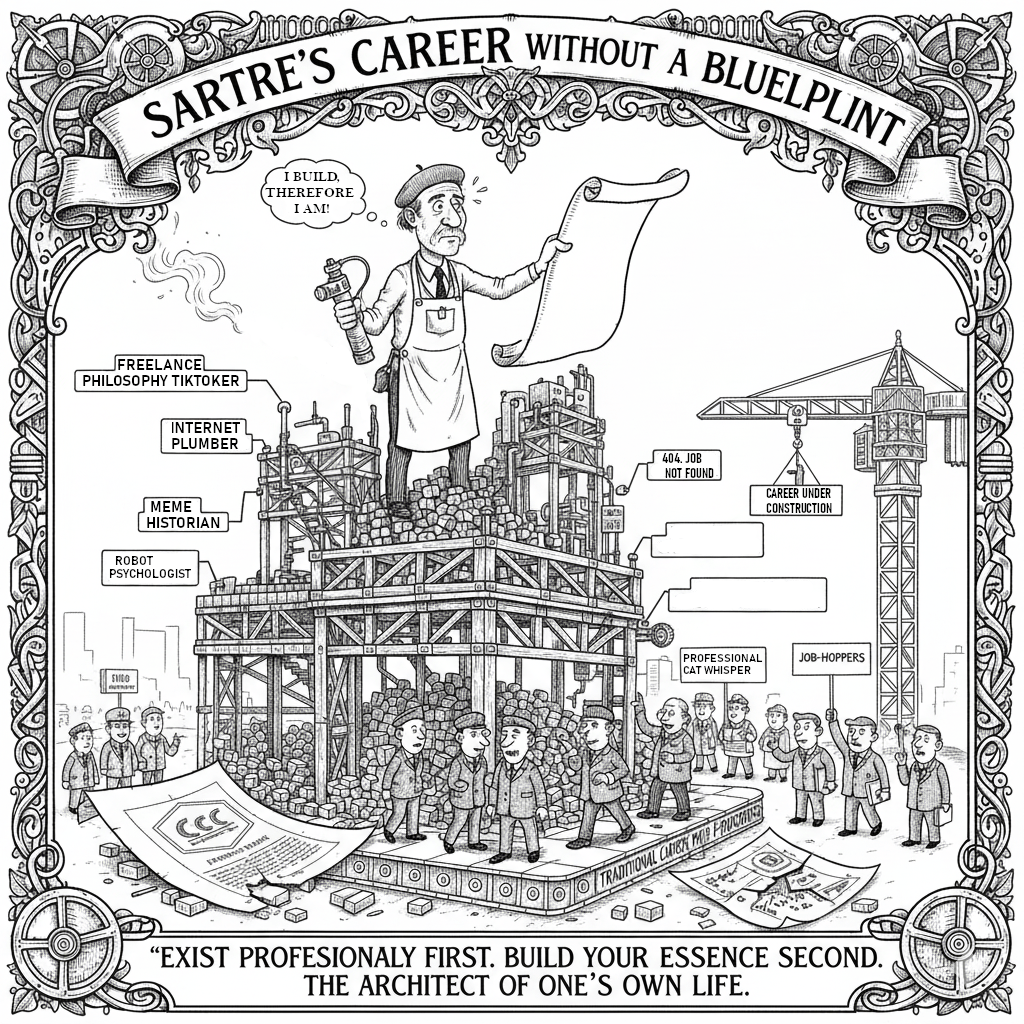
Jean-Paul Sartre, the 20th-century philosopher, provides an existentialist guidebook to career as a part of life. Sartre’s philosophy, particularly “existence precedes essence,” offers a framework for understanding the portfolio career not as a series of jobs, but as a continuous project of self-creation. At the core of Sartre’s existentialism is the reversal of traditional philosophy. For millennia, it was held that a thing’s essence (its nature or purpose) precedes its existence. A paper-knife is first conceived with a purpose (to cut paper) and then brought into existence [29]. Sartre argued this applies to objects, not humans. For humans, “existence precedes essence” [30]. We are born without a predetermined nature, purpose, or identity. We are “thrown” into the world as pure existence, and only through our choices and actions do we define our essence [30]. “Man is nothing else but what he makes of himself,” Sartre declared [32].
The portfolio career can be seen as the “career without a blueprint,” a path embodying the Sartrean condition. Unlike the traditional career, with its pre-designed ladder and defined roles, the portfolio careerist is thrown into the professional world and must create their own path. They “decide the job titles and job descriptions,” designing a professional identity based on their unique skills and interests [1]. There is no external authority dictating their purpose. They exist professionally first, as a collection of potential skills, and only through their actions do they define what kind of professional they are. They are the “architect of their own lives,” tasked with becoming successful on their own terms [7]. The portfolio career is not a path to be found, but a structure to be built.
The Burden of Freedom: Anxiety in Self-Curation
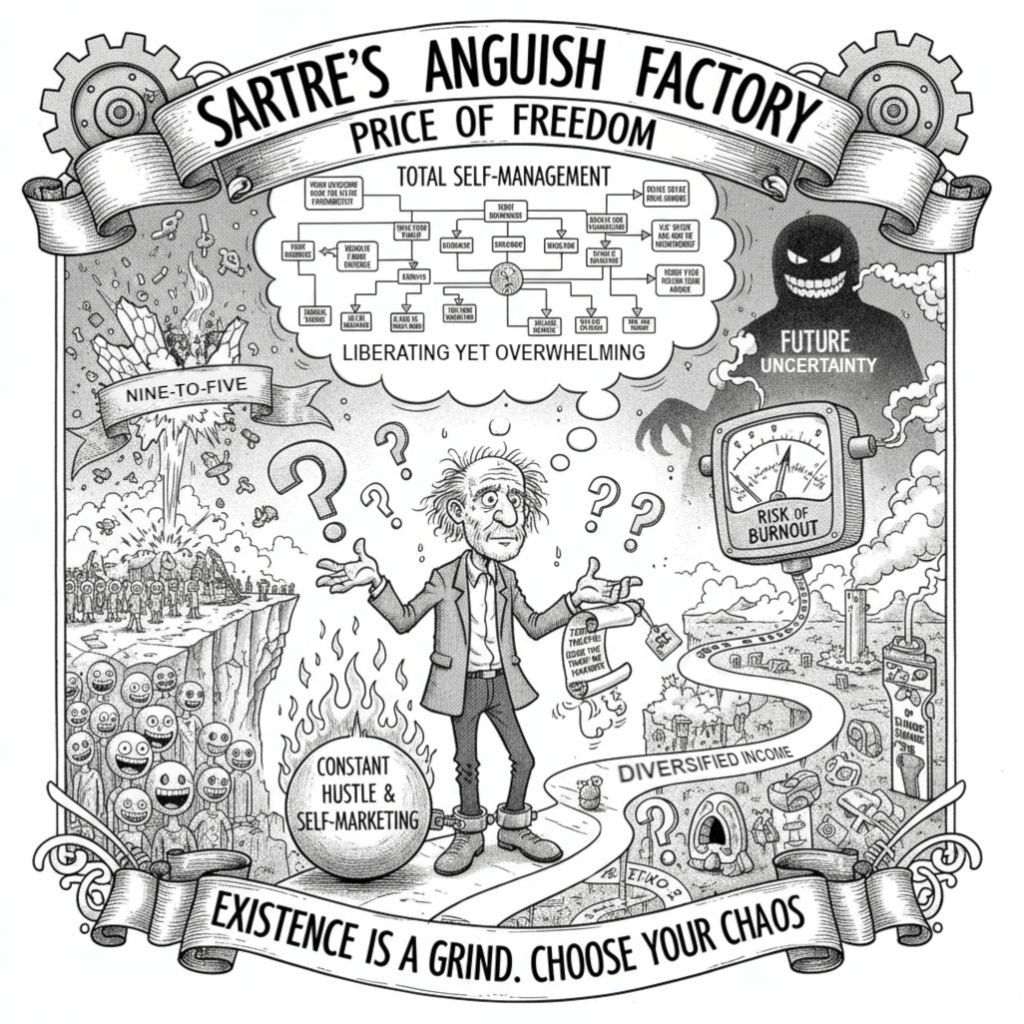
For Sartre, this radical freedom is not a simple gift; it is an inescapable burden. To be “condemned to be free” means we are without excuse, bearing total responsibility for who we become [29]. Every choice defines us and implicitly endorses a vision of humanity. This weight of responsibility, this awareness that our essence is up to us, leads to existential “anguish” or anxiety [31].
The psychological challenges of the portfolio career can be interpreted as the lived experience of this Sartrean anguish. The path is often described as “liberating” and “overwhelming” [33]. Freedom from a nine-to-five structure is exhilarating but comes with the heavy burden of total self-management [34]. The portfolio careerist must constantly make choices a traditional employee does not: which projects to pursue, how to price services, how to manage variable income, and how to plan for a future without corporate benefits [2].
The portfolio careerist is responsible for defining their own metrics of success. Without the external validation of a promotion or raise, they must determine for themselves what a successful life looks like [20]. This lack of an external benchmark, this confrontation with their own potential, is the source of Sartrean anxiety. The stress of the portfolio career is not merely logistical; it is existential. It is the anxiety from being the sole author of one’s professional destiny. This constant need to hustle, market oneself, and navigate uncertainty can lead to stress and burnout [33].
The Traditional Career as “Bad Faith”
To escape the anguish of radical freedom, Sartre argued, people engage in self-deception he called “bad faith” (mauvaise foi) [31]. Bad faith is pretending we are not free. It involves fleeing responsibility by convincing ourselves we are fixed objects with predetermined roles, like the paper-knife. A classic example is the waiter who so fully immerses himself in the role of waiter that he denies his own freedom, acting as if his essence is “waiter-ness” [31]. He lets a socially defined role dictate his being, abdicating the responsibility of self-creation [31].
From this perspective, the traditional career path can be viewed as a societal structure for enabling bad faith.
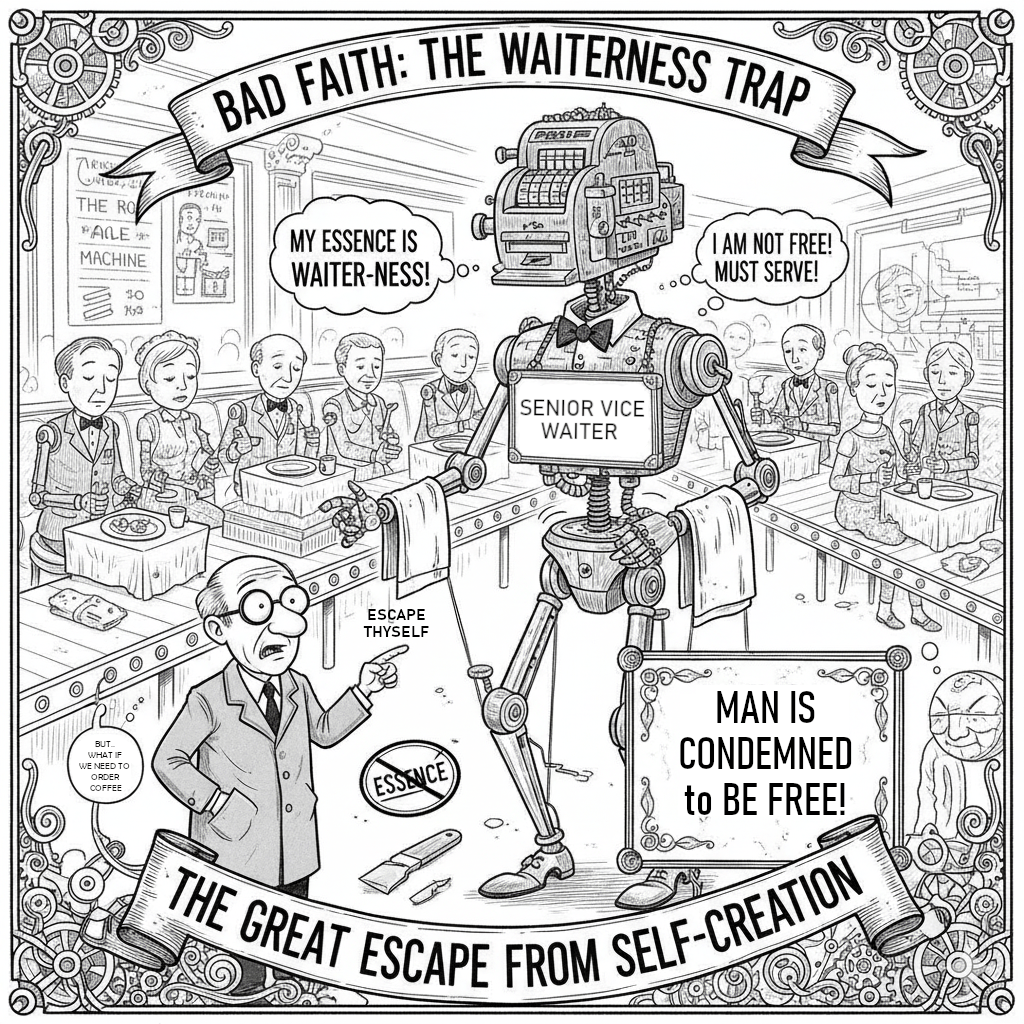
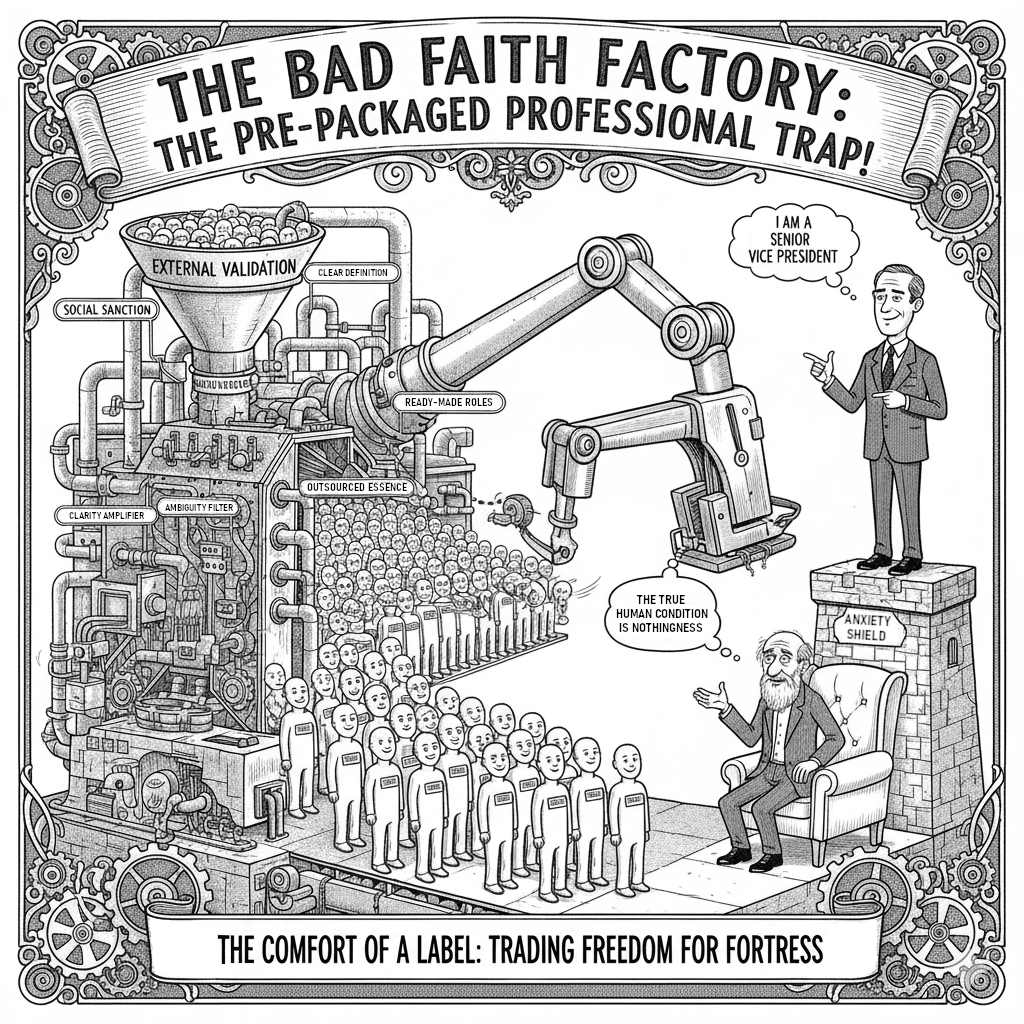
It provides ready-made, socially sanctioned identities (“intern,” “manager”) that individuals can adopt, avoiding the difficult work of creating their own professional essence. Energy in a traditional career is concentrated at the “start,” when one is recruited into a job title the company created [1]. By accepting this pre-defined role, the individual can outsource the definition of their professional self to the organization [11]. This allows them to say, “I am a Senior Vice President,” treating this title as a fixed, essential identity, not a contingent result of choices. This provides a shield against existential anxiety.
The most common criticism of the portfolio career, its “lack of career identity,” can be reinterpreted as its greatest philosophical virtue. From a Sartrean viewpoint, this “lack” is not a deficiency but a reflection of the true human condition. It is the experience of the “nothingness” at the heart of consciousness, the void necessary for authentic freedom and self-creation [36]. The anxiety from this identity ambiguity is not a sign of a flawed career model but a symptom of genuine freedom. The discomfort of the portfolio careerist, who cannot fall back on a simple job title, is the discomfort of being authentically responsible for forging one’s own professional meaning.
The Dialectic of Fluidity and Stability
The philosophies of Heraclitus and Sartre converge to provide a complete picture of the portfolio careerist’s world. Heraclitus describes the objective reality: a professional environment of constant, unpredictable flux. The economic landscape, technological advancements, and project-based work ensure nothing is permanent; stability is an illusion [23]. Sartre describes the subjective task of the individual navigating this river. The individual is a free agent, an architect “condemned” to build a life and self without a blueprint [29].
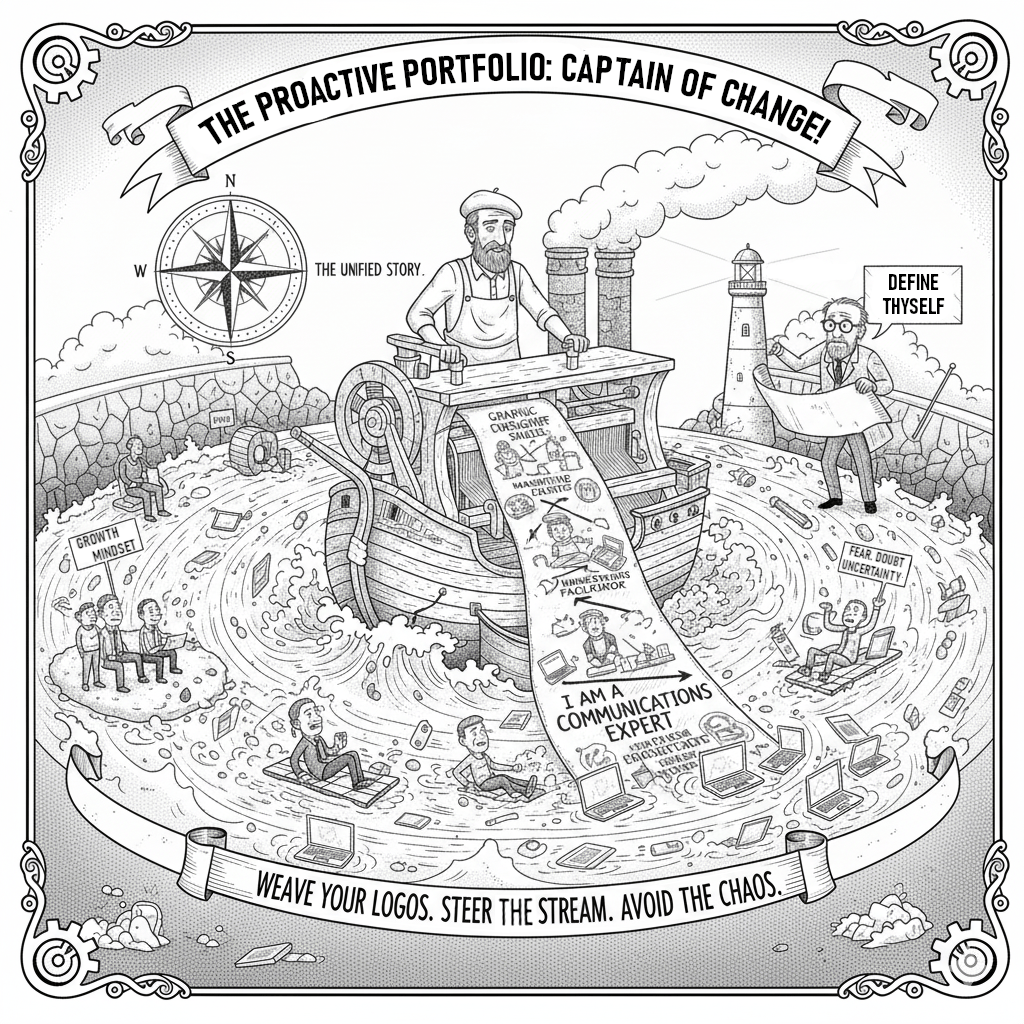
The portfolio careerist can be envisioned as a Sartrean architect building a boat (a coherent professional self) to navigate the Heraclitean river. This boat is not static. It is a project in constant motion, a vessel perpetually repaired, modified, and redesigned in response to changing market currents and the captain’s evolving interests. Choosing materials (skills), destinations (projects), and the vessel’s form (professional identity) is a continuous exercise in Sartrean freedom. The building environment, the ever-flowing river of opportunities, is fundamentally Heraclitean.
The Coherent Narrative as a Bridge
The crucial element bridging these two philosophical realities, objective flux and subjective freedom, is the “coherent narrative” [17]. This narrative is the psychological and practical tool through which the individual exercises Sartrean freedom to create a stable-enough self to function within Heraclitean instability.
From a Sartrean perspective, the self is a narrative, a “consistent and meaningful life story” woven through reflection on past experiences and projections toward future goals [37]. The portfolio careerist’s coherent narrative is precisely this: a Sartrean project of self-definition. It is the conscious choice to imbue disparate events with meaning. This project is not created in a vacuum. It is constructed from the raw material of the Heraclitean flow of varied jobs, clients, and learning experiences. The narrative is the act of finding the Logos within the flux, articulating the underlying order one has chosen to create.
This narrative transforms a portfolio from reactive gigs into a proactive, strategic career. It provides the “growth mindset” and “longer-term responsibility” distinguishing a professional with a portfolio from a gig worker [17]. It is the story that says, “I was not just a graphic designer, then a marketing consultant, then a workshop facilitator. I am a communications expert who has applied my core skills across different modalities.” This narrative act creates a provisional stability, a navigable identity allowing the individual to chart a course through change without being swept away.
This Freedom a Choice?
While Heraclitus and Sartre provide a powerful lens for understanding the portfolio career, a purely philosophical analysis risks idealizing a harsh economic reality. A critical sociological perspective must ask: Is embracing a fluid professional identity always a liberating choice? Or is it, for many, an economic necessity imposed by a precarious labor market where stable employment is unavailable?
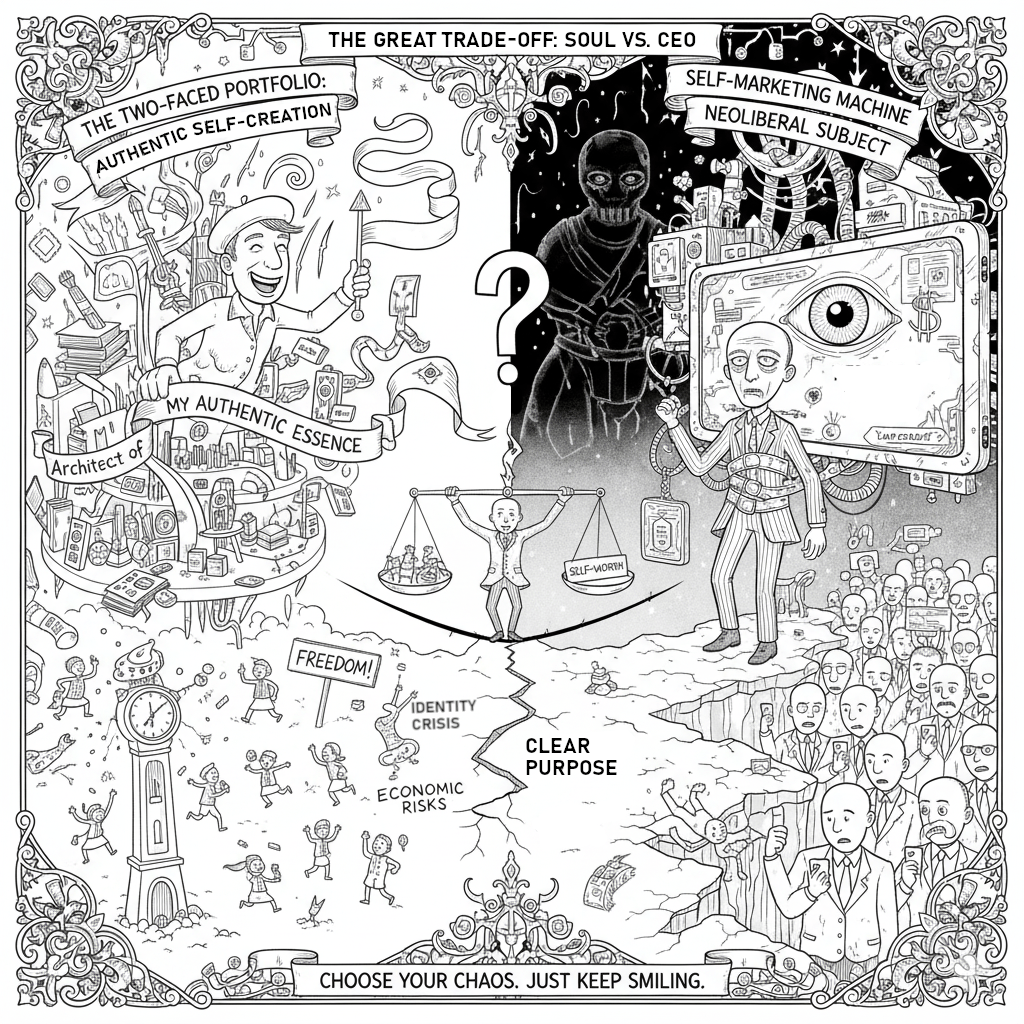
The evidence suggests the portfolio career exists on a wide spectrum. For some, particularly those with in-demand skills and strong networks, it is a path to greater autonomy and fulfillment [7]. These individuals, the “focused experts,” embody the Sartrean architect, freely choosing projects. For many others, the portfolio career is linked to economic necessity, like needing multiple side jobs to pay rent [3]. For this group, “flexibility” can be a euphemism for lacking a safety net. The challenges of income inconsistency, absence of benefits like health insurance and retirement plans, and the constant, uncompensated labor of self-marketing paint a picture less of liberation and more of relentless pressure [2].
This reality suggests the portfolio career has two faces. One is existential liberation. The other is that of the “neoliberal subject,” a worker disciplined by the market to be perpetually entrepreneurial, flexible, and responsible for all economic risks. This individual must treat their life as a business and their self as a brand. The Sartrean “project of the self” becomes indistinguishable from the “project of self-marketing.” Radical freedom is constrained by the market’s demand for a profitable brand. Setbacks are not just professional challenges but can feel like “existential crises,” as livelihood and self-worth are precariously intertwined [38]. Any complete analysis must acknowledge this duality: the portfolio career is both a potential path to authentic self-creation for some and a new form of disciplined, precarious labor for many.
The Future of the Working Self
The ascent of the portfolio career challenges traditional conceptions of a fixed, stable professional identity. By deconstructing the linear, organization-conferred identity and replacing it with a fluid, self-curated model, this new way of working forces a confrontation with fundamental questions about the self. The analysis through Heraclitus and Jean-Paul Sartre reveals the portfolio career is more than an economic trend; it is the embodiment of a profound philosophical shift. It replaces the essentialist question, “What are you?” with the existential question, “What are you becoming?”
The “coherent narrative” emerges as the critical psychological tool for the modern professional. It is the bridge between the objective reality of flux and the subjective task of freedom. It is the Sartrean act of self-definition that imposes a personal Logos (an order and purpose) onto the Heraclitean flow of disparate experiences, creating a provisional, navigable identity.
This philosophical liberation is tempered by a critical sociological reality. The freedom of the portfolio career is not equally distributed. For some, it is a genuine expression of autonomy; for others, it is a response to economic precarity, a new form of disciplined labor where the self must be constantly marketed to survive. This duality underscores the challenges accompanying this shift.
The broader societal implications are significant. If stable employment no longer confers identity, society must grapple with new sources of cohesion and meaning. Educational systems must evolve to prepare students not for a single job, but to become “captains of their own cottage industries” [3]. equipped with self-management, entrepreneurship, and resilience. The rise of the fluid career demands the cultivation of a fluid self. This concept is at once empowering, offering potential for a more authentic, multifaceted life, and challenging, placing the immense burden of creating meaning squarely on the individual. The future of the working self is one of constant becoming, requiring a new level of consciousness, creativity, and courage.
References
[1] What is a portfolio career and is it right for you?, accessed October 8, 2025, https://distancelearning.aru.ac.uk/blog/what-is-a-portfolio-career/
[2] Is It Time to Ditch the Traditional Career Path? Exploring the Portfolio Career – Ivy Exec, accessed October 8, 2025, https://ivyexec.com/career-advice/2025/is-it-time-to-ditch-the-traditional-career-path-exploring-the-portfolio-career
[3] Portfolio career – Wikipedia, accessed October 8, 2025, https://en.wikipedia.org/wiki/Portfolio_career
[4] Charles Handy – Thinkers50, accessed October 8, 2025, https://thinkers50.com/biographies/charles-handy/
[5] Portfolio Career | Topics | Business – Tutor2u, accessed October 8, 2025, https://www.tutor2u.net/business/topics/portfolio-career
[6] Charles Handy: Understanding Power Culture & Organizational Theory – Business.com, accessed October 8, 2025, https://www.business.com/articles/management-theory-of-charles-handy/
[7] The Rise of Portfolio Careers: Navigating Multiple Roles in the Modern Workforce, accessed October 8, 2025, https://corporatejobbank.com/the-rise-of-portfolio-careers-navigating-multiple-roles-in-the-modern-workforce/
[8] What Is A Portfolio Career?, accessed October 8, 2025, https://portfolio-collective.com/content/articles/what-is-a-portfolio-career/
[9] The Construction of Professional Identity Brianna Barker Caza Asper …, accessed October 8, 2025, https://ecommons.cornell.edu/bitstream/handle/1813/71987/Creary21_rev_The_construction_of_professional_identity.pdf?sequence=1
[10] (PDF) Professional Identify Formation: History, Practice and Challenges – ResearchGate, accessed October 8, 2025, https://www.researchgate.net/publication/380497699_Professional_Identify_Formation_History_Practice_and_Challenges
[11] ivyexec.com, accessed October 8, 2025, https://ivyexec.com/career-advice/2025/is-it-time-to-ditch-the-traditional-career-path-exploring-the-portfolio-career#:~:text=Unlike%20the%20traditional%20career%20model,across%20different%20fields%20and%20opportunities.
[12] Portfolio Careers: By Necessity or by Choice? – Career Vision, accessed October 8, 2025, https://careervision.org/portfolio-careers-necessity-choice/
[13] Professional identities – where do they come from, and why are they important? – Medcast, accessed October 8, 2025, https://medcast.com.au/blog/professional-identities-where-do-they-come-from-and-why-are-they-important
[14] Explore Portfolio Careers | Multiple Roles, One Career Path – JobLeads, accessed October 8, 2025, https://www.jobleads.com/career-advice/fancy-being-a-portfolio-careerist
[15] Why you should consider a portfolio career – Pickard Properties, accessed October 8, 2025, https://pickardproperties.co.uk/talking-points/why-you-should-consider-a-portfolio-career/
[16] One Thing Every Multi-Potentialite Needs to Know About a Portfolio Career – Vix Anderton, accessed October 8, 2025, https://vixanderton.com/blog/one-thing-every-multi-potentialite-needs-to-know-about-a-portfolio-career
[17] Don’t Worry. Your Job Skills Matter Less in a Non-Linear, “Portfolio” Career, accessed October 8, 2025, https://johntarnoff.com/embrace_your_portfolio_career/
[18] Working Identity & the Psychology of Career Reinvention – Jill Walker, accessed October 8, 2025, https://jillwalker.com/working-identity-the-psychology-of-career-reinvention/
[19] Characteristics of people that successfully build a portfolio | Thomas Thor, accessed October 8, 2025, https://www.thomas-thor.com/5-characteristics-of-people-that-successfully-build-a-work-portfolio-for-themselves/
[20] Portfolio Career: Pros, Cons and How to Get Started – 2025 – MasterClass, accessed October 8, 2025, https://www.masterclass.com/articles/portfolio-career
[21] Heraclitus (Stanford Encyclopedia of Philosophy), accessed October 8, 2025, https://plato.stanford.edu/entries/heraclitus/
[22] Panta Rhei — what does that mean?, accessed October 8, 2025, https://pantarhei.press/2019/11/08/panta-rhei-what-does-that-mean/
[23] Panta Rhei – Eric Roth, accessed October 8, 2025, https://ericroth.org/my-interests/panta-rhei/
[24] Panta Rhei: The concept of impermanence in Greet philosophy – Fabrizio Musacchio, accessed October 8, 2025, https://www.fabriziomusacchio.com/weekend_stories/told/2025/2025-01-05-panta_rhei/
[25] What To Do When You Want To Do Everything: Is A Portfolio Career Right For You?, accessed October 8, 2025, https://www.careershifters.org/expert-advice/what-to-do-when-you-want-to-do-everything-is-a-portfolio-career-right-for-you
[26] Heraclitus: Life Is Flux – World History Encyclopedia, accessed October 8, 2025, https://www.worldhistory.org/article/75/heraclitus-life-is-flux/
[27] What Type of Portfolio Career Is Right For You, accessed October 8, 2025, https://portfolio-collective.com/content/articles/understanding-portfolio-work/what-type-of-portfolio-career-is-right-for-you/
[28] Using portfolios to enhance career resilience | Request PDF – ResearchGate, accessed October 8, 2025, https://www.researchgate.net/publication/232494919_Using_portfolios_to_enhance_career_resilience
[29] Jean-Paul Sartre’s Existentialism: “Existence Precedes Essence”, accessed October 8, 2025, https://jamesbishopblog.com/2020/07/27/jean-paul-sartres-existentialism-existence-precedes-essence/
[30] Existence precedes essence – Wikipedia, accessed October 8, 2025, https://en.wikipedia.org/wiki/Existence_precedes_essence
[31] Existence Precedes Essence: What Sartre Really Meant …, accessed October 8, 2025, https://philosophybreak.com/articles/existence-precedes-essence-what-sartre-really-meant/
[32] Become the Architect of Your Life | by Oscar | Medium, accessed October 8, 2025, https://medium.com/@oscarwyk/the-roadmap-to-self-creation-366bad089d0a
[33] Why Choose a Portfolio Career – Taylor Elyse Morrison, accessed October 8, 2025, https://www.taylorelyse.com/post/portfolio-career
[34] Building A Portfolio Career & Quitting My 9-5 Job – Nick Lafferty, accessed October 8, 2025, https://nicklafferty.com/blog/portfolio-career/
[35] Existence Precedes Essence: The Power of Self-Creation | by ADITI ADLAKHA | Medium, accessed October 8, 2025, https://medium.com/@aditi250791/existence-precedes-essence-the-power-of-self-creation-dedf2add54ff
[36] Existence precedes essence : r/Existentialism – Reddit, accessed October 8, 2025, https://www.reddit.com/r/Existentialism/comments/1i99dzt/existence_precedes_essence/
[37] Reflection, Memory and Selfhood in Jean-Paul Sartre’s Early Philosophy – ResearchGate, accessed October 8, 2025, https://www.researchgate.net/publication/263480562_Reflection_Memory_and_Selfhood_in_Jean-Paul_Sartre’s_Early_Philosophy
[38] Losing Ourselves In Work: The Dangerous Identity Crisis Of Modern …, accessed October 8, 2025, https://allwork.space/2025/06/losing-ourselves-in-work-the-dangerous-identity-crisis-of-modern-careers/