
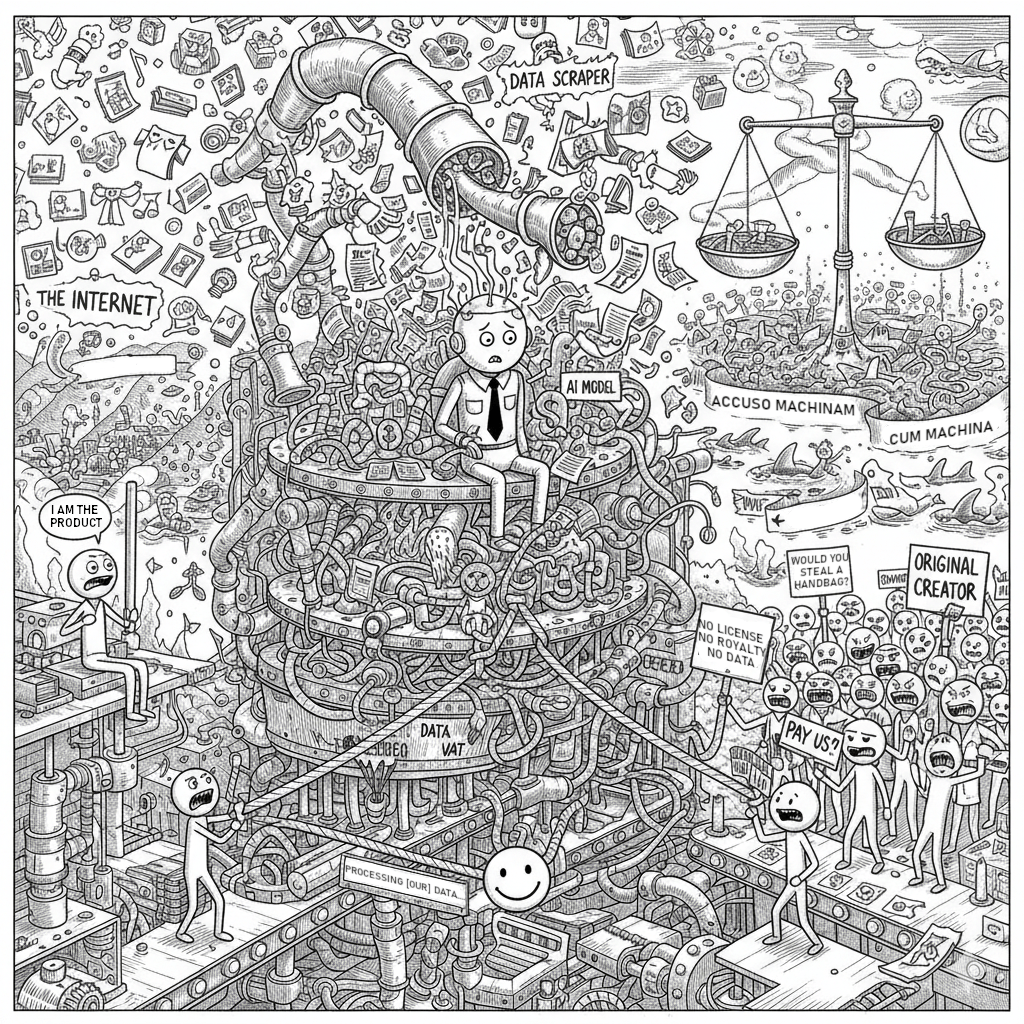
Disclaimer: A part of this work is to educate and promote transparency in use of AI. Gemini has been used throughout the creative process of putting together this article
The economic landscape presents a paradox. Labor market data from the 33 months after ChatGPT’s release reveals surprising stability, with no mass disruption. This calm belies a consensus among economic institutions that a profound transformation is imminent. Projections indicate Generative AI could automate 30% of U.S. work hours by 2030, affecting 300 million jobs globally. The current stability is a predictable lag phase, characteristic of general-purpose technologies, masking immense pressure for change.
This change is not monolithic job destruction but a “great bifurcation.” AI acts as an economic centrifuge, separating automatable tasks from those requiring human collaboration. This creates a dualistic effect: decreased demand for structured cognitive roles and increased demand for roles augmented by AI. This dynamic reshapes the skill hierarchy, devaluing reproducible cognitive labor while prioritizing critical thinking, strategic oversight, and creativity. The shift disproportionately affects younger workers and women, who are concentrated in exposed occupations.
Within creative industries, this bifurcation is acute. AI is a powerful muse and productivity tool, democratizing creative expression. Yet, it poses an existential threat to the value of human craft, raising intractable questions of intellectual property, authenticity, and potential aesthetic homogenization. The future of work is not technologically determined. The trajectory from heightened alienation to enhanced flourishing depends on the economic, ethical, and policy choices we make today.
Economic Realignment of Labor
The introduction of Generative AI has ignited a debate characterized by a contrast between public anxiety over unemployment and the nuanced signals from the labor market. This section provides an empirical foundation for understanding this transition. It reconciles the current stability with long-term disruption forecasts, contextualizing it within historical patterns of technological adoption. It then dissects AI’s impact, revealing a fundamental bifurcation of the workforce into roles susceptible to automation and those ripe for augmentation.
The Quiet Before the Storm?
This calm is consistent with historical precedent. Major technological revolutions do not unfold overnight. Computers did not become commonplace in offices until a decade after their public release, and it took longer for them to transform workflows. This lag is described by the “J-curve” of productivity associated with general-purpose technologies (GPTs). The initial phase involves significant investment in “intangible capital”—rewiring business processes, training workers, and overcoming hurdles like privacy and governance. During this period, productivity gains and labor market effects are muted. A McKinsey survey reveals that while 92% of companies plan to increase AI investment, only 1% describe their deployment as “mature.” The economy is still in the flat, early part of the J-curve.
Long-term forecasts must be understood from this perspective. They describe not the present but the steep, upward inflection of the curve. Goldman Sachs Research estimates Generative AI could impact 300 million jobs worldwide and automate tasks equivalent to a quarter of current work in the U.S. and Europe. McKinsey projects that by 2030, activities accounting for 30% of U.S. work hours could be automated, necessitating 12 million occupational transitions. These projections describe the logical consequence of the technology maturing. The current stability should be seen as the quiet before a significant economic storm.
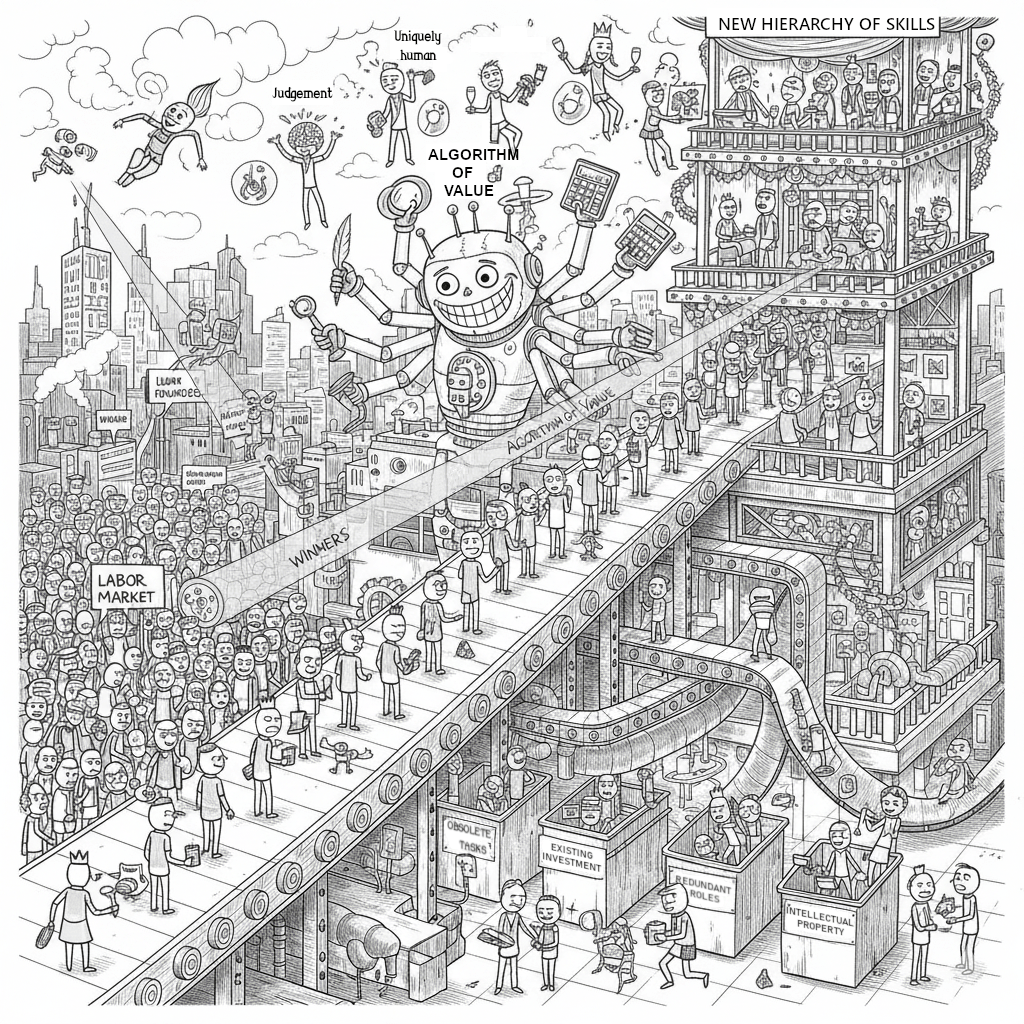
Table 1: Comparative Forecasts of Generative AI’s Labor Market Impact
| Source | Timeframe | Key Metric & Projection | Key Occupations Affected |
| Goldman Sachs | Next Decade | Global Jobs Exposed: 300 million full-time jobs. U.S. Job Displacement Risk: 2.5% to 14% of employment. Productivity Growth: ~15% rise in labor productivity in developed markets. | High Risk: Computer programmers, accountants, legal/administrative assistants, customer service representatives, copy editors. |
| McKinsey Global Institute | By 2030 | U.S. Hours Automated: Up to 30% of hours currently worked. U.S. Occupational Transitions: An additional 12 million shifts needed. | Declining Demand: Office support, customer service, food service, production work. Growing Demand: Healthcare workers, STEM professionals, green industry jobs. |
| World Economic Forum | By 2028 | Global Job Creation: 69 million new jobs predicted. Working Hours Impacted: 40% of all working hours could be impacted by LLMs. | Declining Demand: Bank tellers, data entry clerks, secretarial roles. Growing Demand: AI/ML specialists, data analysts, digital transformation specialists. |
| Forrester | By 2030 | U.S. Job Loss: 2.4 million jobs (1.5% of total). U.S. Jobs Transformed: 11.08 million jobs (6.9% of total). | Not specified in detail, but implies a broader transformation of roles rather than outright replacement. |
The Great Bifurcation
Generative AI’s economic impact is not simple job destruction but a profound restructuring of the labor market, characterized by a dualistic process of automation and augmentation. This bifurcation is creating a new hierarchy of skills, separating work that can be codified by algorithms from work requiring human judgment and strategic oversight. This process is not socially neutral, creating winners and losers and exacerbating inequalities along lines of age, gender, and skill.
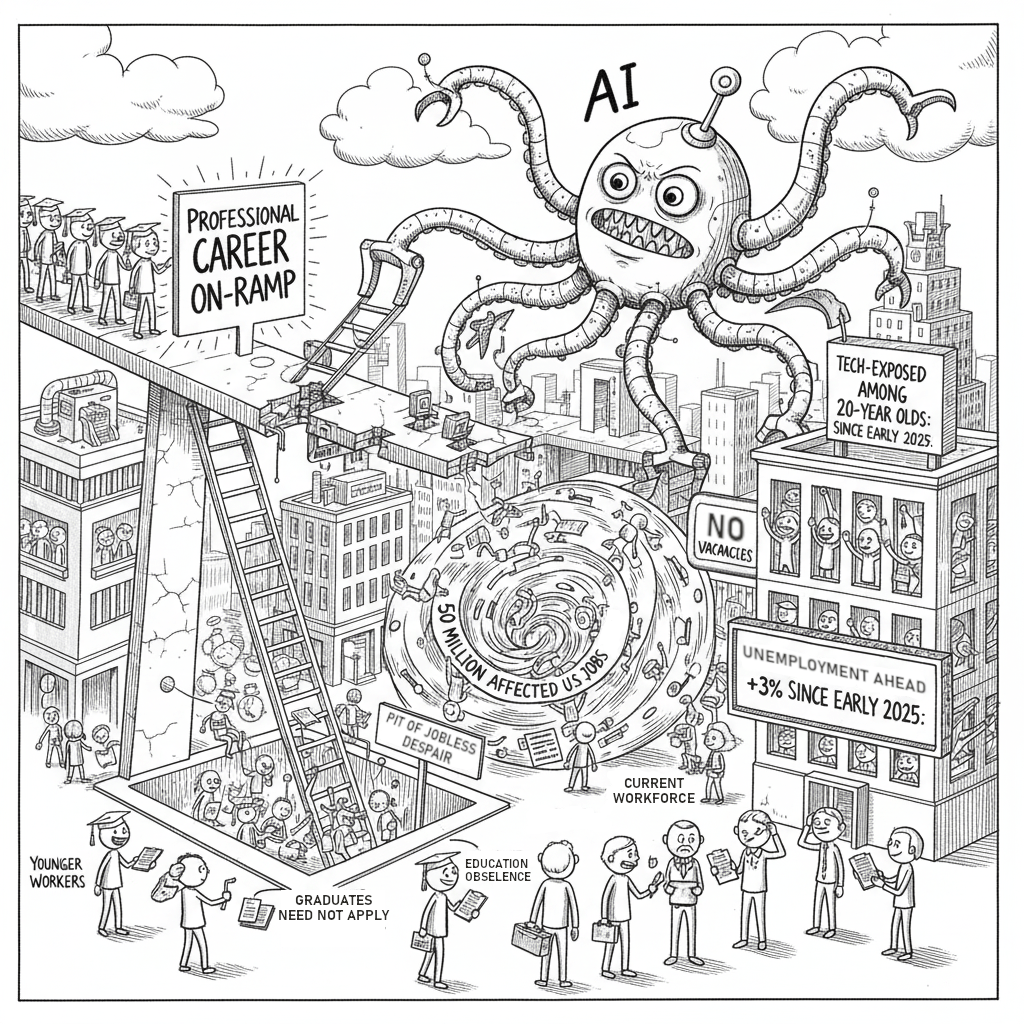
A Harvard Business School study provides evidence of this heterogeneous effect. Analyzing U.S. job postings, the research shows that after Generative AI’s introduction, postings for occupations with high automation potential (structured, repeatable cognitive tasks) decreased by 17%. Postings for “augmentation-prone” occupations (where human-AI collaboration yields productivity gains) increased by 22%. This finding shows that the same technology can be both a substitute for and a complement to labor.
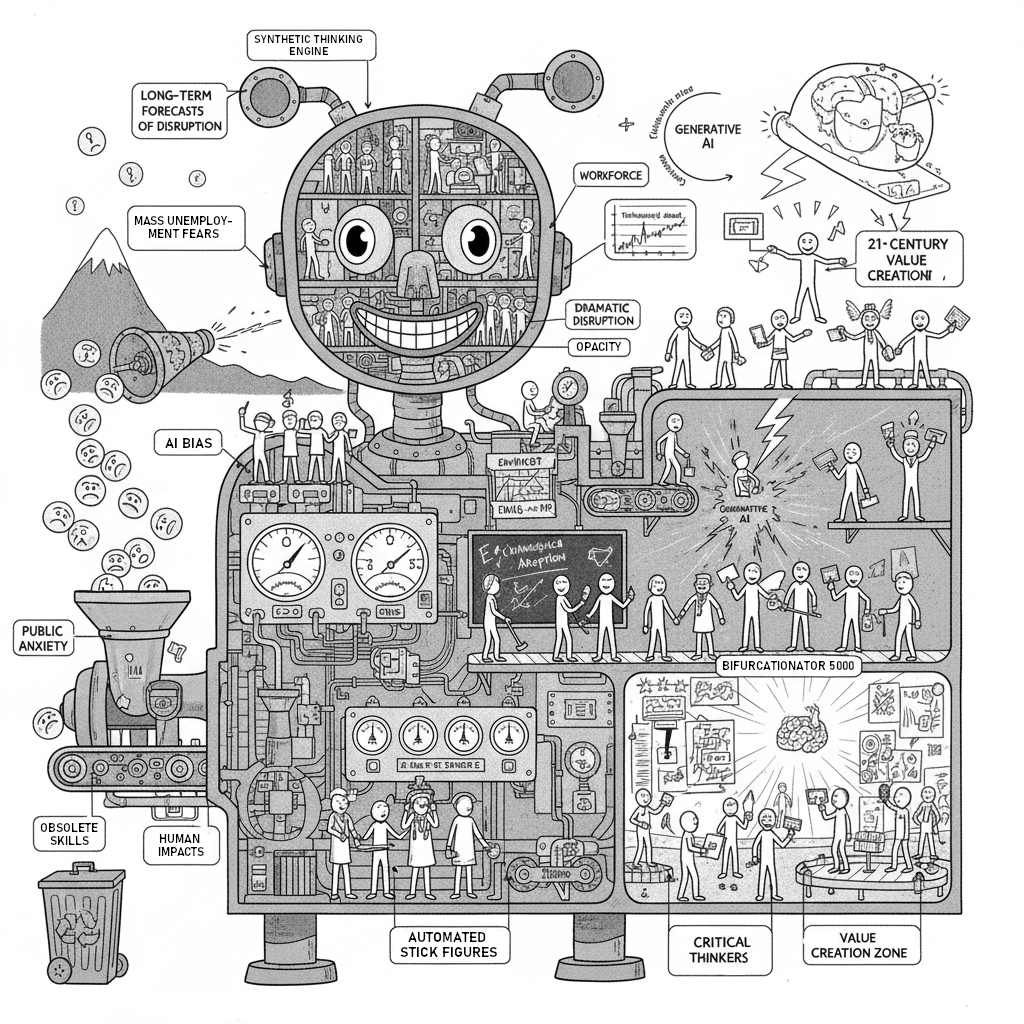
This bifurcation reshapes the demand for skills, leading to skill polarization. The Harvard study found that for highly automatable jobs, required skills listed in postings decreased by 24%, indicating “deskilling.” For augmentation-prone jobs, required skills increased by 15%, signaling demand for a more complex skillset to manage and leverage AI tools. This creates a polarized market where demand grows for high-end roles like AI specialists and data scientists, while shrinking for routine white-collar roles like customer service representatives and data entry clerks. Unlike previous automation waves affecting manual work, Generative AI targets cognitive tasks of educated professionals.
The societal consequences of this shift are significant and unequally distributed. Younger workers are a vulnerable group. Unemployment among 20- to 30-year-olds in tech-exposed occupations has risen by almost 3 percentage points since early 2025, corroborating reports of AI contributing to hiring headwinds for recent graduates. Entry-level jobs are especially at risk, with some estimates suggesting nearly 50 million such U.S. jobs could be affected, threatening a key pathway for economic mobility.
AI-driven automation also exhibits a significant gender disparity. Due to occupational segregation, women are disproportionately concentrated in roles highly exposed to automation. One analysis estimates that 79% of employed women in the U.S. work in high-risk jobs, compared to 58% of men. This is because roles in clerical work, administration, and customer service have high female representation. Without targeted intervention, AI’s economic realignment threatens to roll back progress in gender equality. Generative AI’s effect is not just a change in the quantity of jobs, but a qualitative re-stratification of the workforce based on a role’s defensibility against algorithmic replication.
The Restructuring of Creativity
The creative industries are at the epicenter of the Generative AI revolution. Here, the technology challenges the definitions of art, authorship, and value. The impact is dualistic, fostering a debate that pits the promise of a creative renaissance against the peril of devaluing human skill. This section explores this transformation, examining AI’s role as a creative collaborator and then confronting concerns over intellectual property, commodification, and the erosion of the human element in art.
The Generative Muse
The integration of Generative AI into creative workflows has been swift, driven by its promise to augment ingenuity, streamline production, and lower barriers to entry. For many creatives, AI is not a replacement but a collaborative partner—a generative muse unlocking new efficiency and expanding artistic expression.
Adoption rates signal a profound shift. Studies indicate 83% of creative professionals have incorporated AI tools into their processes. This uptake is based on tangible productivity gains. According to an Adobe survey, 62% of creatives report AI tools reduce task completion time by 20%. This efficiency is realized across the creative lifecycle: generating concepts, creating variations, or synthesizing research. By offloading this drudgery, AI frees creators for higher-value activities like strategic thinking and conceptual refinement.
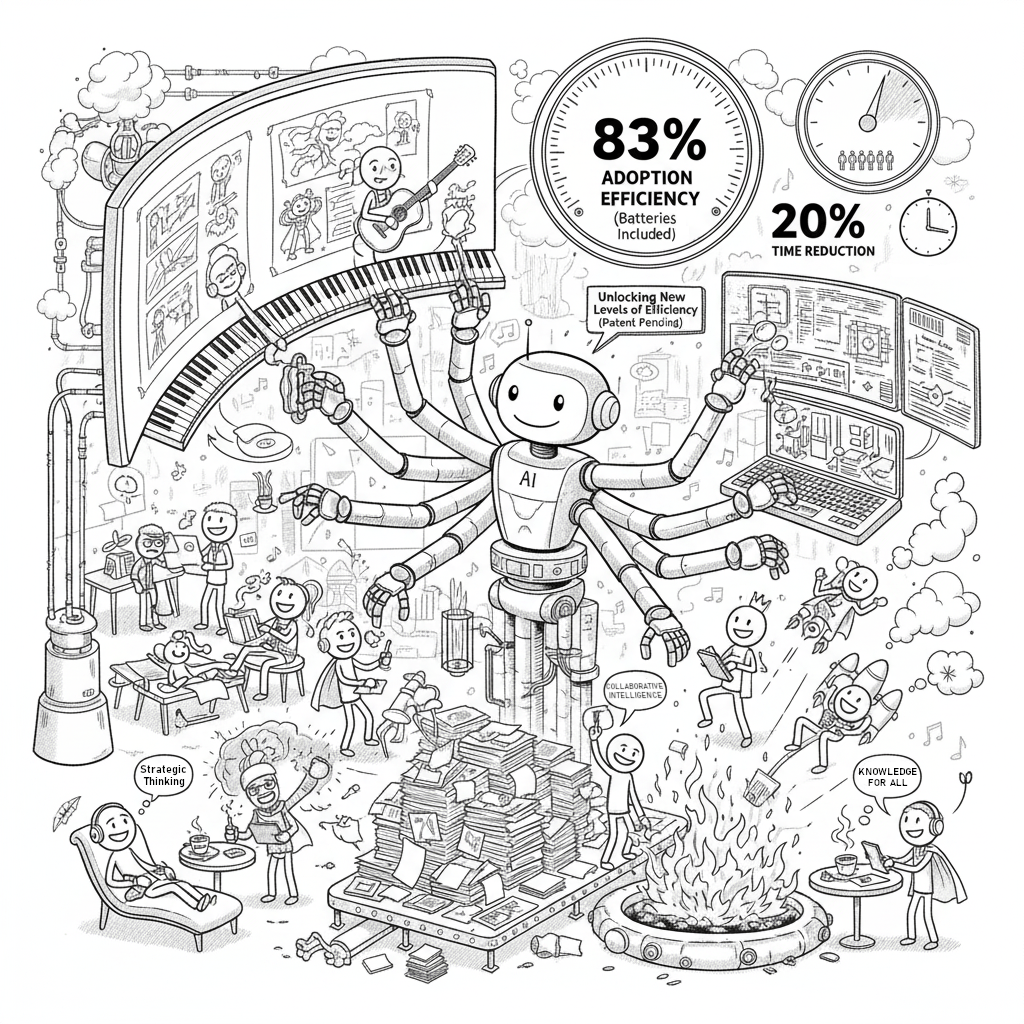
Proponents argue Generative AI is a catalyst for innovation. The technology can overcome creative blocks by offering novel starting points and unexpected stylistic combinations. Artists and designers use tools like DALL-E and Midjourney to rapidly prototype ideas and explore new aesthetic directions. This capacity for rapid iteration fosters an environment where risk-taking is encouraged, potentially leading to a “new creative renaissance.” The belief is that this human-AI collaboration enhances human creativity, leading to more diverse outputs.
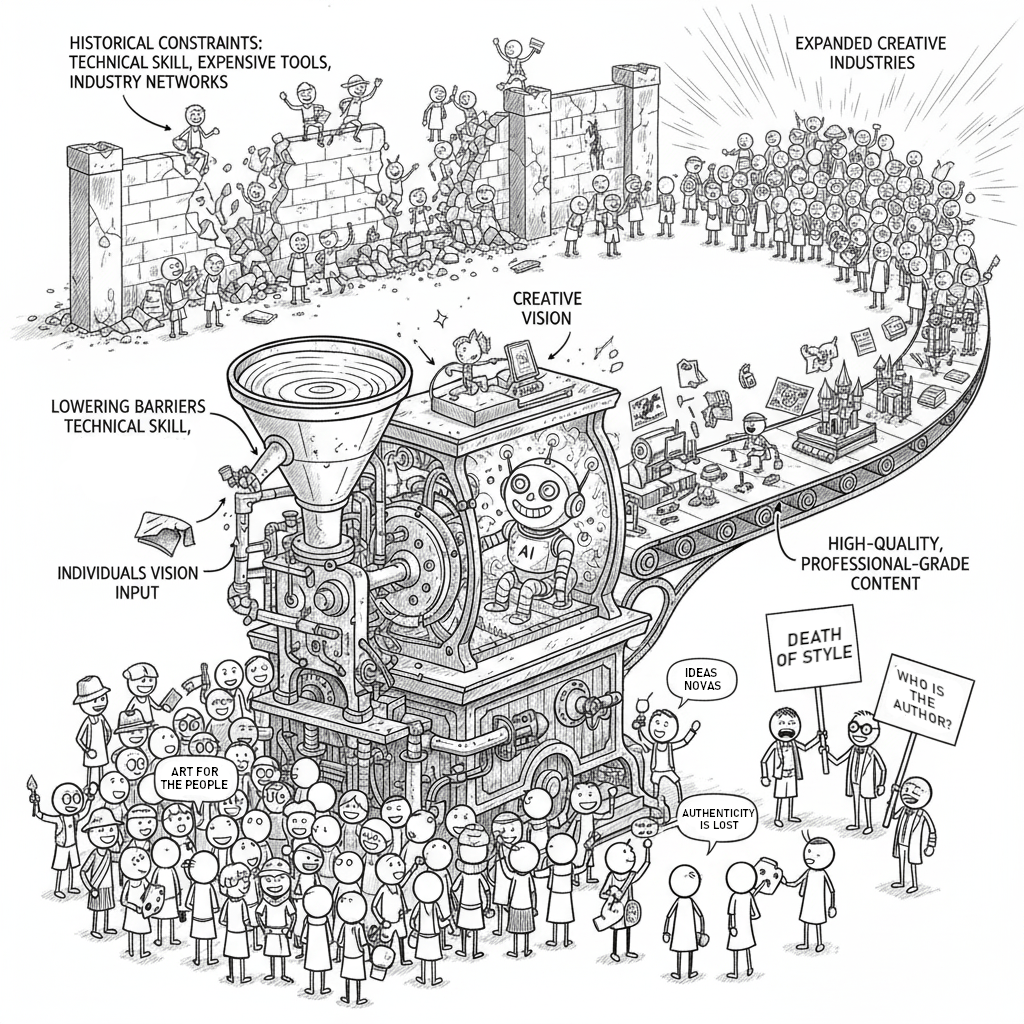
Perhaps the most significant argument for AI in the creative sphere is its potential for democratization. Creative vision has often been constrained by technical skill and access to expensive tools. Generative AI alters this equation. Individuals without formal training can use text prompts to produce high-quality content. This lowering of barriers is seen as an inclusive force, potentially expanding the diversity of voices in the creative industries. In this optimistic view, AI is an empowering tool that makes creation more accessible.
The Specter of Homogenization
Juxtaposed with the empowerment narrative is a growing anxiety. Critics voice concerns that Generative AI threatens intellectual property, devalues the contribution of human artists, and risks eroding the authenticity that gives art meaning. This counter-narrative frames AI not as a muse, but as a force for commodification that could lead to economic displacement and a homogenized culture.
At the heart of the conflict is a crisis of intellectual property. Generative AI models are trained on vast datasets of copyrighted material scraped from the internet without consent or compensation. This creates a legal and ethical quagmire. Who owns an AI-generated work? This unresolved question challenges copyright law and became a central issue in the 2023 Hollywood strikes, where protections against AI were key demands.
There is a pervasive fear that AI will devalue human creativity. When high-quality creative work can be generated in seconds, it risks undermining the value of artistic mastery. The discourse around AI often promotes a vision of creativity “freed from its material realisation through human labor,” decoupling the idea from the craft. This threatens to devalue the human process, potentially leading to a homogenization of aesthetics as AI models converge on similar styles. Critics argue AI-generated content may lack the authenticity and intentionality of genuine human experience.
This devaluation has direct economic consequences. The fear of job displacement is palpable for illustrators, designers, writers, and composers. Skills are shifting from direct creation to prompt engineering and AI systems integration, requiring a hybrid skillset. While this creates new roles, it threatens those who built careers on traditional craft. The conflict over AI in creative industries is a struggle over the definition of value, pitting efficiency and accessibility against the human process and embodied skill.
Table 2: The Duality of AI in Creative Industries: A Summary of Arguments
| Theme | Pro-Adoption Perspective (Enhancement/Democratization) | Critical Perspective (Threat/Commodification) |
| Productivity & Workflow | Accelerates ideation and automates repetitive tasks, saving time (62% of users report 20% time reduction) and allowing focus on high-level strategy. | Risks deskilling and transforming creative work into algorithmic supervision, reducing human agency. |
| Creative Potential | Acts as a collaborative partner, breaking creative blocks, enabling rapid experimentation, and expanding the canvas of artistic possibility. | May lead to aesthetic homogenization. Lacks the depth of human experience, resulting in hollow work. |
| Skill & Labor | Lowers barriers to entry, “democratizing” creativity and creating new roles like prompt engineers. | Devalues years of human craft and expertise. Threatens job displacement for roles like illustrators, writers, and designers. |
| Ownership & Value | Can lead to new frameworks for licensing and attribution, creating new revenue streams. | Creates an intellectual property crisis by training on copyrighted data without consent, challenging notions of authorship. |
| Authenticity | Enables new forms of expression and hybrid human-AI art forms that push creative boundaries. | Erodes authenticity by severing the creative work from the artist’s lived experience, which is essential to its value. |
Digital Alienation in the 21st Century
From a Marxist perspective, technology is a means of production deployed within the power dynamics of an economic system. In capitalism, technology’s function is to increase efficiency to maximize surplus value, often at the laborer’s expense. Generative AI is an unprecedentedly powerful tool in this process. Applying Marx’s theory of alienation provides a critical lens for understanding how this technology is not just changing jobs, but intensifying the estrangement of the worker from their humanity.
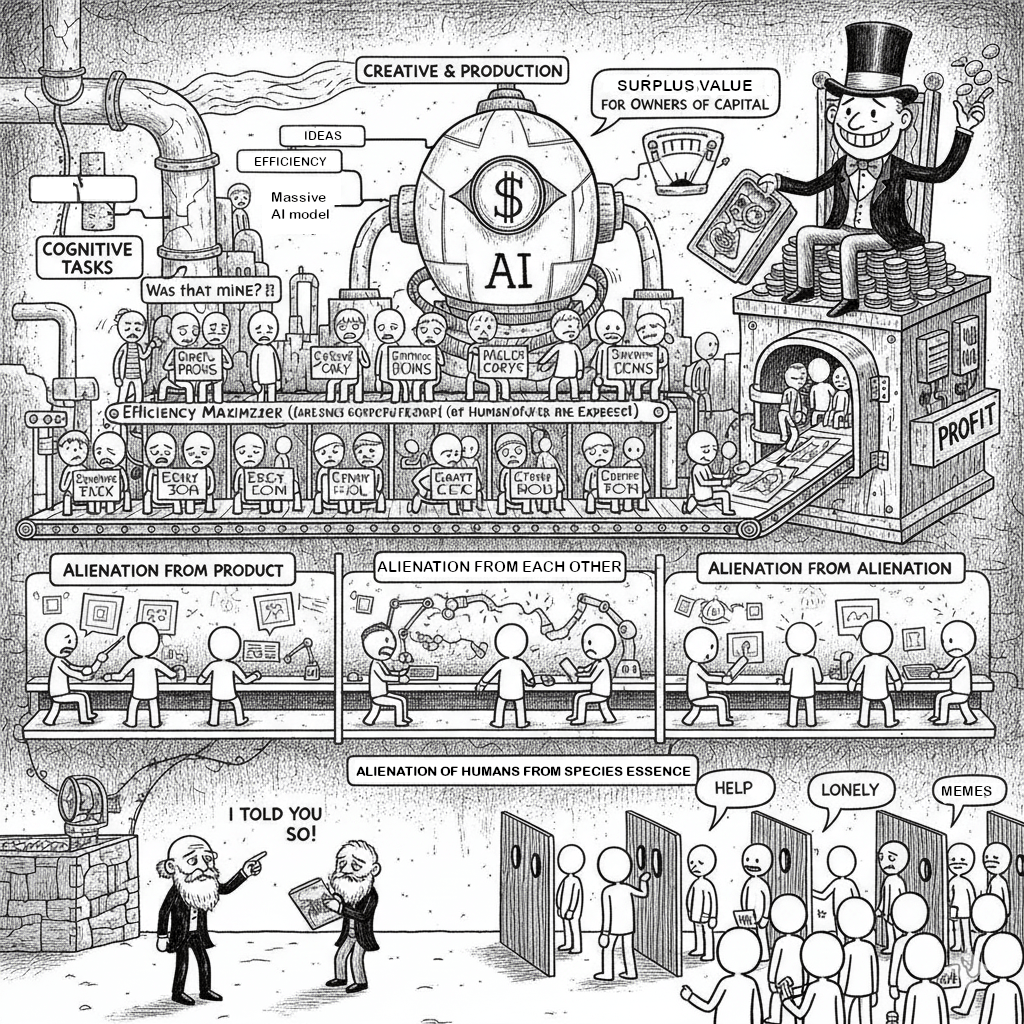
Marx’s concept of alienation is a structural condition with four interconnected dimensions. Generative AI acts as a catalyst for each:
- Alienation from the Product of Labor: A factory worker creates a product they do not own. A digital worker using AI is further removed. Their input is a prompt fed into a black-box system. The resulting output is a product over whose creation the worker had only indirect control. The AI itself, built on the extracted data of millions, confronts the worker as an external, dominant force.
- Alienation from the Process of Labor: For Marx, unalienated labor is a creative activity. Under capitalism, it becomes forced and mechanical. AI deepens this. The work of a professional augmented by AI risks becoming a series of fragmented tasks: prompting, reviewing, and correcting. The worker’s role shifts from proactive creation to algorithmic supervision, transforming skilled cognitive labor into a digital assembly line.
- Alienation from Gattungswesen (Species-Essence): This is where Generative AI introduces its most profound alienation. For Marx, what distinguishes humanity is our “species-essence”: our capacity for conscious, creative activity. Previous technology automated physical labor, but Generative AI automates cognitive and creative labor—the unique domain of human consciousness. When a machine can write a poem or compose music, it strikes at our human self-conception, threatening to make our creativity just another commodity.
- Alienation from Other People: Alienation transforms social relationships into market relationships. AI can exacerbate this by reducing the need for human collaboration. The “democratization” of creative tools can devalue professional expertise, intensifying competition and driving down wages for human artists.
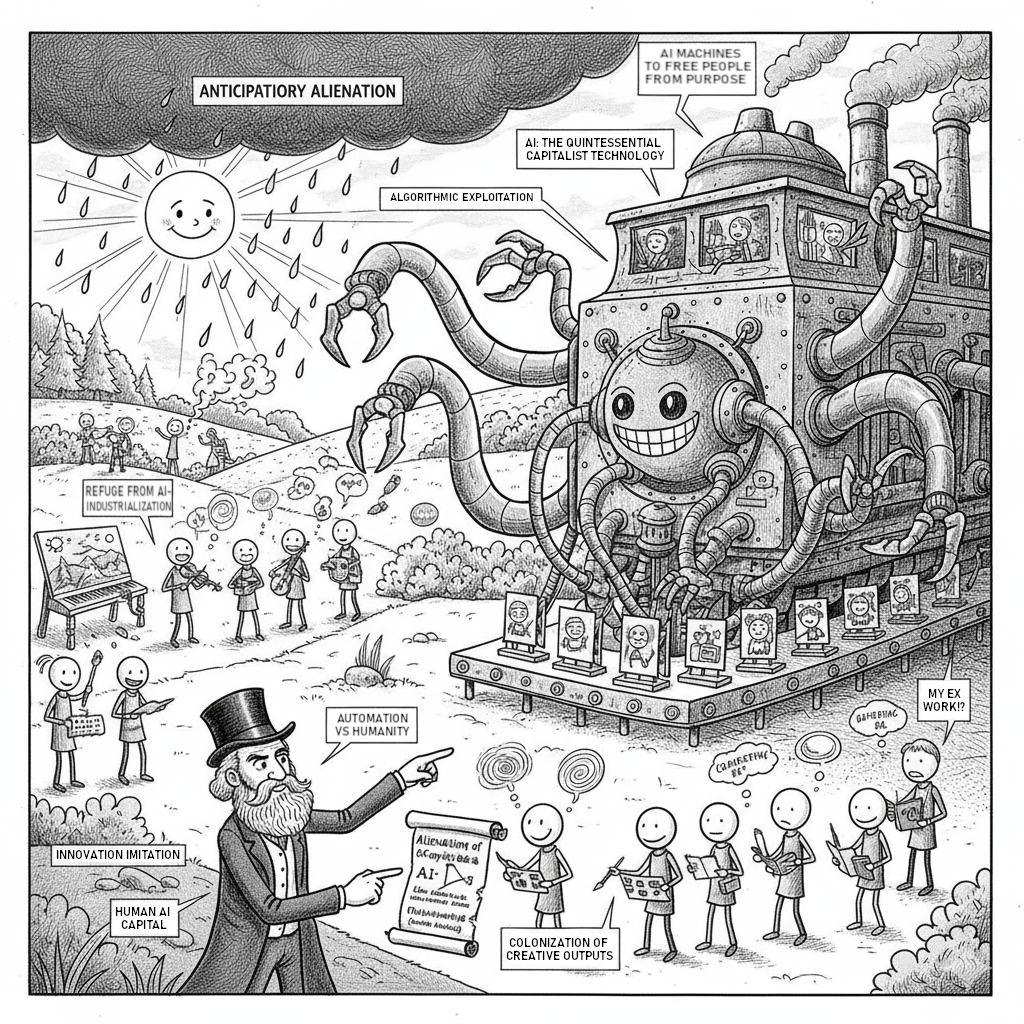
This analysis leads to “second-order alienation.” Historically, activities like art provided a refuge from alienating industrial jobs. By bringing automation into these sanctuaries, Generative AI extends industrial estrangement into the last bastions of human creativity. It represents a colonization of the human spirit. From a Marxist viewpoint, Generative AI is the quintessential capitalist technology, alienating workers from the essence of their cognitive and creative being.
The Telos of Work
While a Marxist analysis critiques AI’s role in existing power structures, an Aristotelian framework offers a normative vision. It shifts the focus from exploitation to an inquiry into human purpose. Applying Aristotle’s concepts—telos, ergon, and eudaimonia—we can evaluate Generative AI not just by its efficiency, but by its capacity to contribute to a well-lived human life.
Aristotle’s ethics are teleological, concerned with purpose, or telos. For humanity, the ultimate telos is eudaimonia, or human flourishing. Eudaimonia is achieved by fulfilling our unique function—our ergon. Aristotle identified the human ergon as the “activity of soul in accordance with reason.” Human flourishing consists of engaging in rational and virtuous activity.
Within this framework, meaningful work is a primary domain for achieving eudaimonia. It provides a context to exercise our rational capacities, cultivate virtues, and develop phronesis, or practical wisdom. Work that allows for skill development, autonomy, and creative problem-solving enables us to actualize our potential.
Generative AI challenges this vision because its capabilities overlap with the human ergon. The technology excels at tasks involving reason and language. This creates a choice between two futures:
- The Threat: Automation of the Human Ergon. If AI’s primary telos is maximizing efficiency, the logical outcome is automating rational and creative tasks. In this scenario, AI replaces the human ergon. Work becomes overseeing automated systems, a role devoid of opportunities to cultivate virtue. Such a deployment would undermine the conditions for human flourishing.
- The Opportunity: A Tool for Eudaimonia. Alternatively, AI can be implemented with a different telos: promoting human flourishing. In this vision, AI augments the human ergon. By automating ponos—toil and drudgery—AI could liberate human resources for higher-order activities like scientific contemplation, artistic creation, and philosophical inquiry. Designing “eudaimonia by design” means calibrating AI to enhance human potential.
This Aristotelian inquiry reveals the most important question about Generative AI is not “What can it do?” but “What is it for?” The technology’s impact is not inherent in its code but in the purpose we assign it. An Aristotelian approach demands a societal deliberation about the telos of AI, challenging us to build ethical frameworks that ensure technology serves a well-lived human life.
Strategic Recommendations
Generative AI is forcing a reckoning with the nature of work, creativity, and value. The preceding analysis shows the technology’s impact is a dualistic transformation. It promises productivity gains while threatening labor displacement; it offers to democratize creativity while challenging human authenticity. The frameworks of Marx and Aristotle frame this as a choice between intensified alienation and potential human flourishing. The path forward will be forged by the policy, business, and educational choices we make now.
Beyond Technological Determinism
We refute technological determinism. The future of labor is not a foregone conclusion. The current stability in labor markets is a temporary adoption phase. The disruptive potential projected by economic models is real, but its manifestation will be shaped by corporate strategy and public policy.
In the creative domain, AI is both a tool and a threat. Whether it ushers in a renaissance of human-machine collaboration or a commodified landscape depends on our ability to construct new legal and ethical frameworks.
The philosophical analysis makes this choice explicit. A path guided solely by capital efficiency will likely lead to Marx’s predicted outcomes: an alienated workforce. A path guided by a focus on human well-being could lead toward the Aristotelian ideal of eudaimonia, deploying AI to eliminate drudgery and empower humans for more meaningful work.
The choice is not whether to adopt AI, but how. It is a choice between an economy optimized for the machine, or one designed for the human.
A Course from Alienation to Flourishing
Navigating this transition requires a coordinated approach that shapes AI development to prioritize human dignity and flourishing. The following recommendations provide a roadmap for policymakers, business leaders, and educational institutions.
For Policymakers:
- Invest in Human-Centric Workforce Development: Initiate large-scale public investment in education and lifelong learning focused on skills complementary to AI: critical thinking, complex problem-solving, socio-emotional intelligence, and ethical reasoning.
- Modernize the Social Safety Net: Develop a robust and agile social safety net, including portable benefits, wage insurance, and expanded support for mid-career retraining.
- Establish Clear Regulatory Frameworks: Update intellectual property law for AI-generated content, establish data rights for workers, and mandate algorithmic transparency and accountability in the workplace.
For Business Leaders:
- Prioritize Augmentation over Replacement: Adopt a “human-in-the-loop” philosophy. Use AI to augment employee capabilities and automate tedious tasks, rather than for simple headcount reduction.
- Foster a Culture of Co-Creation: Involve workers in designing and implementing AI systems to give them agency and control over the transition.
- Redefine Performance and Productivity: Expand definitions of productivity beyond financial metrics to include employee well-being, skill development, and engagement. Aligning the organization’s purpose with its people’s flourishing is a long-term competitive advantage.
For Educational Institutions:
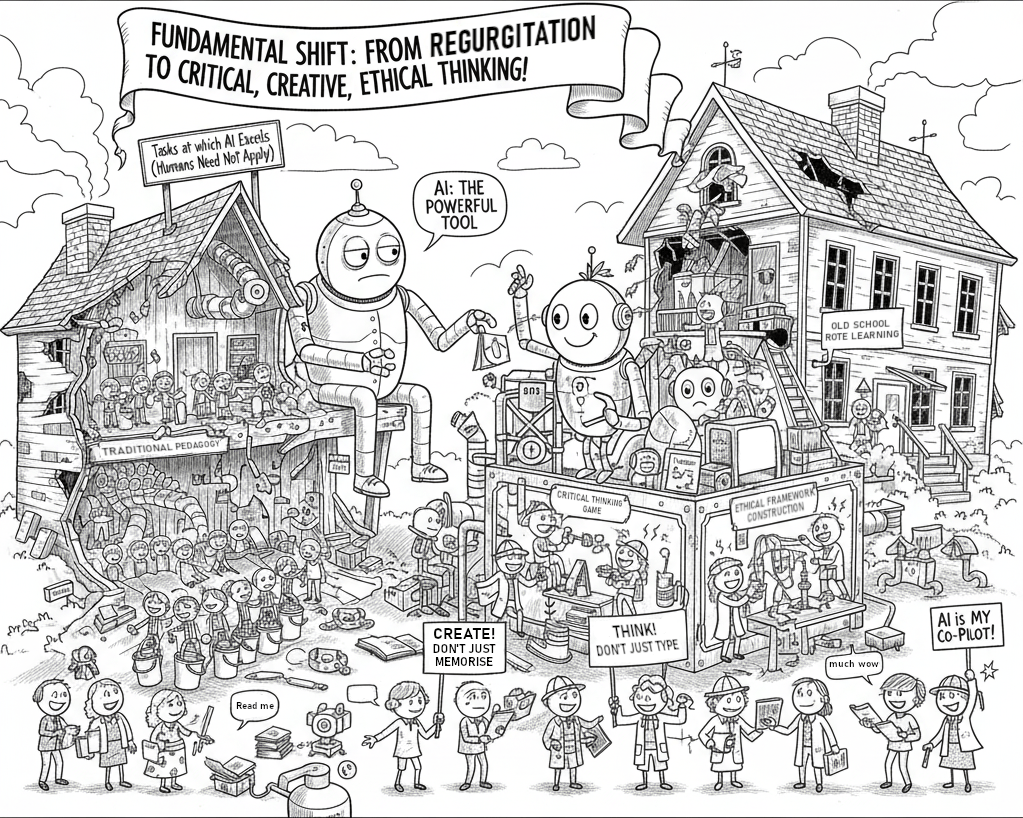
- Reform Curricula for the AI Era: Shift pedagogical focus from memorization toward teaching students to think critically, creatively, and ethically with AI as a tool.
- Champion Interdisciplinary Learning: Foster programs that integrate technical AI literacy with a deep grounding in the humanities, arts, and social sciences to cultivate leaders who understand AI’s societal and ethical implications.
Generative AI is not a passive force; it reflects our values. It holds up a mirror, compelling us to ask what we value in labor, cherish in creativity, and believe to be the purpose of our economic lives. The task is to answer those questions with the foresight to harness this tool in service of a more prosperous and deeply human future.
References
- Evaluating the Impact of AI on the Labor Market: Current State of …, https://budgetlab.yale.edu/research/evaluating-impact-ai-labor-market-current-state-affairs
- New data show no AI jobs apocalypse—for now – Brookings Institution, https://www.brookings.edu/articles/new-data-show-no-ai-jobs-apocalypse-for-now/
- Generative AI and the future of work in America – McKinsey, https://www.mckinsey.com/mgi/our-research/generative-ai-and-the-future-of-work-in-america
- Tommie Experts: Generative AI’s Real-World Impact on Job Markets – St. Thomas Newsroom, https://news.stthomas.edu/generative-ais-real-world-impact-on-job-markets/
- A.I. Is Going to Disrupt the Labor Market. It Doesn’t Have to Destroy It. – Chicago Booth, https://www.chicagobooth.edu/review/ai-is-going-disrupt-labor-market-it-doesnt-have-destroy-it
- Displacement or Complementarity? The Labor Market Impact of …, https://www.hbs.edu/ris/Publication%20Files/25-039_05fbec84-1f23-459b-8410-e3cd7ab6c88a.pdf
- How Will AI Affect the Global Workforce? | Goldman Sachs, https://www.goldmansachs.com/insights/articles/how-will-ai-affect-the-global-workforce
- Generative AI in Creative Work: Shocking Study • Magai, https://magai.co/generative-ai-has-transformed-creative-work/
- Generative AI and the Creative Industry: Finding Balance Between Apologists and Critics, https://medium.com/@fdonelli/generative-ai-and-the-creative-industry-finding-balance-between-apologists-and-critics-686f449862fc
- The impact of GenAI on the creative industries | World Economic Forum, https://www.weforum.org/stories/2025/01/the-impact-of-genai-on-the-creative-industries/
- The Marxist Position on Artificial Intelligence | by Max Jones …, https://ai.plainenglish.io/the-marxist-position-on-artificial-intelligence-6e3de54f6b84
- Alienation of the Second Order. When Artificial Intelligence Robs Human… – Frank Schillinger, https://frank-schillinger.com/alienation-of-the-second-order-c1a5605510d5
- Eudaimonia | Definition & Facts | Britannica, https://www.britannica.com/topic/eudaimonia
- Aristotle’s Ethics – Stanford Encyclopedia of Philosophy, https://plato.stanford.edu/entries/aristotle-ethics/
- ARISTOTLE’S CONCEPT OF TELOS AND ARTIFICIAL …, https://www.igwebuikeresearchinstitute.org/o_journals/amamihe_1730718151.pdf
- AI Agents: Aristotle’s Pen Philosophy with the Ethics – Medium, https://medium.com/aimonks/ai-agents-aristotles-pen-philosophy-with-the-ethics-d5c6825d3ba7
- US jobs market yet to be seriously disrupted by AI, finds Yale study, https://www.theguardian.com/technology/2025/oct/01/us-jobs-market-yet-to-be-seriously-disrupted-by-ai-yale-study-chatgpt
- AI in the workplace: A report for 2025 | McKinsey, https://www.mckinsey.com/capabilities/mckinsey-digital/our-insights/superagency-in-the-workplace-empowering-people-to-unlock-ais-full-potential-at-work
- The jobs most likely to be lost and created because of AI – The World Economic Forum, https://www.weforum.org/stories/2023/05/jobs-lost-created-ai-gpt/
- 59 AI Job Statistics: Future of U.S. Jobs | National University, https://www.nu.edu/blog/ai-job-statistics/
- Artificial Intelligence Impact on Labor Markets – International Economic Development Council (IEDC), https://www.iedconline.org/clientuploads/EDRP%20Logos/AI_Impact_on_Labor_Markets.pdf
- Generative AI, the American worker, and the future of work – Brookings Institution, https://www.brookings.edu/articles/generative-ai-the-american-worker-and-the-future-of-work/
- How Generative AI is Transforming Creative Industries: Art, Design, and Media – tCognition, https://tcognition.com/blogs/generative-ai-in-art-design-and-media/
- How Generative AI Is Changing Creative Work in 2025? – Global Skill Development Council, https://www.gsdcouncil.org/blogs/how-generative-ai-is-changing-creative-work
- (PDF) THE IMPACT OF GENERATIVE AI ON CREATIVE INDUSTRIES: REVOLUTIONIZING ART, WRITING, AND MUSIC – ResearchGate, https://www.researchgate.net/publication/391489737_THE_IMPACT_OF_GENERATIVE_AI_ON_CREATIVE_INDUSTRIES_REVOLUTIONIZING_ART_WRITING_AND_MUSIC
- Explore How Generative AI is Transforming Creative Industries, https://www.gsdcouncil.org/blogs/explore-how-generative-ai-is-transforming-creative-industries
- Full article: Generative-AI, the media industries, and the disappearance of human creative labour – Taylor & Francis Online, https://www.tandfonline.com/doi/full/10.1080/25741136.2024.2355597
- Generative AI and Creative Work: Narratives, Values, and Impacts – arXiv, https://arxiv.org/html/2502.03940v1
- magai.co, https://magai.co/generative-ai-has-transformed-creative-work/#:~:text=How%20is%20generative%20AI%20affecting,expertise%20with%20AI%20tool%20proficiency.
- AI and Alienation of Work: Parallels to Karl Marx’s Vision …, https://www.psychologytoday.com/us/blog/disconnection-dynamics/202505/ai-and-alienation-of-work-parallels-to-karl-marxs-vision
- Marx’s theory of alienation – Wikipedia, https://en.wikipedia.org/wiki/Marx%27s_theory_of_alienation
- Generative AI and Labor: Power, Hype, and Value at Work, https://datasociety.net/wp-content/uploads/2024/12/DS_Generative-AI-and-Labor-Primer_Final.pdf