
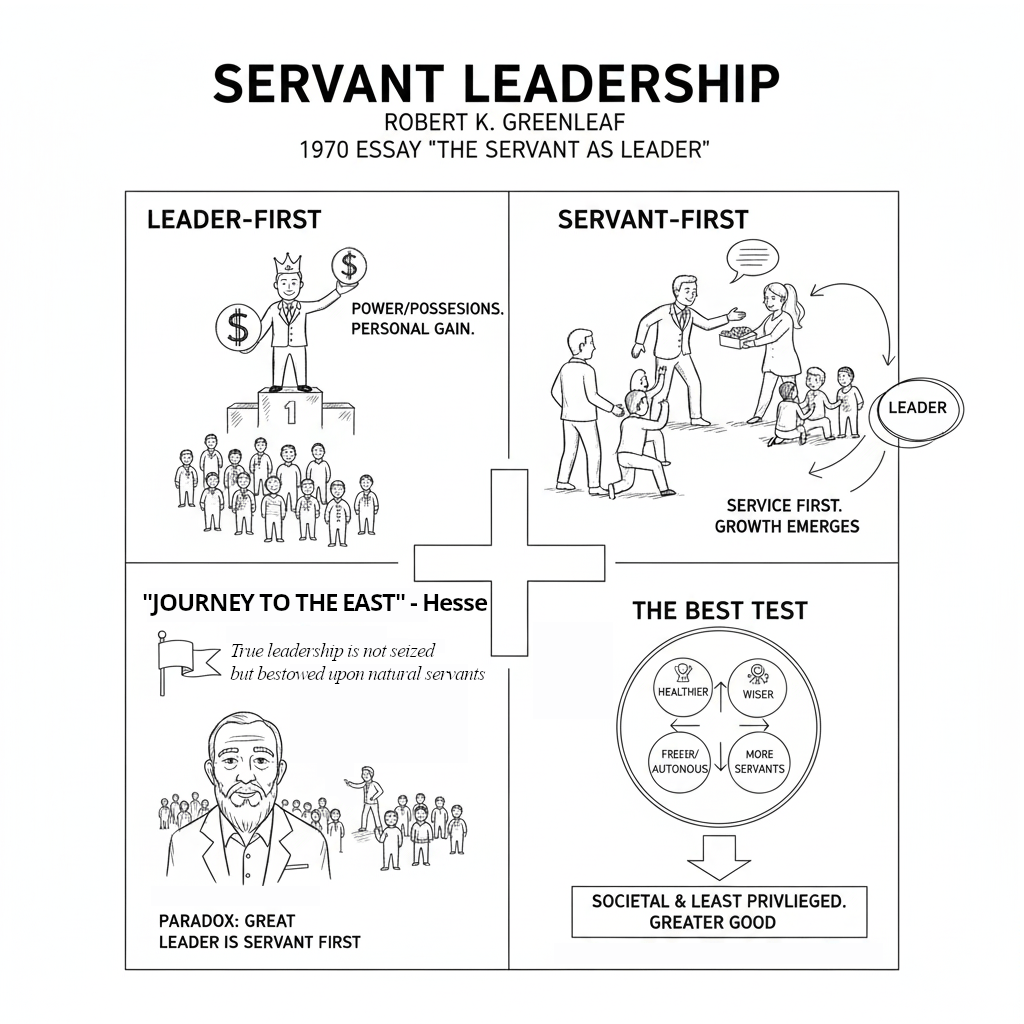
Servant Leadership, introduced by Robert K. Greenleaf, is a paradigm shift in understanding power, authority, and leadership’s purpose. It is a comprehensive philosophy, not just a management technique, grounded in an ethical framework prioritizing individual and community growth and well-being [1]. Fully appreciating its depth requires deconstructing its foundational principles to analyze its core philosophical and moral structure.
Servant First, Leader Second
Servant Leadership’s philosophical cornerstone is Robert K. Greenleaf’s thesis: the true leader is servant first. His 1970 essay, “The Servant as Leader,” posits the journey “begins with the natural feeling that one wants to serve, to serve first. Then conscious choice brings one to aspire to lead” [3]. This sequence is paramount, establishing a distinction between “servant-first” and “leader-first” archetypes [3]. The latter may be driven by a “need to assuage an unusual power drive or to acquire material possessions,” viewing leadership as personal gain [3]. The servant-first is motivated by a pre-existing disposition toward service; leadership is an emergent consequence of that service, not the goal [7].
The concept’s genesis was influenced by Greenleaf’s reading of Hermann Hesse’s 1932 novel, Journey to the East [9]. The story features a servant, Leo, who sustains a group with his spirit. When Leo disappears, the group fails. The narrator later discovers Leo was the Order’s head, a “great and noble leader” [6]. For Greenleaf, this crystallized his philosophy’s paradox: “the great leader is seen as servant first, and that simple fact is the key to his greatness” [11]. True leadership is not seized but bestowed upon natural servants [11].
From this foundation, Greenleaf derived the model’s core ethical directive, framed as the “best test” for a servant-leader [3]. This test shifts the metric of leadership success from conventional outputs toward the holistic development of individuals. The test asks: “Do those served grow as persons? Do they, while being served, become healthier, wiser, freer, more autonomous, more likely themselves to become servants?” [3]. This is a tangible benchmark, not a rhetorical flourish. It demands the leader’s primary focus be fostering their followers’ full potential, engaging them emotionally, relationally, and ethically [13].
Greenleaf extends this ethical calculus beyond the organization, asking, “And, what is the effect on the least privileged in society? Will they benefit or at least not be further deprived?” [3]. This question embeds social justice and corporate responsibility into the framework. The servant-leader’s purview extends to the broader community, reflecting a commitment to holding their institution in trust for the “greater good of society” [12].
Characteristics of Service
Greenleaf provided Servant Leadership’s philosophical soul, while Larry Spears, former Greenleaf Center CEO, codified its practice into ten key characteristics [9]. These are not a disconnected checklist but an interconnected, mutually reinforcing system of virtues. Practiced in concert, they create conditions for follower growth and community well-being. They form three integrated pillars: the relational foundation, the cognitive and influential core, and the orientation toward the future and the collective.
The relational foundation is built on Listening, Empathy, and Healing. Listening is the model’s bedrock. It demands a “deep commitment to listening intently to others” [5]. The servant-leader seeks to clarify the group’s will, listening to what is said and unsaid [12]. This extends inward to one’s “own inner voice,” a reflective practice essential for growth [12]. Empathy follows from deep listening: the effort to understand and accept people for their “special and unique spirits” [12]. This involves assuming good intentions and separating the person from their performance; one can reject an action without rejecting the individual [4]. Healing is a profound relational virtue. Greenleaf recognized many carry “broken spirits” [12]. The servant-leader cultivates an environment where healing relationships and seeking wholeness are possible, a force for transformation and integration [4].
The cognitive and influential core consists of Awareness, Persuasion, and Conceptualization. Awareness, especially self-awareness, strengthens the servant-leader by fostering understanding of ethics, power, and values [9]. Greenleaf noted awareness is not comforting but a “disturber and an awakener,” keeping the leader “sharply awake and reasonably disturbed” and preventing complacency [4]. Persuasion clearly distinguishes servant leadership from authoritarian models [16]. The servant-leader relies on convincing others through dialogue and consensus, not coercing compliance via positional authority [7]. This influence is born of trust, not fear. Conceptualization is the ability to “dream great dreams” and think beyond daily realities [4]. The servant-leader must balance immediate operational needs with articulating a compelling, long-term vision that inspires the team and aligns efforts with broader objectives [1].
The model’s orientation toward the future and collective is captured by Foresight, Stewardship, Commitment to the Growth of People, and Building Community. Foresight is rooted in the intuitive mind, enabling the leader to “understand lessons from the past, the realities of the present, and the likely consequence of a decision for the future” [4]. It synthesizes experience, awareness, and conceptualization. Stewardship frames the leader’s role as a trustee, holding the organization in trust for the greater good of all stakeholders [1]. This mindset promotes ethical decision-making and long-term, sustainable success over short-term personal gain [15]. The Commitment to the Growth of People expresses the philosophy’s ethical core. It stems from the belief “that people have an intrinsic value beyond their tangible contributions as workers” [9]. This commitment manifests in providing mentorship, development opportunities, and a supportive environment [1]. Lastly, Building Community is the leader’s response to alienation in large institutions [9]. The servant-leader fosters belonging, shared values, and connection, creating cohesive teams [3].
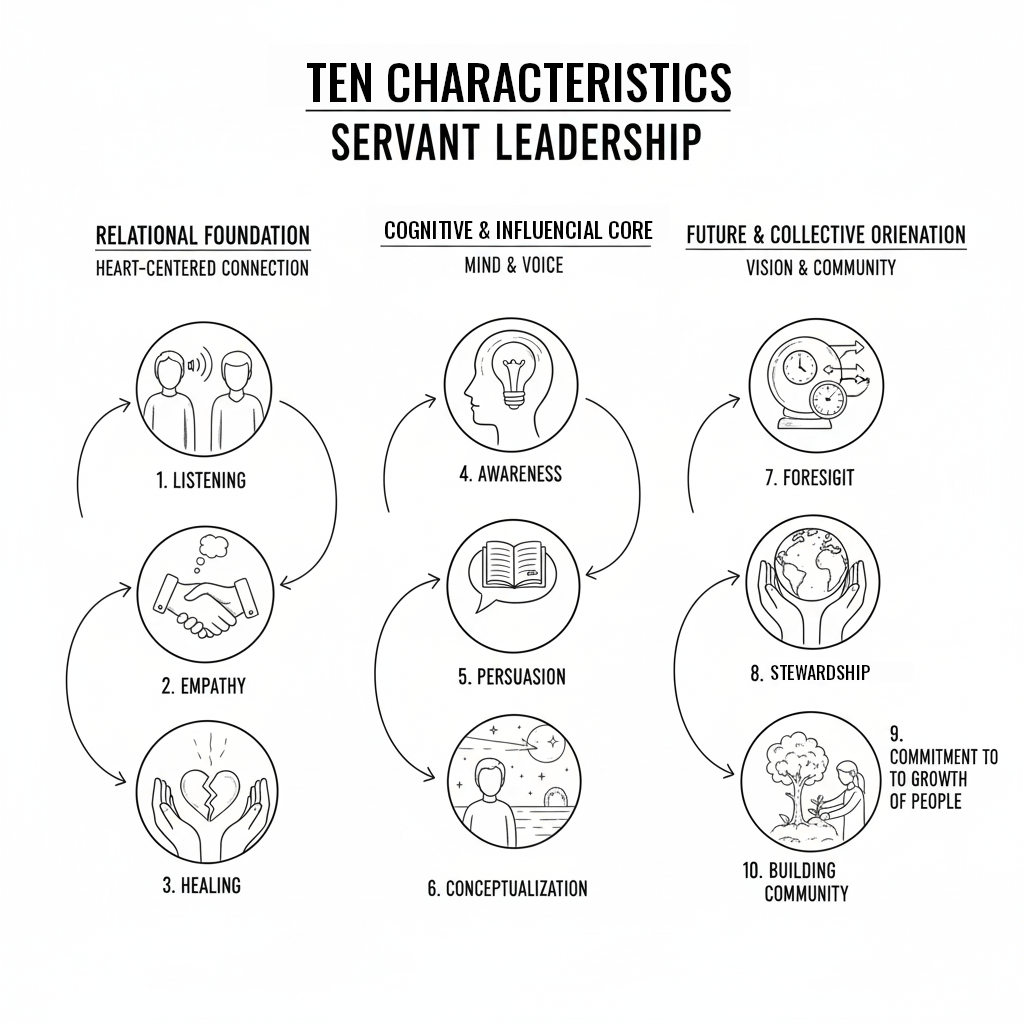
The systemic nature of these characteristics is critical. They are not discrete skills but form a reinforcing virtuous cycle. For instance, active listening [7] is the prerequisite for genuine empathy [12]. Without hearing another’s perspective, empathy is impossible. This cultivated empathy is the foundation for healing relationships [14]. This relational process (listening, empathizing, healing) builds the trust necessary for persuasion to be an effective mode of influence, supplanting coercion [7]. A failure in a foundational characteristic like listening threatens the entire ethical structure. The practice of Servant Leadership is not adopting fashionable behaviors but cultivating a holistic, integrated, and virtuous character.
The Moral Imperative of Follower Growth
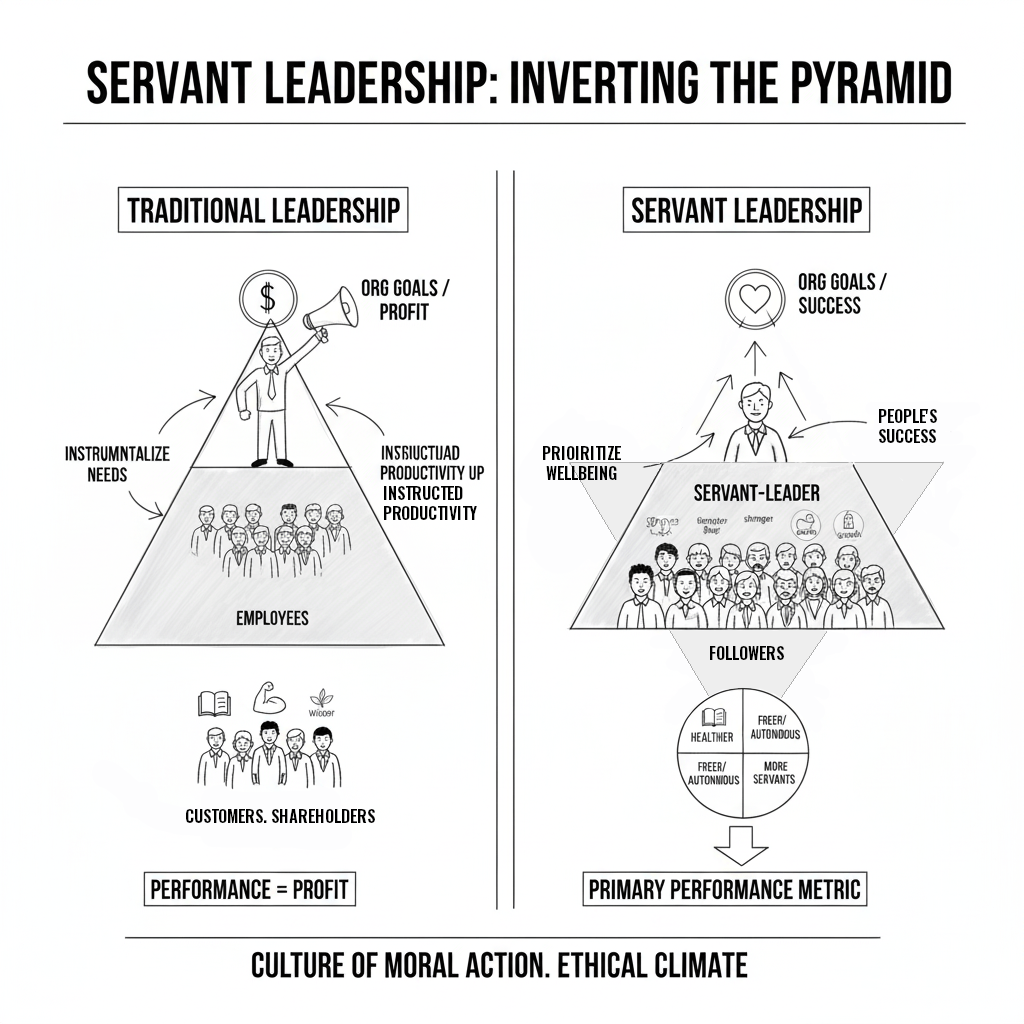
Synthesizing Greenleaf’s credo and Spears’s ten characteristics reveals Servant Leadership’s ultimate ethical foundation: a primary focus on the follower’s flourishing. It is a “holistic approach” engaging followers emotionally, relationally, and ethically, aiming to empower them to “grow into what they are capable of becoming” [13]. This focus is the end, not a means to an end.
In traditional leadership, follower needs are often instrumentalized to serve organizational goals. Employees are developed only as it increases productivity. Servant Leadership inverts this logic. The theory posits that when a leader prioritizes follower needs and well-being, followers are better able to achieve their own goals. This individual success “flows upward,” culminating in the organization’s objectives [13]. Organizational success is a byproduct of a primary commitment to people [7].
This moral core provides a powerful internal safeguard against ethical lapses and corporate misconduct [20]. Many strategies to address misconduct focus on external constraints like regulation and punishment [20]. Servant Leadership offers a foundational solution. It focuses on the decision-maker’s moral character and the institution’s ethical climate [20]. By cultivating virtues like empathy, stewardship, and commitment to growth, the philosophy builds a culture facilitating moral action from the inside out. Individuals become better equipped to withstand unethical pressures [20].
This reorientation radically re-defines “performance.” Greenleaf’s “best test” (measuring follower growth, wisdom, and autonomy) is not an ancillary metric; it is the primary performance indicator [3]. This creates profound tension with conventional capitalist structures prioritizing shareholder value. A truly servant-led organization cannot adopt the philosophy superficially. It must fundamentally restructure incentive systems, performance evaluations, and its definition of success to align with this human-centric metric [22]. Servant Leadership is not just a management style but a counter-cultural philosophy challenging basic assumptions of modern organizational life.
Echoes of the Tao
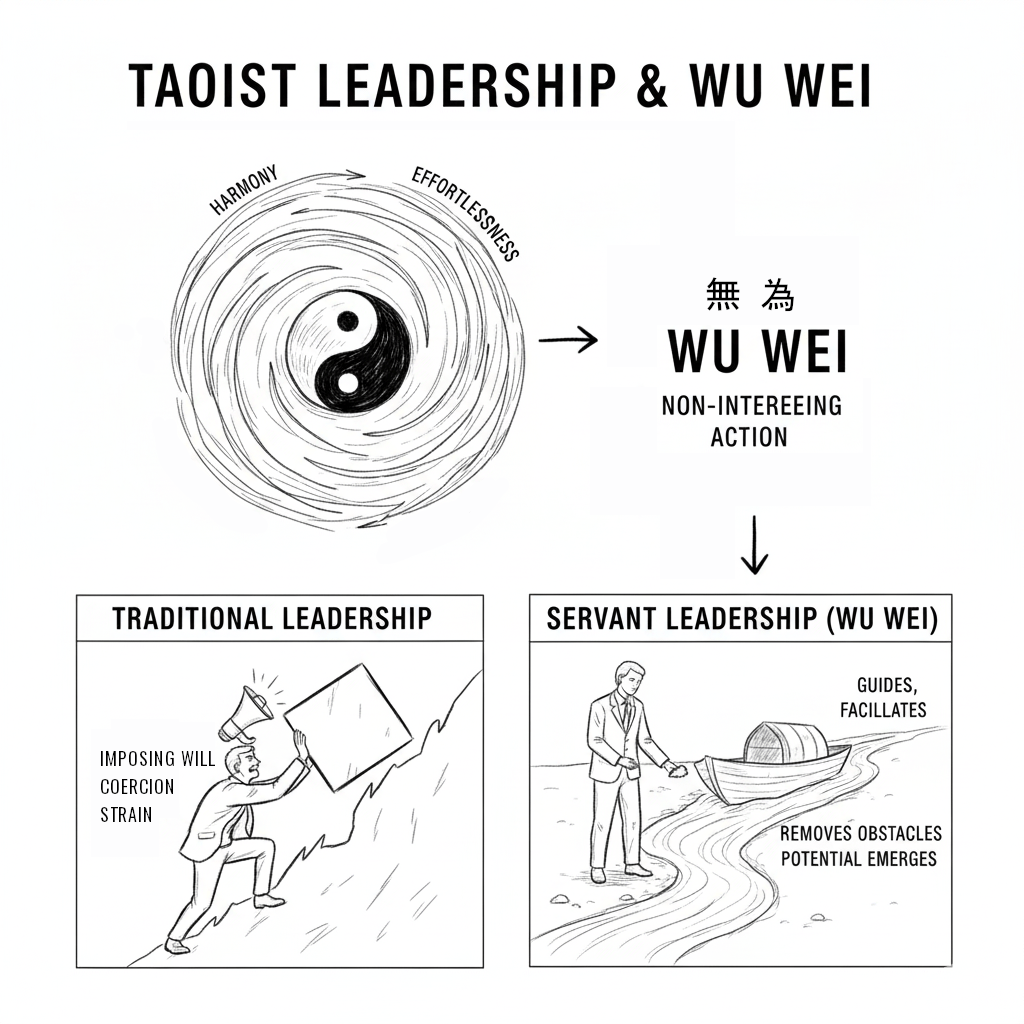
Robert Greenleaf coined the term “servant leadership” in the 20th century, but its core tenets are not modern. They resonate with ancient wisdom, notably the Taoist philosophy of Lao Tzu (6th or 5th century BCE) [4]. The Tao Te Ching reveals that leading through service has profound roots in the Eastern understanding of power, influence, and harmony.
The Uncarved Block
Understanding the Taoist approach to leadership requires grasping its foundational principles. Taoism advocates living in harmony with the Tao, the ineffable, natural flow of the universe [25]. The ideal state is alignment with this current. Central to this alignment is Wu Wei. Often mistranslated as “inaction,” Wu Wei is effortless, spontaneous, or non-interfering action [26]. It is not passivity but a state of peak effectiveness, acting in perfect concert with natural events without strain. A leader practicing Wu Wei does not impose their will but guides, facilitates, and removes obstacles, allowing inherent potential to emerge. This provides the philosophical context for the servant-leader’s preference for persuasion over coercion and facilitation over command [7].
The Highest Ruler
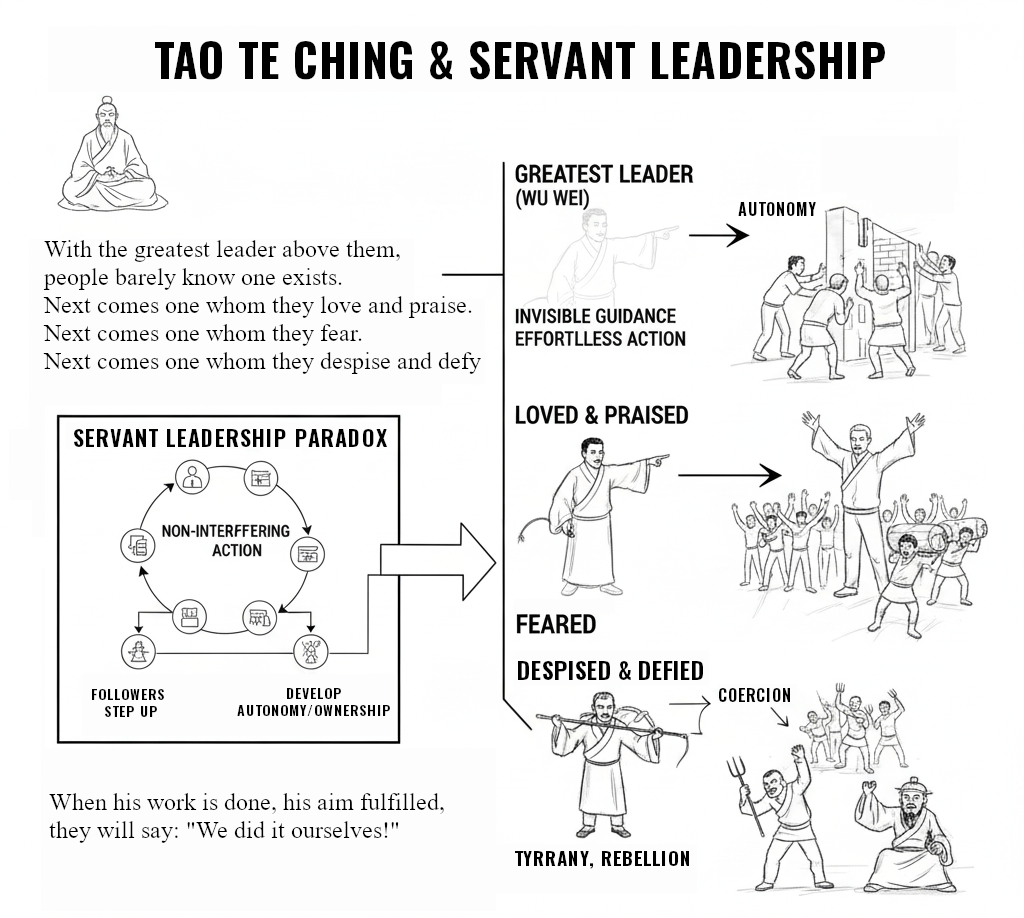
Verse 17 of the Tao Te Ching offers a direct and powerful parallel to Servant Leadership. It presents a clear hierarchy of leadership effectiveness: “With the greatest leader above them, people barely know one exists. Next comes one whom they love and praise. Next comes one whom they fear. Next comes one whom they despise and defy” [27].
The highest, most effective ruler’s presence is so subtle and guidance so seamless they are almost invisible [4]. This leader embodies Wu Wei. The verse concludes with the testament to this leader’s success: “When his work is done, his aim fulfilled, they will say: ‘We did it ourselves!'” [4].
This outcome perfectly reflects the goal in Greenleaf’s “best test.” The people become “freer, more autonomous” [3]. The leader’s ego is absent; all credit is deflected to the team [1]. This is the pinnacle of follower empowerment. The Taoist sage, like the servant-leader, understands success lies not in personal glory but in cultivating others’ capacity and confidence. The leader’s role is to create conditions for success and step back, allowing the group to realize its power [26].
The Taoist concept of Wu Wei is not just a parallel; it is the operational dynamic for this outcome. A traditional leader acts on their team through directives. A leader practicing Wu Wei acts by removing obstacles, asking questions, and facilitating the team’s emergent capacity [1]. This supportive, non-interfering action creates a vacuum of overt control. Followers must step into this space. In doing so, they develop autonomy, creativity, and ownership. This leads directly to the declaration in Verse 17: “We did it ourselves.” The Taoist leader’s “invisibility” is not absence but a sophisticated, strategic choice that causes the empowerment central to Servant Leadership.
The Sea that Lies Low
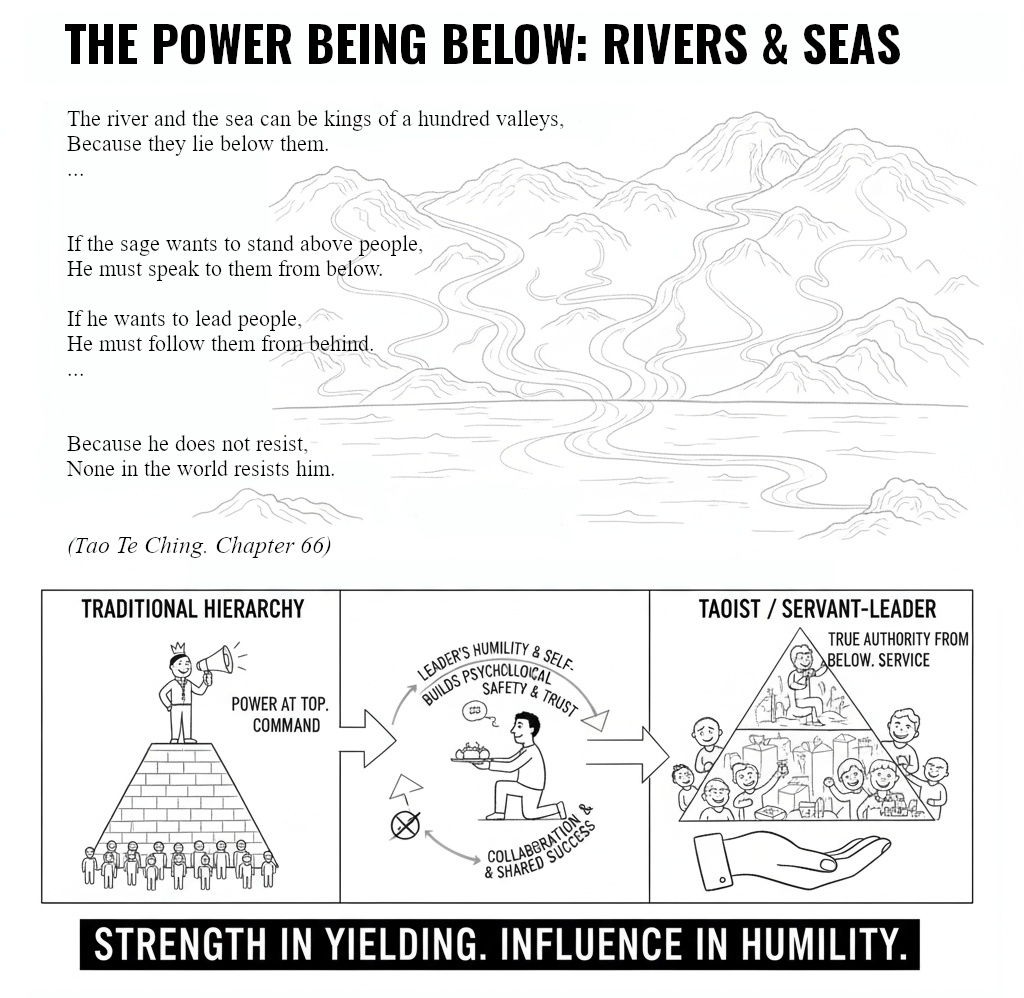
Another powerful metaphor appears in Verse 66 of the Tao Te Ching. Lao Tzu explains why great rivers and seas are “kings of the hundred valleys”: “because they are good at being below them” [32]. By seeking the lowest position, they effortlessly command the allegiance of all streams. He draws a direct lesson for the sage-ruler: “Therefore in the sage’s desire to be above people He must in speech be below them And in his desire to be at the front of people He must in person be behind them” [33].
This teaching to “walk behind them” [25] profoundly articulates the servant-leader’s posture. By placing oneself “below” followers (in service, humility, listening) the leader gains true, lasting influence. This is a radical re-imagining of power dynamics. In most hierarchies, power resides at the top. In Taoist and servant-leader models, true authority is generated from below. Strength is found in yielding, influence in humility [25]. The leader who serves the group’s needs, like the sea, becomes the natural center of gravity.
This humility is not modesty or passivity; it is a sophisticated, intentional leadership strategy. The human ego craves recognition [28]. Lao Tzu and Greenleaf propose a model requiring active suppression of this desire. The leader must choose to be “self-effacing and scanty of words” [4] and deliberately deflect praise to the team [1]. This self-effacement is strategically vital. It builds psychological safety and trust, as followers see their leader isn’t competing with them for status. This trust is the servant-leader’s essential currency. It enables persuasion where a traditional leader would command. The ultimate effect is a culture of collaboration and shared success, not internal competition.
Section 3: The Kantian Imperative: Dignity, Autonomy, and the Ethics of Service
Beyond the intuitive wisdom of the East, the rigorous, rationalist ethics of the European Enlightenment offer another powerful foundation for Servant Leadership. Immanuel Kant’s moral philosophy, especially his Categorical Imperative, provides a robust deontological framework. It affirms the core ethical commitments of service while introducing a crucial critical tension.
The Categorical Imperative
Immanuel Kant’s ethical system, outlined in the Groundwork of the Metaphysics of Morals, is deontological. It bases morality on duty and rules, not on consequences (utilitarianism) or character (virtue ethics) [35]. For Kant, an action’s moral worth is determined by its motivation. An action has moral worth only if performed from a sense of duty, respecting the moral law itself [36].
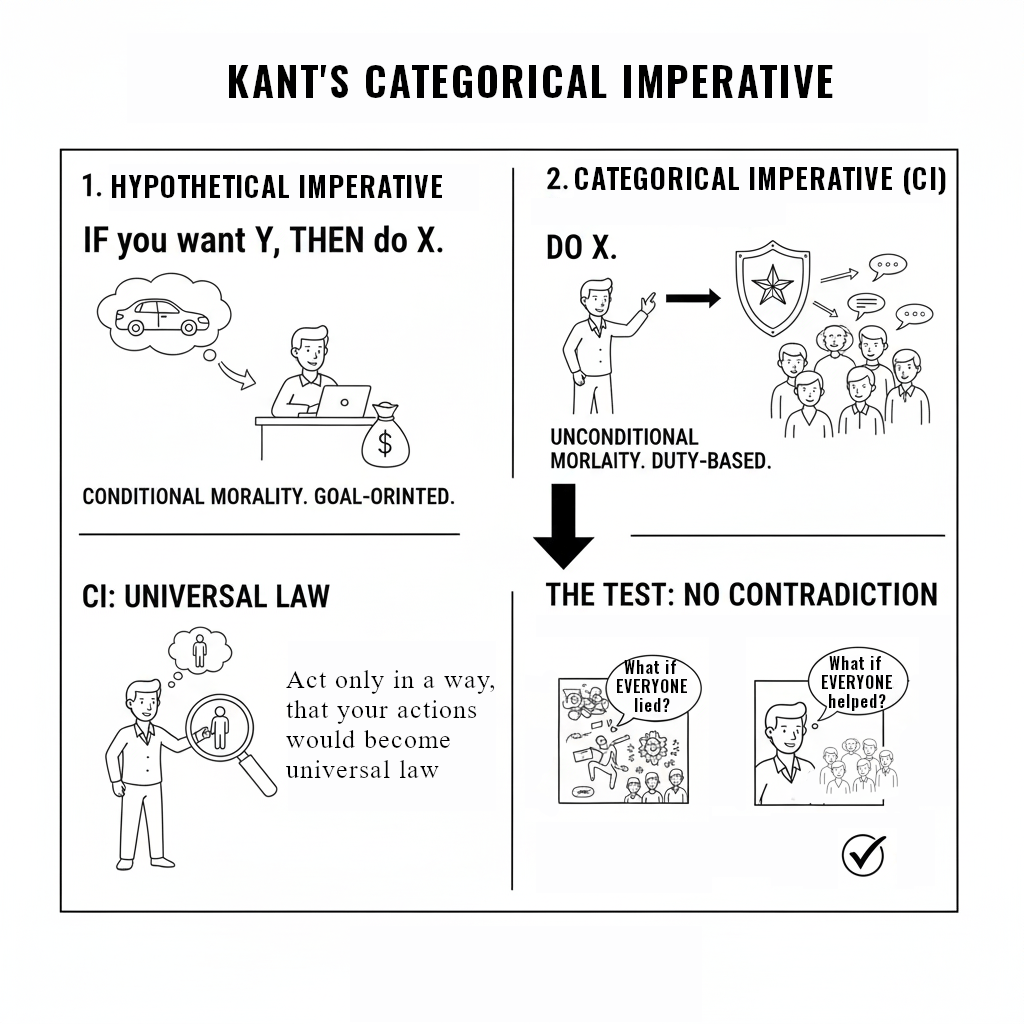
Kant distinguishes two types of “imperatives.” Hypothetical imperatives take the form “If you want Y, then you must do X” [37]. They are conditional. The Categorical Imperative (CI) is unconditional: “Do X,” simply because X is your moral duty [37]. Kant argued the CI is the supreme principle of morality, rationally necessary for all rational agents [38]. His first formulation, the Formula of Universal Law, states: “Act only according to that maxim by which you can at the same time will that it should become a universal law” [35]. This tests intentions: could the principle of our action be applied universally without contradiction?
Humanity as an End in Itself
Kant’s second formulation of the Categorical Imperative, the Formula of Humanity, provides profound ethical substance and connects directly to Servant Leadership. It commands: “Act in such a way that you treat humanity, whether in your own person or in the person of any other, never merely as a means, but always at the same time as an end” [35].
This principle establishes the absolute, intrinsic, and unconditional worth of every rational being. Treating a person as an “end” means recognizing their inherent dignity and autonomy as a self-governing agent. Treating them “merely as a means” is to instrumentalize them: using them as a tool to achieve one’s own goals, without respect for their goals and rationality [35]. Deceiving someone with a false promise, for example, uses their trust as a mere means, ignoring their rational capacity to consent.
Servant Leadership can be seen as a practical, organizational application of this Kantian principle. The philosophy is predicated on rejecting follower instrumentalization. By prioritizing employee growth, well-being, freedom, and autonomy, the servant-leader refuses to treat them as “cogs in a machine” or resources to be exploited [3]. The “best test” (asking if followers become “healthier, wiser, freer, more autonomous”) is a practical guide to treating people as ends in themselves [3]. This alignment provides Servant Leadership with a rigorous ethical justification grounded in Kantian philosophy [42].

A Noble Tension: The Servant’s Duty to Self
Despite this strong alignment, Kantian scrutiny reveals a significant philosophical tension, critiqued by philosopher Norman E. Bowie [42]. The tension resides in the word “servant.”
Bowie’s critique centers on Kant’s Formula of Humanity applying equally to oneself. We have a moral duty not to treat our own humanity merely as a means. Kant discusses duties to oneself, like not committing suicide, as violations of this principle [37]. Bowie’s objection is that “servant” seems to imply a willingness to use oneself as a means to others’ ends. He argues the “servant leader exploits himself for the development of his followers, which is against Kant’s viewpoint” [42]. From a strict Kantian perspective, a philosophy advocating self-instrumentalization or self-sacrifice is morally impermissible. This creates a noble tension: how can one “serve” others without violating the duty to respect oneself as an end?
This tension can be resolved by appealing to Kant’s Formula of the Kingdom of Ends. This formulation asks us to “act according to the maxims of a universally legislative member for a merely possible kingdom of ends” [35]. It invites us to imagine ourselves as citizen and sovereign in an ideal moral community where every member is an end. Bowie’s critique assumes “service” means servile subordination. A servant-leader can re-frame service not as self-exploitation, but as fulfilling a self-imposed, universalizable duty legislated for themselves. The leader could rationally will a universal law: “All who assume a position of leadership shall act primarily to foster the autonomy, growth, and well-being of those they lead.” By acting on this self-legislated maxim, the leader is not used as a mere means; they express their highest autonomy and fulfill a self-defined duty. Service becomes rational self-actualization through duty, not servile self-abnegation. This reframing dissolves the paradox, aligning service with preserving one’s dignity.
Altruism, Duty, and the “Natural Feeling to Serve”
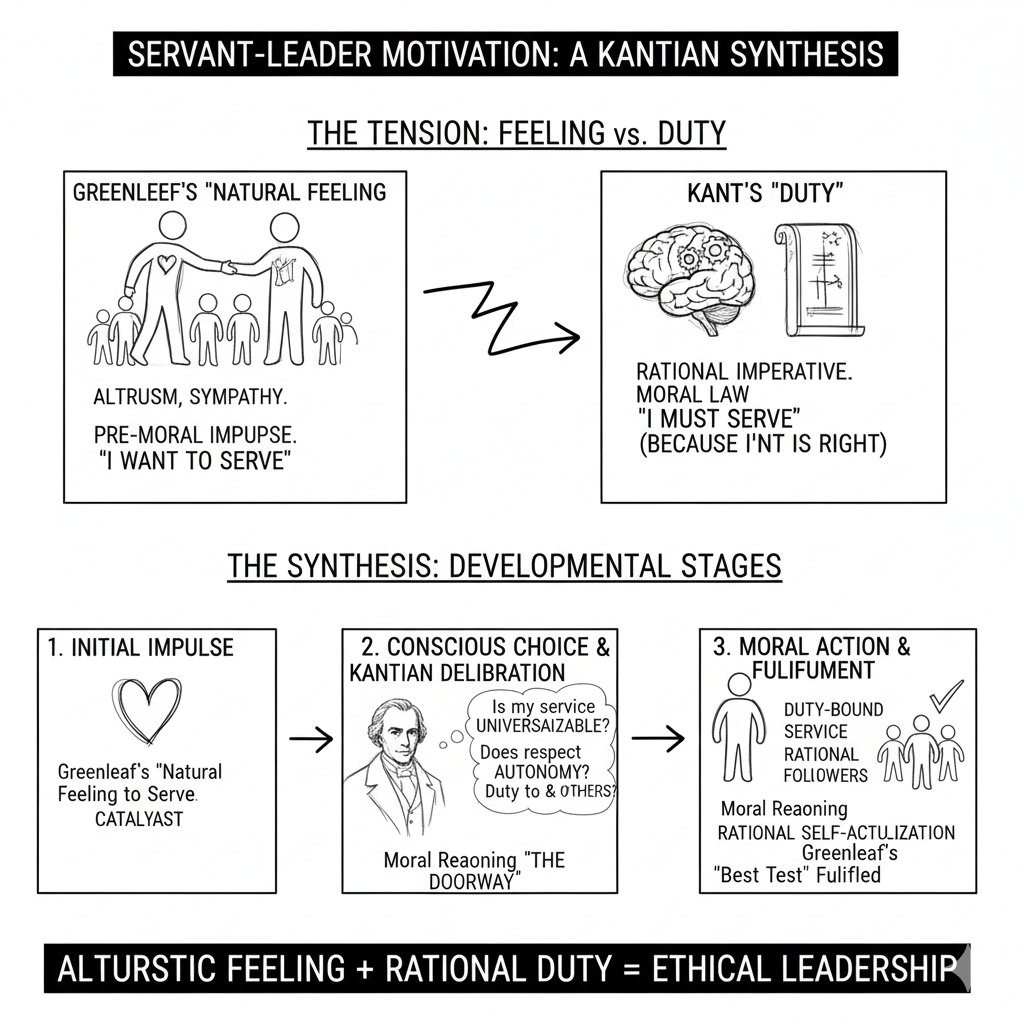
A second, subtle tension arises regarding the servant-leader’s motivation. A core feature is altruism: a selfless concern for others’ well-being [8]. Greenleaf’s model begins with a “natural feeling that one wants to serve” [3]. From a Kantian perspective, an action’s moral worth derives purely from its motivation by duty, not from feelings or inclinations, no matter how noble [36]. An act motivated by sympathy or a “natural feeling” may be praiseworthy, but for Kant, it lacks true moral worth unless performed because it is what the moral law requires [45].
This creates a potential conflict. Is Greenleaf’s “natural feeling” a sufficient moral foundation for a Kantian leader? Must the servant-leader’s actions be motivated purely by a rational recognition of their duty to respect followers’ humanity and autonomy?
This tension can be resolved through a nuanced synthesis, not strict opposition. Greenleaf’s “natural feeling to serve” and Kant’s “duty” can be sequential stages in a leader’s moral development. Greenleaf’s “natural feeling” is the initial psychological impulse, the raw material of morality. In a Kantian sense, this feeling is pre-moral. The moral dimension enters with Greenleaf’s “conscious choice to lead” [3]. At this moment, moral reasoning begins. A developed servant-leader subjects their natural, altruistic feelings to the Categorical Imperative. They would ask, “Is my desire to serve in this way consistent with a universal law that respects their dignity and autonomy and does not violate my duty to myself?” The “natural feeling” acts as a catalyst prompting Kantian moral deliberation. The altruistic feeling gets the leader to morality’s door; the rational principle of duty ensures they walk through it correctly. This synthesis harmonizes Greenleaf’s human-centered impulse with Kant’s rational rigor.
A Synthesis of Service
Servant Leadership’s philosophical and ethical foundations are not monolithic. The model resonates with both the ancient, intuitive wisdom of Taoism and the rigorous, rational deontology of Kantian ethics. A full appreciation requires synthesizing these traditions, revealing a model that is spiritually profound, ethically robust, and enduringly relevant.
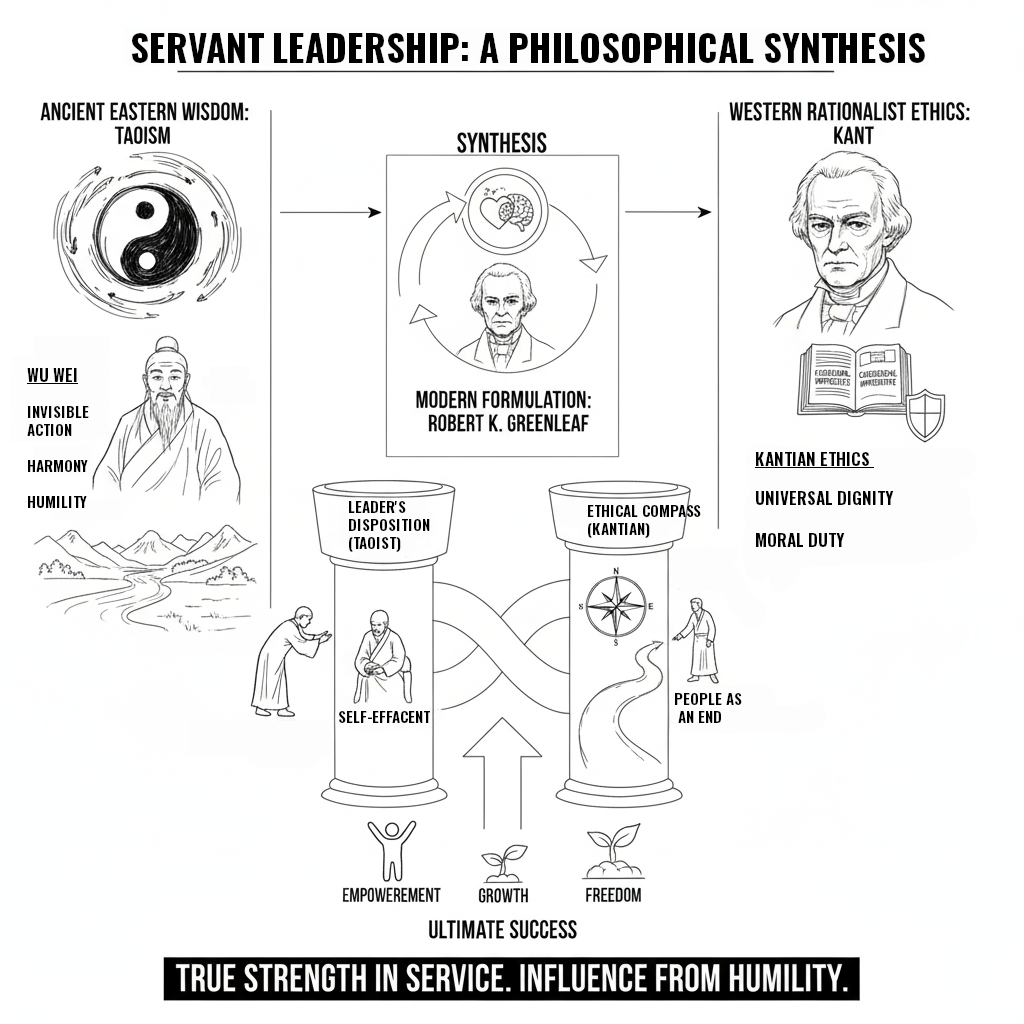
Taoism and Kantianism are not competing foundations for Servant Leadership; they are complementary frameworks operating at interconnected levels. Lao Tzu’s teachings provide the dispositional framework: the internal orientation, spiritual posture, and fundamental ethos. Taoism answers how a leader should be: humble, self-effacing, patient, and in harmony with the natural flow [25]. It describes the sage’s path. Kantian ethics provides the normative framework: the universal, rational test for the morality of actions. Kantianism answers what a leader must do to be ethical: treat all persons, including oneself, as ends, and act only on principles that could be willed as universal laws [35]. It erects the gate of moral duty.
These two frameworks are mutually reinforcing. A leader with a Taoist disposition of humility is psychologically primed to act in ways that pass the Kantian test. The sage’s desire to “walk behind the people” and let them say “we did it ourselves” naturally leads to actions respecting others’ autonomy. Taoist humility makes it easier to pass the Kantian gate. A commitment to the Kantian principle of dignity provides a rational check on the Taoist-inspired leader’s intuitive actions, ensuring “effortless action” isn’t neglect and service isn’t self-abnegating.
The Nature of Altruism in Servant Leadership
Revisiting altruism through this synthesized lens provides a complete definition. The servant-leader’s journey begins with an altruistic impulse, Greenleaf’s “natural feeling to serve” [3]. This is the raw, emotional, other-regarding concern, the seed of the philosophy. A mature servant-leader does not act on this feeling alone. They elevate this impulse through reason, subjecting it to moral principle.
The altruism of a fully-realized servant-leader is not simply feeling good by helping others, a view closer to consequentialist or virtue ethics traditions [46]. It is a principled, duty-bound commitment to others’ flourishing, grounded in a rational, universal respect for their inherent dignity. This can be termed Kantian altruism, where the other-regarding impulse is validated, guided, and given moral worth by its alignment with universal moral law. The leader serves not just because it feels right, but because they rationally determined it is their duty to foster the humanity and autonomy of those they lead.
| Core Tenet | Servant Leadership (Greenleaf) | Taoist Leadership (Lao Tzu) | Kantian Ethics (as applied to Leadership) |
| Leader’s Primary Motivation | A natural desire to serve; focus on others’ growth. | Harmony with the Tao; effortless action ( Wu Wei ). | Acting from duty in accordance with universal moral law. |
| Role of the Leader | “Steward, facilitator, community builder.” | An almost invisible presence; a sage who guides subtly. | A moral agent who respects and enables the autonomy of others. |
| Treatment of Followers | “To be developed, empowered, and served.” | “To be trusted and allowed to take ownership (“”We did it ourselves””).” | “To be treated as ends in themselves, never merely as means.” |
| Source of Authority | “Trust, persuasion, and moral example.” | “Humility, self-effacement, and wisdom.” | Freely granted allegiance based on the leader’s rational and moral stature. |
| Ethical Foundation | Altruistic care; growth and well-being of the community. | Non-interference; allowing natural order to unfold. | The Categorical Imperative; respect for the dignity of rational beings. |
| Potential Pitfall / Tension | May be misconstrued as weakness or lack of direction. | Can be misinterpreted as passivity or inaction. | “The “”servant”” role risks violating the duty to treat oneself as an end.” |
Case Study: A Servant Leader for a Nation
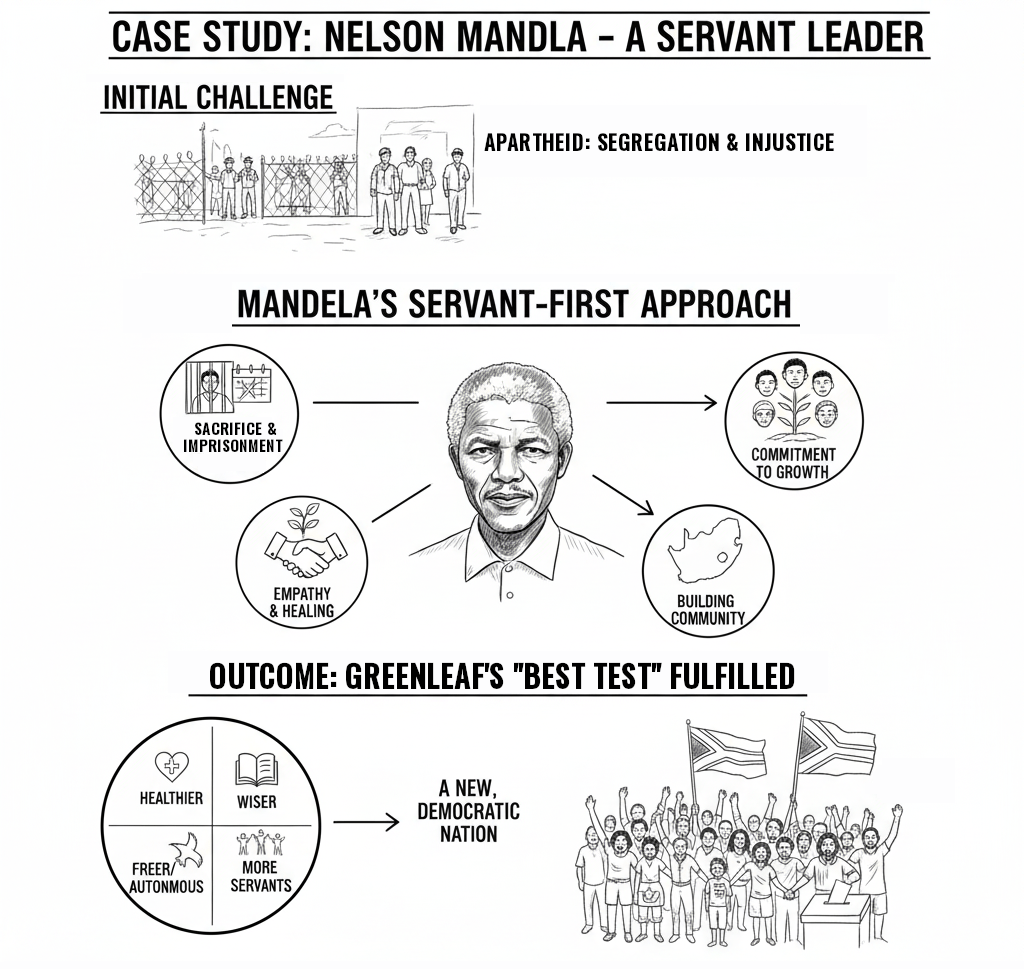
Nelson Mandela’s leadership provides a powerful illustration of servant leadership applied on a national scale, confronting the deep-seated injustice of systemic racial segregation under apartheid in South Africa. His “servant-first” approach was demonstrated through immense personal sacrifice, including 27 years of imprisonment driven by his commitment to serve his people. Upon his release, Mandela exemplified the core tenets of empathy and healing, extending a radical spirit of reconciliation towards his former oppressors to prevent further societal fracture. He championed a commitment to the growth of all South Africans, believing in their shared potential to forge a new nation. His leadership was defined by building community, unifying a deeply divided populace, and a profound foresight that held fast to a long-term vision for a democratic, non-racial South Africa. Mandela’s leadership finds its validation in Greenleaf’s “best test”: he left a nation freer through the dismantling of apartheid, healthier as it moved toward equity, wiser by confronting its history, and more autonomous by empowering all citizens with democratic rights. Mandela’s legacy is a testament to how true leadership, grounded in unwavering service and human dignity, can transform an entire society.
The Enduring Relevance of Leading Through Service
Servant Leadership is more than a simple management technique or a “soft” approach. It is a profound philosophical orientation with a rich, diverse intellectual heritage spanning cultures and millennia. Robert Greenleaf’s modern formulation serves as a nexus, drawing on deep currents of ancient Eastern wisdom and Western rationalist ethics.
The model’s enduring power and relevance lie in this unique synthesis. Servant Leadership combines the humility, strategic patience, and ecological wisdom of Taoism with the rigorous, universal respect for human dignity demanded by Kantian ethics. The Taoist element provides the leader’s disposition, a way of being grounded in harmony and self-effacement. The Kantian element provides the ethical compass, a rational method of acting ensuring service never violates any individual’s absolute worth, including the leader’s.
This fusion creates a leadership model that is deeply humane and ethically unassailable. In a world dominated by coercive, ego-driven leadership paradigms, Servant Leadership offers a compelling antidote. It proposes true strength is found in service, true influence is born of humility, and a leader’s ultimate success is the growth, freedom, and empowerment of followers.
Interactive
References
- Servant Leadership: A Transformative Management Philosophy – ITD World, accessed October 11, 2025, https://itdworld.com/blog/leadership/servant-leadership/
- Servant Leadership – Leadership Tribe US, accessed October 11, 2025, https://leadershiptribe.com/servant-leadership/
- What is Servant Leadership? – Robert K. Greenleaf, accessed October 11, 2025, https://greenleaf.org/what-is-servant-leadership/
- The Time is Right for Servant Leadership – Bhavana Learning Group, accessed October 11, 2025, https://www.bhavanalearning.com/time-right-servant-leadership/
- The Understanding and Practice of Servant- Leadership – Regent University, accessed October 11, 2025, https://www.regent.edu/wp-content/uploads/2020/12/spears_practice.pdf
- Origins of Servant Leadership – ClearlyAgile, accessed October 11, 2025, https://www.clearlyagile.com/agile-ai-blog/origins-of-servant-leadership
- Servant leadership: the leadership theory of robert K. greenleaf – Boyden, accessed October 11, 2025, https://www.boyden.com/media/just-what-the-doctor-ordered-15763495/Leadership%20%20Theory_Greenleaf%20Servant%20Leadership.pdf
- Servant Leadership: – A Theoretical Model – Regent University, accessed October 11, 2025, https://www.regent.edu/wp-content/uploads/2020/12/patterson_servant_leadership.pdf
- Servant Leadership Theory – PON – Program on Negotiation at Harvard Law School, accessed October 11, 2025, https://www.pon.harvard.edu/daily/leadership-skills-daily/servant-leadership-theory/
- The Transcendent Culture of Servant Leadership – Lausanne Movement, accessed October 11, 2025, https://lausanne.org/global-analysis/transcendent-culture-servant-leadership
- Servant Leadership : a Journey into the Nature of Legitimate Power and Greatness, accessed October 11, 2025, https://www.urbanleaders.org/620Leadership/92Readings/articles/Greenleaf-Servant%20Leadership.pdf
- Character and Servant Leadership: Ten Characteristics of Effective, Caring Leaders, accessed October 11, 2025, https://www.regent.edu/journal/journal-of-virtues-leadership/character-and-servant-leadership-ten-characteristics-of-effective-caring-leaders/
- Servant Leadership and Employee Engagement: A Qualitative Study – PMC, accessed October 11, 2025, https://pmc.ncbi.nlm.nih.gov/articles/PMC8520456/
- Ten Principles of Servant Leadership – Stark State College, accessed October 11, 2025, https://www.starkstate.edu/public/system/uploads/files/Student-Life/Servant-LeadershipPowerPoint.pdf
- The Servant Leadership of Robert K. Greenleaf: 10 Essential Qualities for Empowering Others and Building Strong Teams | by The Career Strategist | Medium, accessed October 11, 2025, https://medium.com/@careerstrategist/the-servant-leadership-of-robert-k-a4f29b73372a
- Ten Principles of Servant Leadership | Butler University, accessed October 11, 2025, https://www.butler.edu/student-life/volunteer/resources/servant-leadership-principles/
- Business Basics: What Is Servant Leadership? – Excelsior University, accessed October 11, 2025, https://www.excelsior.edu/article/business-basics-servant-leadership/
- 7 Values of Servant Leadership | PLNU, accessed October 11, 2025, https://www.pointloma.edu/resources/business-leadership/7-values-servant-leadership
- Servant Leadership: a Systematic Literature Review and Network Analysis – PMC, accessed October 11, 2025, https://pmc.ncbi.nlm.nih.gov/articles/PMC8476984/
- The Ethical Safeguards within Servant Leadership – CSU ePress, accessed October 11, 2025, https://csuepress.columbusstate.edu/cgi/viewcontent.cgi?article=1133&context=sltp
- “Servant Leadership: What Makes It an Effective Leadership Model.” by Janice Poland Tanno – ScholarWorks | Walden University Research, accessed October 11, 2025, https://scholarworks.waldenu.edu/dissertations/3922/
- The Case for Servant Leadership – PRSA, accessed October 11, 2025, https://www.prsa.org/article/the-case-for-servant-leadership
- Servant Leadership: How Has it Shaped the Last 20 Years and Where is it Going? Dr. Joycelynn Green | Regent, accessed October 11, 2025, https://www.regent.edu/wp-content/uploads/2023/01/Regent-Research-Roundtables-2023-Servant-Leadership-Green.pdf
- What Is Servant Leadership? | GCU Blog, accessed October 11, 2025, https://www.gcu.edu/blog/business-management/what-servant-leadership
- To lead people, walk behind them. – Laidlaw Scholars Network, accessed October 11, 2025, https://laidlawscholars.network/posts/to-lead-people-walk-behind-them
- Leadership Quote – Lao Tzu on Servant Leadership – Project Success, accessed October 11, 2025, https://www.leancxscore.com/leadership-quote-lao-tzu-help-people-say-we-did-it-ourselves/
- Learning from Tao Te Ching Verse 17 — Leading With Trust, Harmony, and Peace, accessed October 11, 2025, https://triciarosestone.medium.com/in-tao-te-ching-verse-17-lao-tzu-inspires-us-to-view-leadership-through-a-wise-insightful-lens-7a1f6408677a
- Servant Leadership — Is It Really Leadership? – Thompson Pipe Group, accessed October 11, 2025, https://thompsonpipegroup.com/servant-leadership-is-it-really-leadership/
- Quote by Lao-Tzu: “When the Master governs, the people are hardly …” – Goodreads, accessed October 11, 2025, https://www.goodreads.com/quotes/121672-when-the-master-governs-the-people-are-hardly-aware-that
- A Servant Leader: The Paradox Of Lao Tzu – 859 Words – Bartleby.com, accessed October 11, 2025, https://www.bartleby.com/essay/A-Servant-Leader-The-Paradox-Of-Lao-FJY595CJG
- Servant leadership habits and principles to embrace — ELAvate …, accessed October 11, 2025, https://www.elavateglobal.com/ezines/7-servant-leadership-principles-and-habits-to-embrace-at-work
- Tao Te Ching Verse 66: Leading from Behind – Buzzsprout, accessed October 11, 2025, https://www.buzzsprout.com/732839/episodes/6924677-tao-te-ching-verse-66-leading-from-behind
- “To lead the people, walk behind them.” –Lao Tzu – quotes – Reddit, accessed October 11, 2025, https://www.reddit.com/r/quotes/comments/1yfuzg/to_lead_the_people_walk_behind_them_lao_tzu/
- laidlawscholars.network, accessed October 11, 225, https://laidlawscholars.network/posts/to-lead-people-walk-behind-them#:~:text=Lao%20Tzu%3A%20%22To%20lead%20people%2C%20walk%20behind%20them.%22,-The%20Journey%20of&text=Lao%20Tzu%2C%20the%20ancient%20Chinese,he%20is%20considered%20the%20founder).
- The Categorical Imperative: Kant’s Moral Philosophy Explained | by …, accessed October 11, 2025, https://medium.com/@usamanisar/the-categorical-imperative-kants-moral-philosophy-explained-f8e2f224f0be
- The Virtue of Altruism – Tilburg University, accessed October 11, 2025, http://arno.uvt.nl/show.cgi?fid=160318
- Categorical imperative – Wikipedia, accessed October 11, 2025, https://en.wikipedia.org/wiki/Categorical_imperative
- Kant’s moral philosophy, accessed October 11, 2025, https://plato.stanford.edu/entries/kant-moral/
- Treating Persons as Means – Stanford Encyclopedia of Philosophy, accessed October 11, 2025, https://plato.stanford.edu/entries/persons-means/
- Categorical imperative | Research Starters – EBSCO, accessed October 11, 2025, https://www.ebsco.com/research-starters/history/categorical-imperative
- A Simplified Account of Kant’s Ethics, accessed October 11, 2025, https://usna.edu/CoreEthics/Essays/ONeil_Formula_of_Ends.pdf
- A Kantian theory of leadership | Request PDF – ResearchGate, accessed October 11, 2025, https://www.researchgate.net/publication/235274328_A_Kantian_theory_of_leadership
- A Kantian theory of leadership – Experts@Minnesota, accessed October 11, 2025, https://experts.umn.edu/en/publications/a-kantian-theory-of-leadership
- Altruism – Stanford Encyclopedia of Philosophy, accessed October 11, 2025, https://plato.stanford.edu/entries/altruism/
- Which philosophy forces others to act altruistically?, accessed October 11, 2025, https://philosophy.stackexchange.com/questions/44/which-philosophy-forces-others-to-act-altruistically
- Altruism – The Flossopher, accessed October 11, 2025, https://theflossopher.com/altruism