
Disclaimer: A core part of this work is educate and promote transparency in use of AI. Gemini has been used throughout the creative process of generating this article.
The modern corporation faces a fundamental debate over its purpose. This pits the long-dominant theory of shareholder primacy, which focuses only on profit, against the influential paradigm of stakeholder capitalism, which advocates for a broader commitment to all groups a business affects. Amartya Sen’s capability approach offers a third framework for evaluating corporate value beyond financial metrics.
The Friedman Doctrine
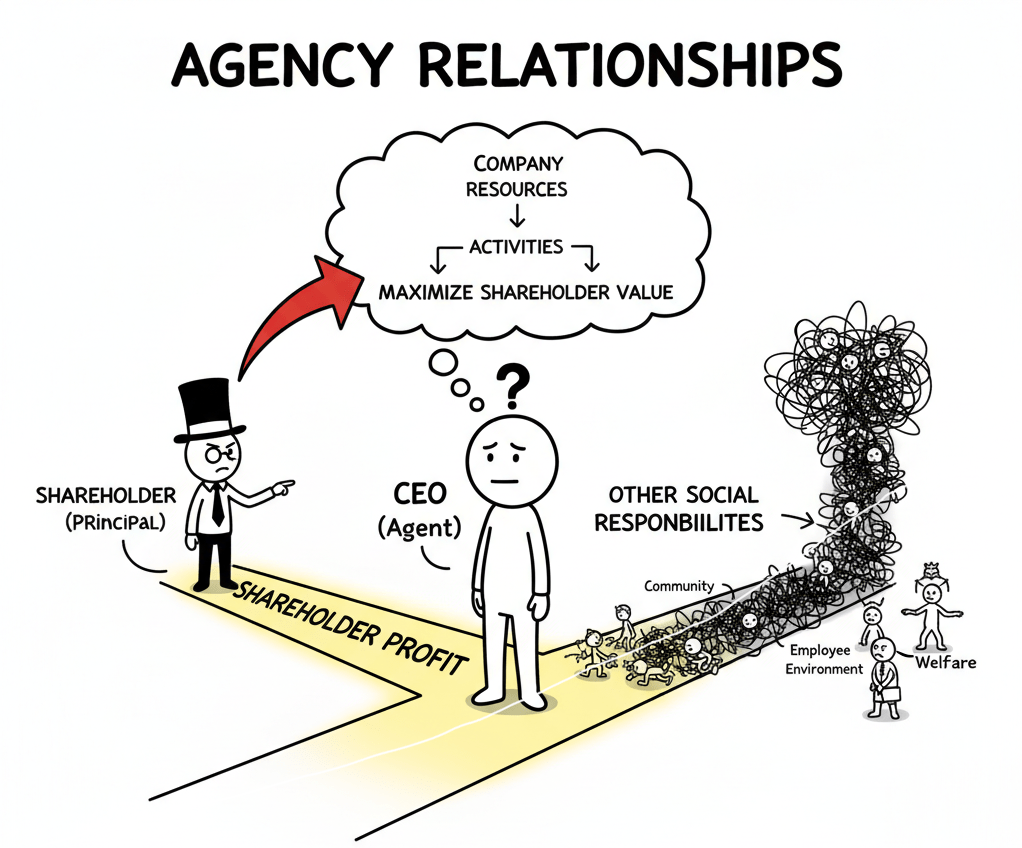
For much of the late 20th century, shareholder primacy, famously articulated by economist Milton Friedman, was the dominant framework for corporate governance.¹ In a 1970 essay, Friedman argued that the “‘one and only one social responsibility of business’ is to ‘use its resources and engage in activities designed to increase its profits so long as it stays within the rules of the game'”.² This view is rooted in property rights, agency relationships, and the proper role of a corporation in a free society.
The doctrine’s foundation is agency theory. In this view, a corporate executive is an agent or employee of the corporation’s owners—its shareholders. The executive’s primary responsibility is to act on the desires of their employers, which is generally to maximize financial return. When a manager directs corporate funds toward social objectives, they are spending someone else’s money without consent. This acts as an unauthorized tax on shareholders (through lower returns), customers (through higher prices), or employees (through lower wages). Friedman contended that individuals can support social causes with their own money; it is not the role of an unelected corporate executive to make that decision for them.
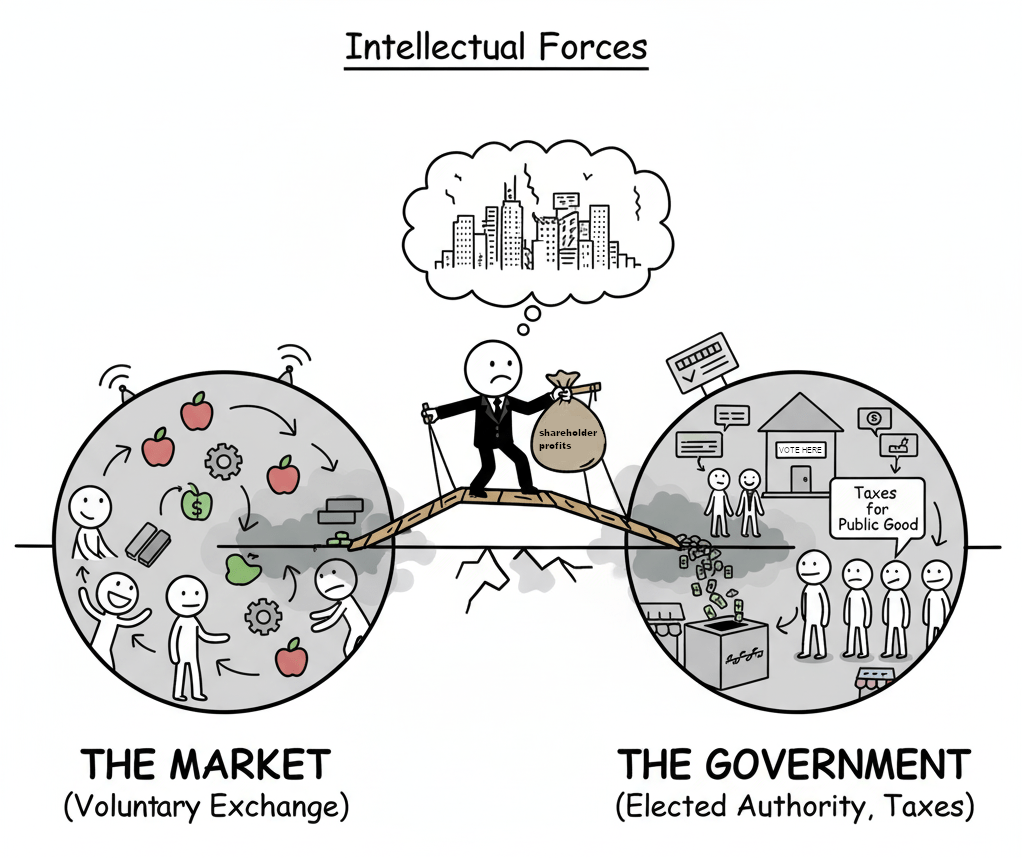
This perspective draws a clear boundary between the market and government. For Friedman, social problems are the responsibility of individuals and their democratically elected governments. When corporate leaders take on this role, they become “unwitting puppets of the intellectual forces that have been undermining the basis of a free society.”² They turn the voluntary mechanism of the market into a political one, blurring the roles of business and government in a way that threatens freedom.
The influence of the Friedman doctrine was profound. It shaped U.S. corporate governance laws and was supported by academic work on agency costs. This era saw the rise of executive compensation tied directly to stock performance and an increase in hostile takeovers, where firms were dismantled to unlock shareholder value, often with little regard for the impact on employees or communities. The legal precedent for this view is often traced to the 1919 case Dodge v. Ford Motor Co., in which the Michigan Supreme Court stated that a “business corporation is organized and carried on primarily for the profit of the stockholders,” though many legal scholars argue this statement lacks binding force.
A Broader View of Corporate Purpose
Stakeholder capitalism argues that a corporation’s purpose is to create long-term value by serving the interests of all its stakeholders, not just its shareholders.¹¹ This model views the company as part of a larger social and economic ecosystem, believing its long-term success depends on the health of that system.¹¹ Key stakeholders include customers, employees, suppliers, communities, and the environment, with shareholders as one important group among many.¹¹
This perspective has gained significant momentum, moving from academic theory to mainstream business practice.¹⁵ This perspective is not new, with intellectual roots dating back decades, but it has gained significant momentum in recent years, moving from academic theory to mainstream corporate discourse. A key moment was the August 2019 “Statement on the Purpose of a Corporation” by the Business Roundtable (BRT), an association of top American CEOs.¹⁷ The statement, signed by 181 CEOs, marked a formal shift from the group’s 1997 endorsement of shareholder primacy.¹²
It declared a “‘fundamental commitment to all of our stakeholders'” and listed these commitments in a specific order: serving customers, investing in employees, dealing fairly with suppliers, and supporting communities, before finally mentioning the goal of “generating long-term value for shareholders”.¹⁴ This sequence suggests that shareholder value is the outcome of successfully serving all other stakeholders, not the primary objective itself.¹⁸
This shift is driven by several factors. Proponents call it “smart capitalism,” a necessary evolution for the free market to maintain its social license to operate.¹⁴ Three main drivers are behind this change:
- There is a growing recognition of the direct link between stakeholder well-being and long-term value.¹⁵ Employees and consumers increasingly prefer companies whose values align with their own, making talent attraction and customer loyalty dependent on a firm’s social and environmental impact.¹⁵
- The world’s largest institutional investors are now pushing companies toward a long-term, stakeholder-focused perspective.¹⁹
- Global crises—such as financial instability, rising inequality, and climate change—have created a sense that the shareholder-only model pushes too many costs onto society, creating systemic risks that threaten the economy.¹⁹
From this viewpoint, stakeholder capitalism is not corporate charity but a pragmatic response needed to build resilient companies and a sustainable economy.²³ In direct opposition to the Friedman doctrine, stakeholder capitalism proposes that a corporation’s purpose is to create long-term value by serving the interests of all its stakeholders, not just its shareholders.11 This model views the corporation as part of a larger social and economic ecosystem, whose long-term success is inextricably linked to the health and well-being of that system.11 The key stakeholders are consistently identified as customers, employees, suppliers, the communities in which the corporation operates, and the environment, with shareholders being one crucial group among many.11
A Capability Approach
Nobel laureate Amartya Sen’s capability approach offers a new perspective on the corporate purpose debate by shifting the focus from interests and resources to outcomes and opportunities.²⁴ This framework assesses well-being and justice beyond traditional economic metrics like income.²⁷ Its central idea is that the freedom to achieve well-being, understood as people’s capabilities, is what truly matters.²⁶
The framework is built on two core concepts: functionings and capabilities.²⁶
- Functionings are the valuable “beings and doings” a person can achieve, from basic things like being healthy to more complex ones like having self-respect or participating in community life.²⁴ They are the parts that make up a person’s life.
- Capabilities are the set of functionings available to a person—their real freedom and opportunity to choose the life they value.²⁶
The distinction is critical. For example, a person who is fasting and a person who is starving share the same functioning (not eating), but their well-being is vastly different. The fasting person has the capability to eat but chooses not to, while the starving person has no choice.²⁹ The capability approach values this freedom of opportunity itself, not just the final outcome.²⁹
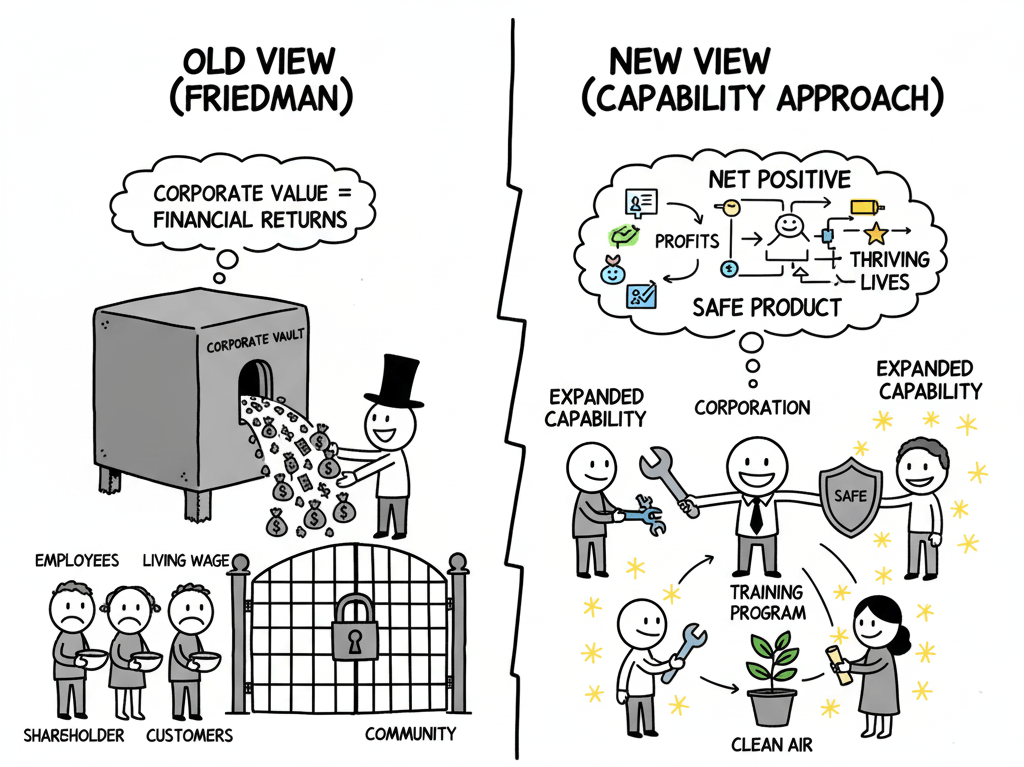
This human-centric framework redefines corporate purpose. Instead of measuring a corporation’s value by financial returns or its ability to balance stakeholder interests, the capability approach evaluates a company based on its impact on the capabilities of the people it affects.³⁰ Under this model, corporate “value creation” is redefined as “capability expansion.”²⁷
Corporate actions are judged by how they enhance or diminish the freedoms of stakeholders. For instance:
- Paying employees a living wage expands their capability for economic security and personal development.
- Ensuring product safety enhances customers’ capability to live healthy and informed lives.
- Minimizing pollution expands a community’s capability to enjoy a clean and thriving environment.
This approach moves beyond the shareholder-stakeholder debate. It reframes corporate social responsibility not as charity or a cost, but as a core part of the company’s impact on human flourishing.²⁵ By focusing on measurable human outcomes, it provides a richer, more ethical metric for corporate performance that aligns business success with expanding human freedom and well-being.²⁸
Capital Markets and Investment Allocation
The shift from shareholder to stakeholder capitalism is not just a philosophical debate; it is actively changing how the global financial system works. This change is driven by the rise of Environmental, Social, and Governance (ESG) criteria, which are creating new dynamics in how assets are priced, how markets operate, and how systemic risks are managed
The clearest sign of stakeholder capitalism’s impact is the massive shift of global investment toward sustainable and ESG-focused strategies. This has grown from a niche interest into a dominant force in asset management.
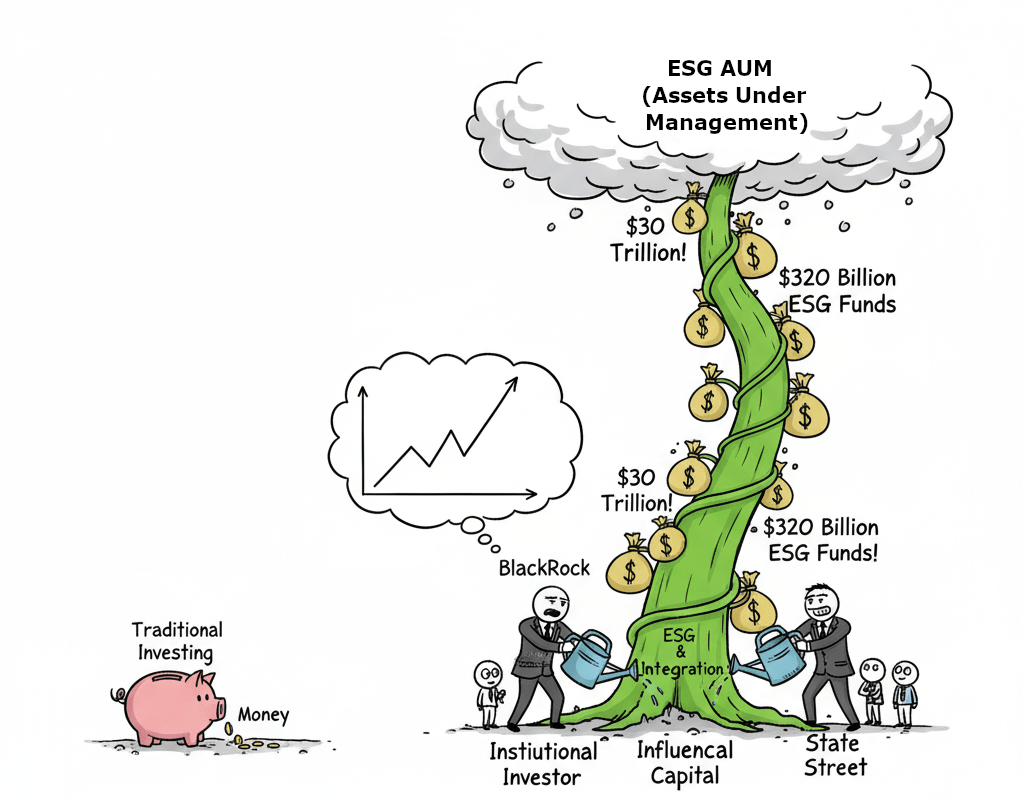
The growth in sustainable assets has been rapid. According to the Global Sustainable Investment Alliance (GSIA), the value of sustainable assets crossed $30 trillion in 2022, a significant portion of all professionally managed money.³⁵ This trend is driven by the world’s largest institutional investors, including BlackRock, Vanguard, and State Street, who are using their immense influence to push companies toward more sustainable behavior.¹⁹ By 2024, BlackRock alone managed approximately $320 billion in dedicated ESG funds, a 53% increase since early 2022, far outpacing the wider market.³⁸ This investor-led movement is not purely ideological; a survey by Gartner found that 85% of investors now consider ESG factors in their decisions, viewing them as essential to long-term performance.¹³
This capital is being deployed through several key strategies:
- ESG Integration: This is the most common strategy, where managers systematically include ESG factors alongside traditional financial analysis to get a more complete picture of a company’s risks and opportunities.³⁶
- Negative/Exclusionary Screening: This involves excluding companies or entire sectors from a portfolio based on their involvement in harmful activities, such as producing tobacco, controversial weapons, or fossil fuels.³⁶
- Thematic and Impact Investing: These are more targeted approaches. Thematic investing focuses on sectors like renewable energy or sustainable agriculture.³⁹ Impact investing goes a step further by seeking to generate a positive, measurable social and environmental impact alongside a financial return.³⁹
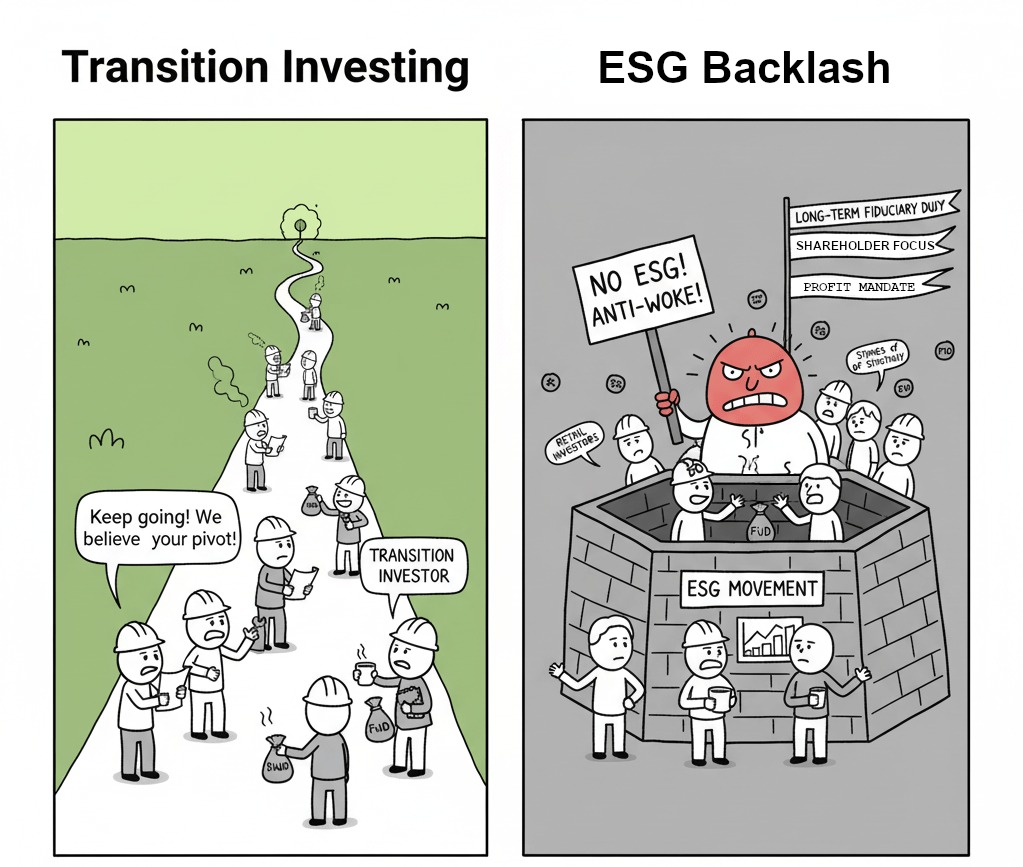
Recently, the landscape has become more complex. A strategy of “transition investing” is gaining ground, which involves investing in companies that are not yet ESG leaders but are actively working to decarbonize and improve their sustainability.⁴² This reflects a practical recognition that driving change in high-impact sectors is crucial. At the same time, the ESG movement has faced a political “backlash,” particularly in the United States.⁴³ However, this has not fundamentally derailed the institutional trend, as major asset owners continue to integrate sustainability into their long-term investment duties.⁴³
Impact on Market Efficiency and Cost of Capital
The massive shift of money toward ESG criteria is having a clear effect on how capital markets work. A key impact is the creation of a more transparent information environment. Research shows that companies with strong ESG performance get more attention from analysts, and the public information about them is more accurate.⁴⁵ This increased transparency reduces the knowledge gap between corporate insiders and outside investors, allowing money to be allocated more efficiently.⁴⁵
This improved information flow directly affects two key market factors: stock liquidity and the cost of capital.
- Stock Liquidity: Studies show a strong link between a company’s ESG performance and how easily its stock can be traded.⁴⁶ A more liquid stock is cheaper to trade, which attracts investors. This is because a wider range of investors are drawn to companies that signal good management and lower long-term risk through their ESG practices.
- Cost of Capital: A key way stakeholder capitalism influences companies is by changing how much it costs them to borrow money.⁴⁶ A McKinsey report found that a high ESG score can lower the cost of capital by about 10%.⁴⁸ This happens because investors see companies with strong ESG policies as less exposed to long-term risks, like regulatory fines, reputational damage, or climate change impacts. As a result, investors demand a lower risk premium, which makes financing cheaper for these companies.⁴⁹ This creates a powerful financial incentive for firms to improve their stakeholder practices.
This market behavior suggests a new, non-financial risk premium is emerging. Markets are starting to price in long-term, stakeholder-related risks that don’t always appear on a balance sheet. For example, poor environmental practices create a potential future cost for cleanup, while poor labor relations create the risk of strikes and high turnover. By rewarding companies that manage these risks, the market is directly rewarding a stakeholder focus.
However, this has its limits. Research from the National Bureau of Economic Research (NBER) suggests that simply selling off stocks in “dirty” industries (divestment) may only have a small effect unless a huge number of investors participate.⁵¹ This implies that active engagement with companies—using investor “voice” to push for change from within—may be a more powerful tool than simply divesting (“exit”).⁵¹
Financial Stability and Systemic Risk
The principles of stakeholder capitalism are also increasingly important to regulators responsible for the stability of the whole economy. The 2007-2009 global financial crisis was a harsh reminder that weak corporate governance can create systemic risks that harm the entire financial system.⁵² Regulators now see a stakeholder approach as a key part of a resilient financial system.
The Financial Stability Board (FSB), which monitors the global financial system, has identified corporate climate transition plans as a valuable tool for financial stability.⁵³ The FSB notes that these plans can give authorities a forward-looking view of how companies are managing climate risks, which helps reduce the chance of a chaotic economic transition.⁵³
The International Monetary Fund (IMF) has also published research showing that stakeholder governance is relevant to the macroeconomy. One IMF paper found that strengthening the rights of stakeholders like creditors and workers had significant impacts on economic performance.⁵⁴ Another IMF paper explicitly includes “stakeholder governance” as a key element of market discipline needed to prevent financial crises.⁵⁷
In the banking sector, stakeholder governance is seen as critical because the stability of banks is a public good.⁵⁸ A model focused only on short-term shareholder profit can encourage excessive risk-taking, with the costs passed on to society during a crisis. A stakeholder model, in contrast, encourages banks to consider their broader responsibilities to the economy and the financial system as a whole.⁵⁸
This alignment of views among investors, corporations, and regulators is creating a powerful, self-reinforcing feedback loop. Investors demand better ESG performance, so companies improve their practices and disclosure. This leads regulators to create mandatory disclosure rules to prevent “greenwashing.” These regulations then further embed ESG factors into investment decisions, speeding up the adoption of stakeholder principles across the entire economy.
Reconciling Profitability with Purpose
The central question surrounding stakeholder capitalism is its impact on corporate performance. Does a focus on societal purpose come at the expense of shareholder returns, or does it create a more resilient, profitable enterprise? This section reviews the empirical research, examines the non-financial drivers of value, and applies Amartya Sen’s capability framework to understand corporate value creation.
Shareholder Returns vs. Sustainable Growth
The financial impact of a stakeholder orientation has been the subject of thousands of studies. Large-scale meta-analyses distill this literature, with a landmark review from NYU Stern’s Center for Sustainable Business offering a comprehensive view of over 1,000 studies published between 2015 and 2020.47 The findings reveal a key distinction between corporate-level performance and portfolio-level investment returns. For studies on corporate financial performance (using metrics like ROE or ROA), the evidence is positive. The NYU Stern analysis found 58% of studies identified a positive correlation between ESG and financial performance, while only 8% found a negative one.49 This suggests that at the firm level, stakeholder-associated practices like strong environmental management and employee relations are linked to better financial results.50
However, for an investor’s portfolio (using risk-adjusted metrics like alpha), the results are more neutral. The same meta-analysis found that 59% of investment studies showed ESG-screened portfolios performed similarly to or better than conventional ones, while 14% found underperformance.61 This challenges the claim that ESG investing consistently generates excess returns (alpha). As markets efficiently price in ESG factors as indicators of quality and lower risk, their ability to generate outperformance diminishes.62 The value is captured by the company, but new investors earn returns comparable to the market, albeit with potentially less volatility.61
This apparent contradiction between firm and portfolio results reflects an increasingly efficient market. The key takeaway is that the primary financial benefit of stakeholder practices may be risk mitigation and resilience, not consistent alpha. The NYU Stern study found that ESG investing provides significant downside protection, especially during crises.47 This was demonstrated during the COVID-19 pandemic, where firms with strong ESG performance showed higher stock returns and market stability.63 The positive link between a stakeholder orientation and financial performance is most pronounced over longer time horizons.47 Actions that are short-term costs, such as investing in employee training or sustainable supply chains, build intangible assets that drive long-term value. A McKinsey study found that U.S. companies with a long-term orientation from 2001 to 2015 outperformed peers across earnings, revenue, investment, and job growth.64
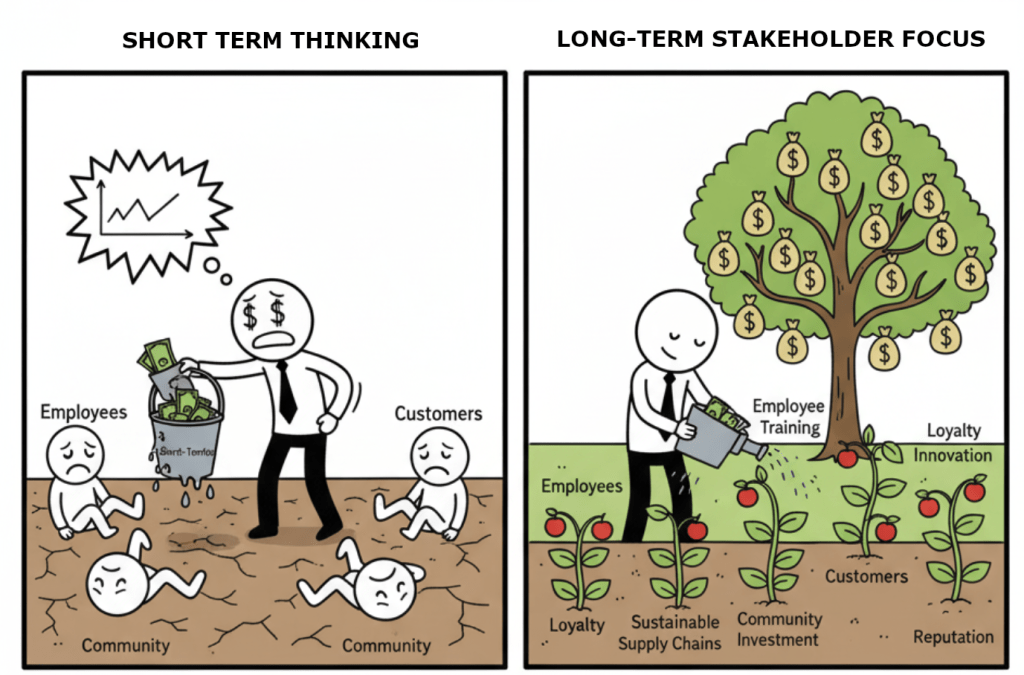
Despite this evidence, a contrarian view persists. Critics argue that diverting resources to non-profit-maximizing activities is a cost to shareholders that must reduce returns.66 They often point to the historical outperformance of the shareholder-focused U.S. S&P 500 index over the stakeholder-oriented European Stoxx 600 index, attributing the gap to a more disciplined focus on shareholder value in the U.S. market.67
The Engines of Long-Term Value: Non-Financial Performance
The financial outperformance of a stakeholder model results from superior non-financial performance that builds intangible assets and creates a competitive advantage.
- Innovation and R&D: A long-term perspective, essential for a stakeholder orientation, is a precondition for innovation. Companies with a long-term view invest more in R&D, especially during downturns.64 Strong ESG performance is positively correlated with both the quantity and quality of corporate innovation, driven by improved governance and reduced agency problems.72
- Human Capital: Employee Retention and Engagement: In a knowledge economy, human capital is a primary source of value. Stakeholder-oriented companies excel at attracting, engaging, and retaining talent.73 Research links better corporate governance to significantly lower employee turnover.75 High employee engagement correlates with earnings per share that are 147% higher than peers.76 Investing in fair wages, training, and a respectful work environment builds a skilled, motivated, and productive workforce.73
- Brand Reputation and Customer Loyalty: In a connected world, a commitment to stakeholder values builds brand trust and reputation.34 This is especially true for younger consumers, with 83% of millennials preferring brands that align with their values.13 This translates into customer loyalty and resilient revenue.49 However, inconsistencies between a company’s proclaimed values and its actions can lead to accusations of corporate hypocrisy, severely damaging stakeholder trust.80
The Capability-Enhanced Corporation
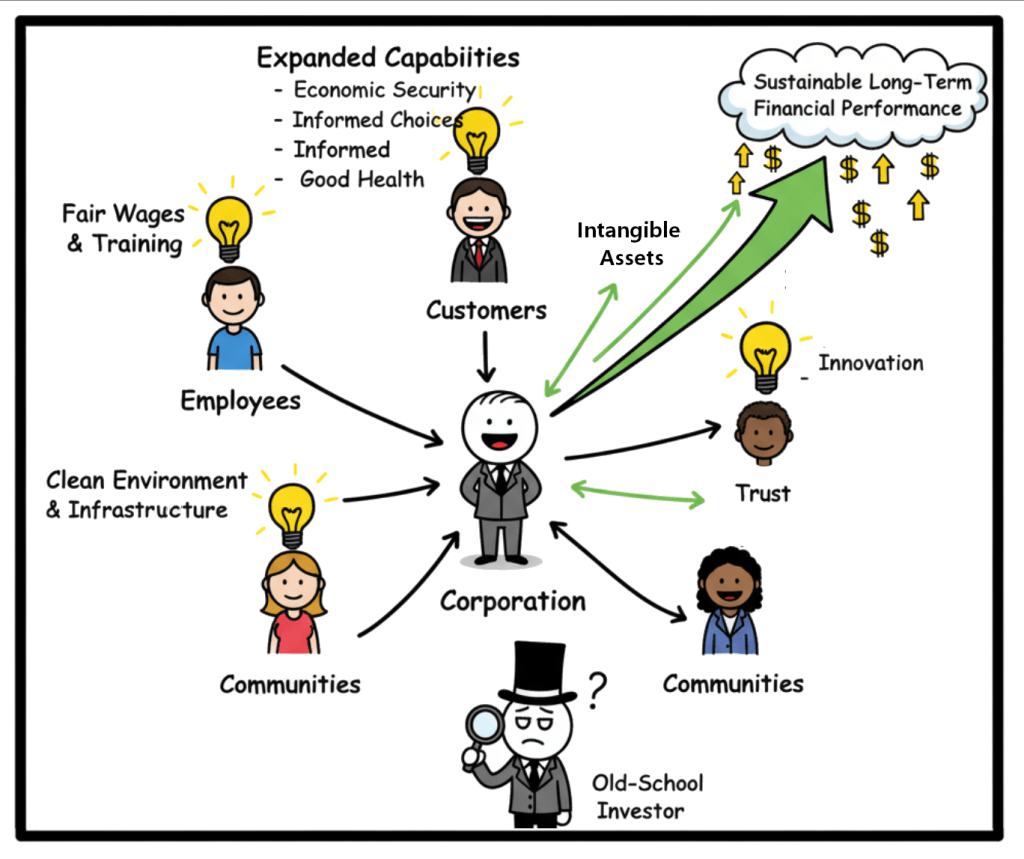
Amartya Sen’s capability approach helps explain how non-financial drivers create long-term value. It suggests that what is often termed “non-financial” performance is actually the creation of valuable intangible assets by expanding stakeholder capabilities. It reframes corporate investments in stakeholders not as costs, but as investments in capability expansion that yield returns.
- For Employees: Fair wages, workplace safety, and training are direct investments in employees’ capabilities for economic security, health, and growth.11 An empowered workforce is a more productive and innovative form of human capital.
- For Customers: Honest marketing, good service, and product safety are investments in customers’ capabilities.11 They enhance a customer’s ability to make informed choices and trust the firm, creating a loyal customer base and stable revenue.
- For Communities: Preventing environmental damage and investing locally are investments in a community’s capabilities for health, safety, and economic opportunity.11 This provides a stable social license to operate, reducing regulatory and reputational risks.
From this view, stakeholder value and long-term shareholder value are part of a virtuous cycle. By enhancing stakeholder capabilities, a corporation builds the human, social, and reputational capital that drives sustainable financial performance.82 Sen’s framework provides the theoretical bridge connecting the “purpose” of stakeholder capitalism to the “profit” sought by shareholders.
Agency Costs, Implementation Hurdles, and Diluted Accountability
The fundamental critique of stakeholder capitalism is accountability. The shareholder primacy model offers a singular, clear objective: maximize shareholder value. This provides a clear yardstick for executive performance.66 Critics argue that stakeholder capitalism destroys this clarity by introducing multiple, vague, and conflicting objectives.83 Without a single bottom line, judging a CEO’s success or failure becomes difficult.
This ambiguity worsens the principal-agent problem. Instead of being accountable to one principal (shareholders), a manager becomes an agent to all stakeholders and, effectively, to none.85 This diffusion of accountability allows managers to pursue their own interests under the guise of “serving stakeholders,” maximizing their own utility rather than value for any single group.83 The stakeholder model also lacks a clear framework for navigating trade-offs between competing interests.66 A decision to raise employee wages might require raising customer prices or reducing environmental investments.87 Without a clear principle for prioritization, such decisions can become arbitrary, reflecting management’s preferences rather than a coherent strategy, potentially harming the enterprise’s long-term health.73
The Tangible and Intangible Costs of Implementation
Shifting to a stakeholder model involves direct costs and competitive pressures.
- Direct Financial Costs: A robust stakeholder strategy requires tangible investments in sustainability initiatives, higher wages, ethical sourcing, and the administrative costs of new governance and reporting structures.73
- Competitive Disadvantage: A firm that internalizes these costs may be at a disadvantage against rivals that do not, especially in low-margin industries or against international competitors with lower labor or environmental standards.89
- Distortion of Capital Markets: Critics argue that widespread adoption of ESG principles artificially inflates the cost of being a public company through extensive compliance and reporting.88 This could disincentivize companies from going public, reducing investment opportunities and concentrating capital in less transparent private markets.88
This dynamic is creating a macroeconomic experiment, pitting the shareholder-centric U.S. market against the more stakeholder-oriented European market.1 Proponents of shareholder primacy cite the historical outperformance of U.S. equities as evidence of their model’s superior efficiency and value creation, a direct result of a disciplined focus on shareholder returns.67
“Woke-Washing” Rhetoric vs. Reality
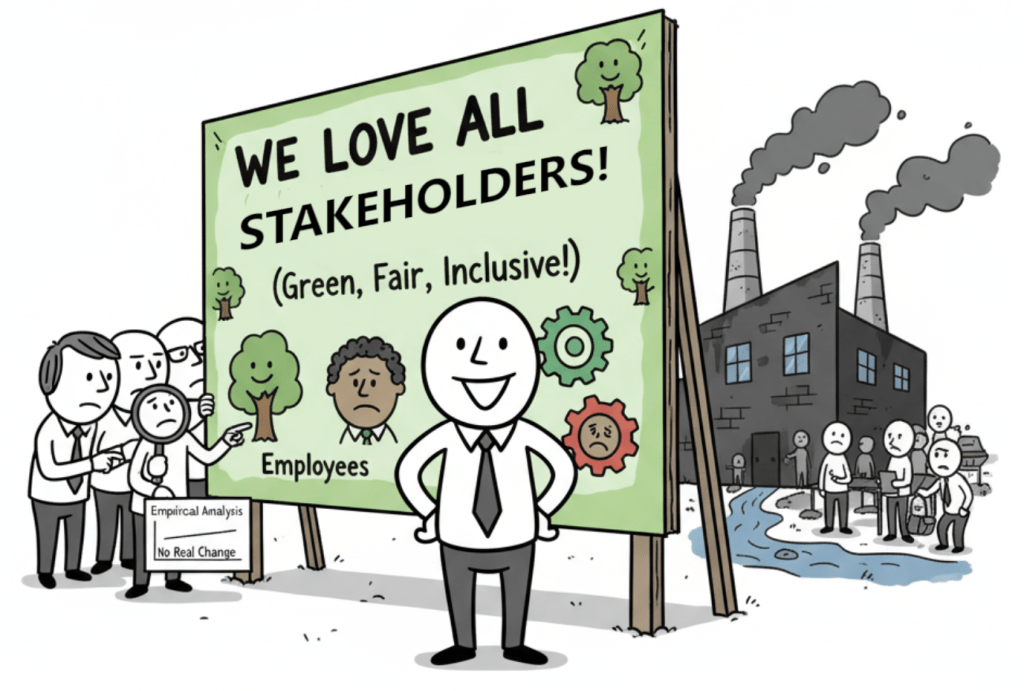
A key criticism is that corporate adoption of stakeholder capitalism is often a public relations exercise, termed “greenwashing” or “woke-washing.” This involves using stakeholder rhetoric as a marketing tool without making substantive changes to business practices.23 The Business Roundtable’s 2019 statement is a focal point for this critique. Critics noted that many signatory CEOs claimed it merely described how they already operated, suggesting no meaningful change was intended.2 Subsequent studies found little evidence of significant shifts in governance, executive pay, or resource allocation away from shareholders among the signatories.91 This gap between rhetoric and reality damages stakeholder trust. Research on corporate hypocrisy shows that when stakeholders perceive an inconsistency between a company’s stated values and its conduct, it can generate strong negative reactions like cynicism and boycotts.80 The reputational damage from perceived hypocrisy can be greater than if no pro-social claims had been made at all.
Synthesis and Strategic Recommendations
The tension between shareholder primacy and stakeholder capitalism defines modern corporate strategy. A simple verdict on which model is superior is inadequate; a synthesis integrating the insights of both paradigms is required.
Long-Term Value as Capability Expansion
An uncompromising adherence to either model has significant drawbacks. Pure shareholder primacy can foster a short-term focus that externalizes costs and creates systemic risks.4 Conversely, an ill-defined stakeholderism risks insulating managers from accountability, leading to inefficient capital allocation.66 The most effective path is a synthesis: maximizing long-term, risk-adjusted shareholder value is best achieved by strategically investing in the capabilities of key stakeholders. This view sees stakeholder interests not as a constraint on shareholder value, but as the primary means of creating it.15 A company cannot thrive long-term if its employees are disengaged, its customers are distrustful, and its community revokes its social license to operate. Amartya Sen’s capability approach provides the measurement framework for this model. It allows a corporation to define its purpose and measure performance by its concrete impact on human flourishing.31 These tangible outcomes—healthier employees, loyal customers, resilient communities—are not just social benefits; they represent the creation of the human, social, and reputational capital that forms the bedrock of sustainable financial success. In this view, enhancing stakeholder capabilities is the most durable strategy for maximizing long-term shareholder value.
Pathways to Authentic Stakeholder Capitalism
Translating this model from principle to practice requires action from all major economic actors. The following recommendations outline a pathway toward a more effective form of stakeholder capitalism.
For Corporate Boards and Executives:
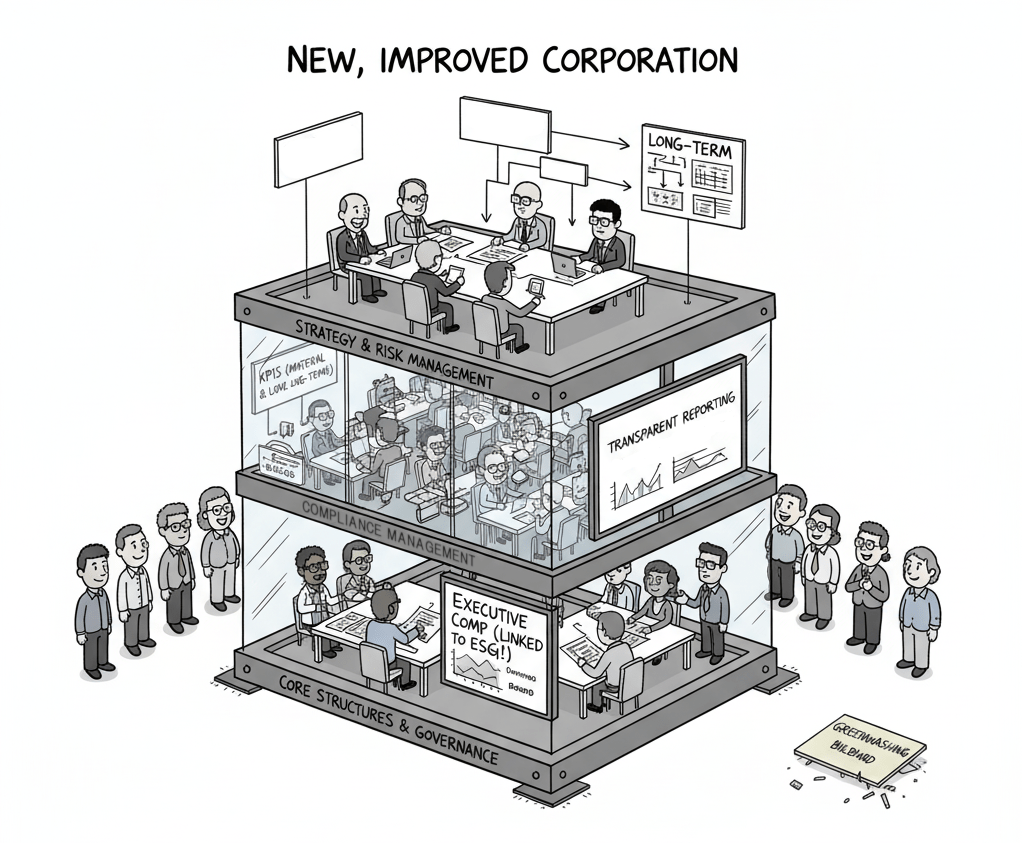
- Embed Stakeholder Governance into Core Structures: Formally update governance guidelines to reflect a commitment to long-term value for all stakeholders. This includes diversifying board composition and linking a significant portion of executive compensation to material, long-term ESG and capability-enhancement metrics.65
- Adopt Rigorous Measurement and Transparent Reporting: To combat “greenwashing,” companies must adopt standardized frameworks for measuring and reporting non-financial performance, focusing on material stakeholder issues and communicating progress against clear KPIs.19
- Integrate Stakeholder Analysis into Strategy and Risk Management: Stakeholder considerations must be integrated into core processes of strategy, capital allocation, and risk management, not siloed in a sustainability department.73
For Institutional Investors and Asset Managers:
- Promote Patient Capital through Long-Term Mandates: Asset owners should shift from quarterly performance reviews to long-term mandates that reward patient, engaged stewardship.94
- Exercise “Voice” to Drive Substantive Change: Large investors should use their influence to push for substantive governance changes, demanding evidence of how stakeholder engagement is integrated into long-term strategy and risk management.51
- Develop Sophisticated Valuation Models: The investment community must refine valuation models to more accurately price non-financial risks and the value of intangible assets created through stakeholder capability enhancement.
For Policymakers and Regulators:
- Champion Globally Aligned Disclosure Standards: Policymakers should support a globally aligned baseline for sustainability disclosure to reduce compliance burdens, enhance comparability, and combat greenwashing.23
- Modernize Fiduciary Duty and Corporate Law: Legal frameworks should be clarified to explicitly permit directors and fiduciaries to consider the long-term interests of all material stakeholders, providing legal certainty for a broader view of value.
- Create a Level Playing Field: Governments should use policy tools like carbon pricing and tax incentives to ensure companies are rewarded, not penalized, for internalizing social and environmental costs, preventing a “race to the bottom.”9

Final Thought
The transition to a stakeholder-oriented model of capitalism is an ongoing, contested process. Its success will depend not on grand pronouncements, but on the disciplined work of redesigning corporate governance, investment incentives, and the fundamental definition of value. The evidence suggests a well-executed stakeholder strategy is not a betrayal of capitalism, but its most intelligent evolution.
References
- Shareholders vs Stakeholders Capitalism | Penn Carey Law: Legal Scholarship Repository, accessed October 6, 2025, https://scholarship.law.upenn.edu/context/fisch_2016/article/1002/viewcontent/GeorgiouComplete_Paper___Shareholder_vs_Stakeholder_Capitalism_NEW.pdf
- Has stakeholder capitalism really replaced shareholder primacy? | SHARE, accessed October 6, 2025, https://share.ca/blog/stakeholder-capitalism-shareholder-primacy/
- The Future of Capitalism: How Business Leaders Should Prepare, accessed October 6, 2025, https://business.columbia.edu/insights/finance-economics/future-capitalism-how-business-leaders-should-prepare
- Friedman doctrine – Wikipedia, accessed October 6, 2025, https://en.wikipedia.org/wiki/Friedman_doctrine
- en.wikipedia.org, accessed October 6, 2025, https://en.wikipedia.org/wiki/Friedman_doctrine#:~:text=5%20References-,Overview,responsibility%20is%20to%20its%20shareholders.
- Friedman, M. (1970). A Friedman DoctrineThe Social Responsibility of Business Is to Increase Its Profits. Times Machine, New York Times. – References, accessed October 6, 2025, https://www.scirp.org/reference/referencespapers?referenceid=3881583
- Shareholder primacy – Wikipedia, accessed October 6, 2025, https://en.wikipedia.org/wiki/Shareholder_primacy
- Friedman Doctrine – Overview, What It Says, Influence – Corporate Finance Institute, accessed October 6, 2025, https://corporatefinanceinstitute.com/resources/equities/friedman-doctrine/
- What Stakeholder Capitalism Can Learn from Milton Friedman | Oxford Law Blogs, accessed October 6, 2025, https://blogs.law.ox.ac.uk/business-law-blog/blog/2020/11/what-stakeholder-capitalism-can-learn-milton-friedman
- Milton Friedman, The Social Responsibility of Business – YouTube, accessed October 6, 2025, https://www.youtube.com/watch?v=kt6Cwtn1DQU
- Understanding Stakeholder Capitalism: Serving All Interests – Investopedia, accessed October 6, 2025, https://www.investopedia.com/stakeholder-capitalism-4774323
- So Long to Shareholder Primacy – The Harvard Law School Forum on Corporate Governance, accessed October 6, 2025, https://corpgov.law.harvard.edu/2019/08/22/so-long-to-shareholder-primacy/
- Stakeholder Capitalism: A New Business Imperative – Submittable Blog, accessed October 6, 2025, https://www.submittable.com/blog/stakeholder-capitalism-a-new-business-imperative/
- Business Roundtable Redefines the Purpose of a Corporation to …, accessed October 6, 2025, https://www.businessroundtable.org/business-roundtable-redefines-the-purpose-of-a-corporation-to-promote-an-economy-that-serves-all-americans
- An Introduction to Stakeholder Capitalism | Yale School of Management, accessed October 6, 2025, https://som.yale.edu/story/2022/introduction-stakeholder-capitalism
- 181 CEOs pledged to lead companies for ‘all stakeholders’ in 2019. Did it make a difference? | Institute for Business in Global Society, accessed October 6, 2025, https://www.hbs.edu/bigs/181ceos-pledged-for-stakeholder-capitalism-in-2019-did-it-make-a-difference
- How the Business Roundtable Accidentally Set Back Stakeholder Capitalism, accessed October 6, 2025, https://enterpriseengagement.org/newswire/content/8635457/how-the-business-roundtable-accidentally-set-back-stakeholder-capitalism/
- For Long-Term Success, Companies Must Deliver for All Stakeholders | Business Roundtable, accessed October 6, 2025, https://www.businessroundtable.org/for-long-term-success-companies-must-deliver-for-all-stakeholders
- Stakeholder Capitalism: From Balance Sheet to Value Sheet, accessed October 6, 2025, https://corpgov.law.harvard.edu/2021/02/13/stakeholder-capitalism-from-balance-sheet-to-value-sheet/
- Stakeholder Capitalism for Long-Term Value Creation, accessed October 6, 2025, https://corpgov.law.harvard.edu/2019/06/13/stakeholder-capitalism-for-long-term-value-creation/
- The Decline of Milton Friedman’s Shareholder Doctrine – NHH, accessed October 6, 2025, https://www.nhh.no/en/research-centres/digital-innovation-for-growth/dig-news-and-blogs/2024/the-decline-of-milton-friedmans-shareholder-doctrine/
- What is the difference between stakeholder capitalism, shareholder capitalism and state capitalism? – The World Economic Forum, accessed October 6, 2025, https://www.weforum.org/stories/2021/01/what-is-the-difference-between-stakeholder-capitalism-shareholder-capitalism-and-state-capitalism-davos-agenda-2021/
- What stakeholder capitalism is and what it isn’t – The World Economic Forum, accessed October 6, 2025, https://www.weforum.org/stories/2025/02/stakeholder-capitalism-what-it-is-and-what-it-isn-t/
- Sen’s Capability Approach | Internet Encyclopedia of Philosophy, accessed October 6, 2025, https://iep.utm.edu/sen-cap/
- Amartya Sen’s Capability Approach and Education: Enhancing Social Justice, accessed October 6, 2025, https://journals.openedition.org/lisa/8913
- The Capability Approach (Stanford Encyclopedia of Philosophy), accessed October 6, 2025, https://plato.stanford.edu/entries/capability-approach/
- Humanizing Development: Taking Stock of Amartya Sen’s Capability Approach, accessed October 6, 2025, https://www.scielo.org.mx/scielo.php?script=sci_arttext&pid=S0301-70362020000400191
- Amartya Sen & OPHI – Oxford Poverty and Human Development Initiative, accessed October 6, 2025, https://ophi.org.uk/research/amartya-sen-and-ophi
- Capability approach – Wikipedia, accessed October 6, 2025, https://en.wikipedia.org/wiki/Capability_approach
- A capability approach to the sustainable development goals: towards positive corporate human rights – WUR eDepot, accessed October 6, 2025, https://edepot.wur.nl/680170
- THE CAPABILITY APPROACH AS GUIDANCE FOR CORPORATE …, accessed October 6, 2025, https://repository.globethics.net/bitstream/handle/20.500.12424/188739/the_capability_approach_107.pdf?sequence=1&isAllowed=y
- en.wikipedia.org, accessed October 6, 2025, https://en.wikipedia.org/wiki/Shareholder_primacy#:~:text=In%20his%201962%20book%2C%20Capitalism,maximizing%20profits%20for%20their%20shareholders.%22
- The Shareholders vs. Stakeholders Debate – MIT Sloan Management Review, accessed October 6, 2025, https://sloanreview.mit.edu/article/the-shareholders-vs-stakeholders-debate/
- The Rise of Stakeholder Capitalism and The Increasing Focus on Social Impact Investing, accessed October 6, 2025, https://www.lumorus.com/the-rise-of-stakeholder-capitalism-and-the-increasing-focus-on-social-impact-investing/
- Tracking Progress Of Global Sustainable Investments – Gunung Capital, accessed October 6, 2025, https://gunungcapital.com/tracking-progress-of-global-sustainable-investments/
- Latest edition of the Global Sustainable Investment Review confirms strong growth of ESG assets all over the world | Our Center of Expertise, accessed October 6, 2025, https://gsh.cib.natixis.com/our-center-of-expertise/articles/latest-edition-of-the-global-sustainable-investment-review-confirms-strong-growth-of-esg-assets-all-over-the-world
- The Ramifications of Blackrock and Vanguard’s ESG Investments …, accessed October 6, 2025, https://www.jsr.org/hs/index.php/path/article/download/7617/3532/55280
- BlackRock reports growing ESG assets under management (2024) – Ballotpedia, accessed October 6, 2025, https://ballotpedia.org/BlackRock_reports_growing_ESG_assets_under_management_(2024)
- Sustainable investing with ETFs | iShares – BlackRock, accessed October 6, 2025, https://www.ishares.com/us/strategies/sustainable-investing
- Environmental, Social, and Governance (ESG) Investing: What It Is & How It Works, accessed October 6, 2025, https://www.investopedia.com/terms/e/environmental-social-and-governance-esg-criteria.asp
- ESG – Morningstar Indexes, accessed October 6, 2025, https://indexes.morningstar.com/esg
- BlackRock’s Shift from ESG Investing to Transition: A Bold Move Towards Sustainable Transformation — RAO Global, accessed October 6, 2025, https://raoglobal.org/insights/blackrocks-shift-from-esg-investing-to-transition-a-bold-move-towards-sustainable-transformation
- For Asset Owners, Sustainability Still Matters | Morningstar, accessed October 6, 2025, https://www.morningstar.com/sustainable-investing/asset-owners-sustainability-still-matters
- 6 Sustainable-Investing Trends to Watch in 2025 | Morningstar, accessed October 6, 2025, https://www.morningstar.com/sustainable-investing/6-sustainable-investing-trends-watch-2025
- Full article: Corporate ESG performance and the capital market’s information environment: evidence from analysts’ forecasts – Taylor & Francis Online, accessed October 6, 2025, https://www.tandfonline.com/doi/full/10.1080/15140326.2024.2433770
- Does ESG performance promote vitality of capital market? Analysis from the perspective of stock liquidity – Frontiers, accessed October 6, 2025, https://www.frontiersin.org/journals/environmental-science/articles/10.3389/fenvs.2023.1132845/full
- ESG and Financial Performance – NYU Stern, accessed October 6, 2025, https://www.stern.nyu.edu/experience-stern/about/departments-centers-initiatives/centers-of-research/center-sustainable-business/research/research-initiatives/esg-and-financial-performance
- Stakeholder Capitalism – Embracing Today’s Opportunity – International Insurance Society, accessed October 6, 2025, https://www.internationalinsurance.org/sites/default/files/2021-02/Stakeholder%20Capitalism%20-%20Article%202%20-%202.2021.pdf
- ESG and Financial Performance: Insights, Impact & Strategy 2025, accessed October 6, 2025, https://senecaesg.com/insights/esg-and-financial-performance-insights-impact-strategy-2025/
- Environmental, social, and governance (ESG) performance and financial outcomes: Analyzing the impact of ESG on financial performance – ResearchGate, accessed October 6, 2025, https://www.researchgate.net/publication/373819463_Environmental_social_and_governance_ESG_performance_and_financial_outcomes_Analyzing_the_impact_of_ESG_on_financial_performance
- NBER WORKING PAPER SERIES TO STARVE OR TO STOKE? UNDERSTANDING WHETHER DIVESTMENT VS. INVESTMENT CAN STEER (GREEN) INNOVATION Ja, accessed October 6, 2025, https://www.nber.org/system/files/working_papers/w30942/w30942.pdf
- The Imperative of Strong Corporate Governance for Financial Stability – Bank for International Settlements, accessed October 6, 2025, https://www.bis.org/review/r170818a.pdf
- The Relevance of Transition Plans for Financial Stability, accessed October 6, 2025, https://www.fsb.org/uploads/P140125.pdf
- IMF Working Papers Volume 2008 Issue 229: Banks and Labor as Stakeholders: Impact on Economic Performance (2008) – IMF eLibrary, accessed October 6, 2025, https://www.elibrary.imf.org/view/journals/001/2008/229/001.2008.issue-229-en.xml
- Banks and Labor as Stakeholders: Impact on Economic …, accessed October 6, 2025, https://www.imf.org/external/pubs/ft/wp/2008/wp08229.pdf
- Banks and Labor as Stakeholders: Impact on Economic Performance in – IMF eLibrary, accessed October 6, 2025, https://www.elibrary.imf.org/view/journals/001/2008/229/article-A001-en.xml
- 7 The Role of Central Banks in Ensuring Financial Stability in – IMF eLibrary, accessed October 6, 2025, https://www.elibrary.imf.org/display/book/9781589064409/ch007.xml
- Stakeholder governance and the CSR of banks: An analysis of an internal governance mechanism based on game theory – PMC, accessed October 6, 2025, https://pmc.ncbi.nlm.nih.gov/articles/PMC9358248/
- Corporate Governance and Financial Stability: The Case of Commercial Banks in Vietnam, accessed October 6, 2025, https://www.mdpi.com/1911-8074/15/11/514
- Global Sustainable Investment Review 2022 | GSIA, accessed October 6, 2025, https://www.gsi-alliance.org/members-resources/gsir2022/
- ESG AND FINANCIAL PERFORMANCE: – NYU Stern, accessed October 6, 2025, https://www.stern.nyu.edu/sites/default/files/assets/documents/NYU-RAM_ESG-Paper_2021.pdf
- Is ESG Data Helping Investors? No. And Yes. – Morningstar, accessed October 6, 2025, https://www.morningstar.com/sustainable-investing/is-esg-data-helping-investors-no-yes
- The Effect of ESG performance on the stock market during the COVID-19 Pandemic – Evidence from Japan – PubMed Central, accessed October 6, 2025, https://pmc.ncbi.nlm.nih.gov/articles/PMC10300199/
- From principle to practice: Making stakeholder capitalism work – McKinsey, accessed October 6, 2025, https://www.mckinsey.com/capabilities/strategy-and-corporate-finance/our-insights/from-principle-to-practice-making-stakeholder-capitalism-work
- The case for stakeholder capitalism | McKinsey, accessed October 6, 2025, https://www.mckinsey.com/capabilities/strategy-and-corporate-finance/our-insights/the-case-for-stakeholder-capitalism
- The Case Against Stakeholder Capitalism December 2022 – Engagement Strategies Media, accessed October 6, 2025, https://enterpriseengagement.org/articles/content/8635058/the-case-against-stakeholder-capitalism-december-2022/
- ir@strive.com strive.com The Cost of Stakeholder Capitalism, accessed October 6, 2025, https://strive.com/documents/FG/strive_bitcoin/news/628254_The_Cost_of_Stakeholder_Capitalism_-_White_Paper_v3.pdf
- An empirical analysis of the impact of ESG on financial performance: the moderating role of digital transformation – Frontiers, accessed October 6, 2025, https://www.frontiersin.org/journals/environmental-science/articles/10.3389/fenvs.2023.1256052/full
- How do ESG investments affect financial performance? A meta-analysis – UiS Brage, accessed October 6, 2025, https://uis.brage.unit.no/uis-xmlui/handle/11250/3023433
- Do ESG Practices Promote Financial Performance? Comparison of English, Chinese, and Korean Papers Through Bibliometric and Meta-Analysis – MDPI, accessed October 6, 2025, https://www.mdpi.com/2071-1050/16/22/9810
- Study Finds That Stakeholder-Oriented Companies Yield Higher …, accessed October 6, 2025, https://news.wharton.upenn.edu/press-releases/2022/01/study-finds-that-stakeholder-oriented-companies-yield-higher-returns/
- From ratings to action: The impact of ESG performance on corporate innovation – PMC, accessed October 6, 2025, https://pmc.ncbi.nlm.nih.gov/articles/PMC10901093/
- Stakeholder model of corporate governance – Diligent, accessed October 6, 2025, https://www.diligent.com/resources/blog/stakeholder-model-corporate-governance
- When stakeholder orientations matter: Modelling employee orientation, shareholder orientation and supply chain orientation as necessary and sufficient conditions for firm performance – PubMed Central, accessed October 6, 2025, https://pmc.ncbi.nlm.nih.gov/articles/PMC10522997/
- Corporate Governance, Employee Turnover, and Financial Performance | Request PDF – ResearchGate, accessed October 6, 2025, https://www.researchgate.net/publication/394708751_Corporate_Governance_Employee_Turnover_and_Financial_Performance
- Stakeholder Capitalism: The Solution to Our Climate Crisis? | illuminem, accessed October 6, 2025, https://illuminem.com/illuminemvoices/stakeholder-capitalism-the-solution-to-our-climate-crisis
- Factors Affecting Employee’s Retention: Integration of Situational Leadership With Social Exchange Theory – PMC, accessed October 6, 2025, https://pmc.ncbi.nlm.nih.gov/articles/PMC9309793/
- Stakeholder Capitalism – Position Paper – Coazt, accessed October 6, 2025, https://coazt.io/position-papers/stakeholder-capitalism/
- Why trust is key to leading companies unlocking value | World Economic Forum, accessed October 6, 2025, https://www.weforum.org/stories/2022/08/why-trust-is-key-to-leading-companies-unlocking-value/
- Communicating Moral Responsibility: Stakeholder Capitalism, Types, and Perceptions, accessed October 6, 2025, https://www.mdpi.com/2071-1050/15/5/4386
- Strategies for Retaining Employees in the Nonprofit Sector – ScholarWorks | Walden University Research, accessed October 6, 2025, https://scholarworks.waldenu.edu/cgi/viewcontent.cgi?referer=&httpsredir=1&article=6219&context=dissertations
- Shareholder vs. Stakeholder: What’s the Difference? – Investopedia, accessed October 6, 2025, https://www.investopedia.com/ask/answers/08/difference-between-a-shareholder-and-a-stakeholder.asp
- Effect of Stakeholder Capitalism After the 2019 Business Roundtable Pledge – JagWorks@USA – University of South Alabama, accessed October 6, 2025, https://jagworks.southalabama.edu/cgi/viewcontent.cgi?article=1086&context=honors_college_theses
- Stakeholder capitalism: an idea whose time should be—but has not yet come | Kearney, accessed October 6, 2025, https://www.kearney.com/service/global-business-policy-council/article/stakeholder-capitalism-an-idea-whose-time-should-be-but-has-not-yet-come
- What Stakeholder Capitalism Can Learn From Jensen and Meckling, accessed October 6, 2025, https://www.promarket.org/2021/05/09/stakeholder-capitalism-jensen-meckling-theory-firm/
- The Business Judgment Rule in Stakeholder Capitalism – Scholarly Commons, accessed October 6, 2025, https://scholarlycommons.law.northwestern.edu/cgi/viewcontent.cgi?article=1905&context=njilb
- Milton Friedman Was Right About Shareholder Capitalism …, accessed October 6, 2025, https://www.aei.org/op-eds/milton-friedman-was-right-about-shareholder-capitalism/
- Stakeholder Capitalism: Theft, Path to Central Planning, or Both? | The Heritage Foundation, accessed October 6, 2025, https://www.heritage.org/progressivism/report/stakeholder-capitalism-theft-path-central-planning-or-both
- The Rise of Stakeholder Capitalism | White & Case LLP, accessed October 6, 2025, https://www.whitecase.com/insight-our-thinking/rise-stakeholder-capitalism
- Despite Critics, There’s ‘No Going Back’ From Stakeholder Capitalism, Says the Professor Who Pioneered the Theory in the ’80s, accessed October 6, 2025, https://justcapital.com/news/stakeholder-capitalism-pioneer-ed-freeman-on-business-roundtable-purpose-statement-anniversary-woke-capitalism-and-esg-08-2021/
- (PDF) Stakeholder capitalism strategies and opportunities for corporate governance, accessed October 6, 2025, https://www.researchgate.net/publication/347584682_Stakeholder_capitalism_strategies_and_opportunities_for_corporate_governance
- Effect of Stakeholder Capitalism After the 2019 Business Roundtable Pledge – JagWorks@USA – University of South Alabama, accessed October 6, 2025, https://jagworks.southalabama.edu/honors_college_theses/81/
- Stakeholder capitalism strategies and opportunities for corporate governance – Virtus InterPress, accessed October 6, 2025, https://virtusinterpress.org/IMG/pdf/jgrv9i4art5.pdf
- Long-term capitalism | Blog post | PRI, accessed October 6, 2025, https://www.unpri.org/research/long-term-capitalism/3025.article
- To build long-term value, think like your stakeholders | EY – Global, accessed October 6, 2025, https://www.ey.com/en_gl/insights/strategy/think-like-your-stakeholders-to-build-long-term-value
- Business leaders: the shift to stakeholder capitalism is up to us, accessed October 6, 2025, https://www.weforum.org/stories/2020/01/shift-to-stakeholder-capitalism-is-up-to-us/
- McKinsey on Cooperatives – Capitalism for the long term, accessed October 6, 2025, https://www.mckinsey.com/~/media/mckinsey/dotcom/client_service/Strategy/McKinsey%20on%20Cooperatives/PDFs/McK_on_Cooperatives-Capitalism_for_the_long_term.ashx