
The contemporary demand for authentic leaders is a defining feature of the 21st-century social and political landscape. This call for genuineness is not a timeless virtue but a specific historical response to a perceived crisis of institutional legitimacy. It emerged from corporate scandals and political disillusionment, offering a new leadership model predicated on integrity and transparency. Understanding this demand requires defining the ideal and examining the societal fractures that made it compelling.
Defining the Authentic Leader
Authentic Leadership Theory (ALT) posits a leadership style prioritizing a “healthy alignment between a leader’s internal values and beliefs and their external behavior” [1]. At its core, it is about leading from integrity, self-awareness, and vulnerability [2]. The modern conception, popularized by Bill George, frames authentic leaders as individuals of “the highest integrity, committed to building enduring organizations who have a deep sense of purpose and are true to their core values” [3].
This leadership model is defined by distinct characteristics. The foundational components include:
- Self-awareness: A deep understanding of one’s own values, beliefs, strengths, and weaknesses, and how they impact others [1].
- Relational Transparency: Presenting one’s genuine self to others through open, honest, and direct communication. This involves sharing thoughts and feelings appropriately and building trust through disclosure [3].
- Internalized Moral Perspective: Being guided by an internal moral compass and a strong set of ethics, rather than by external pressures or the pursuit of short-term success [4].
- Balanced Processing: The ability to objectively analyze all relevant data and consider diverse viewpoints, including those that challenge one’s own positions, before making a decision [3].
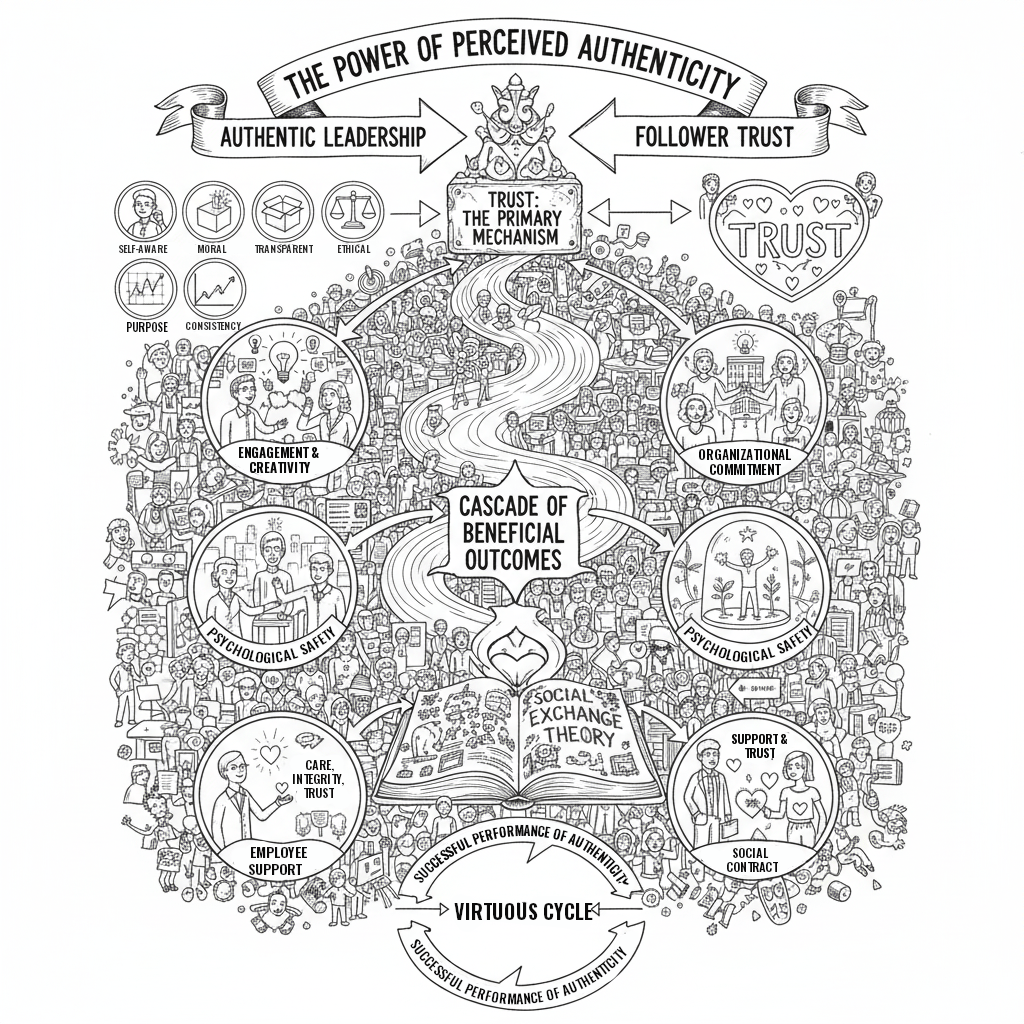
These characteristics are not merely personal virtues; they are the functional bedrock for effective leadership. By fostering psychological safety and demonstrating consistency between words and actions, authentic leaders are believed to build profound trust with followers [1]. This trust is linked to improved employee engagement, enhanced creativity, and greater organizational commitment [1].
Historical Catalysts and the Crisis of Trust
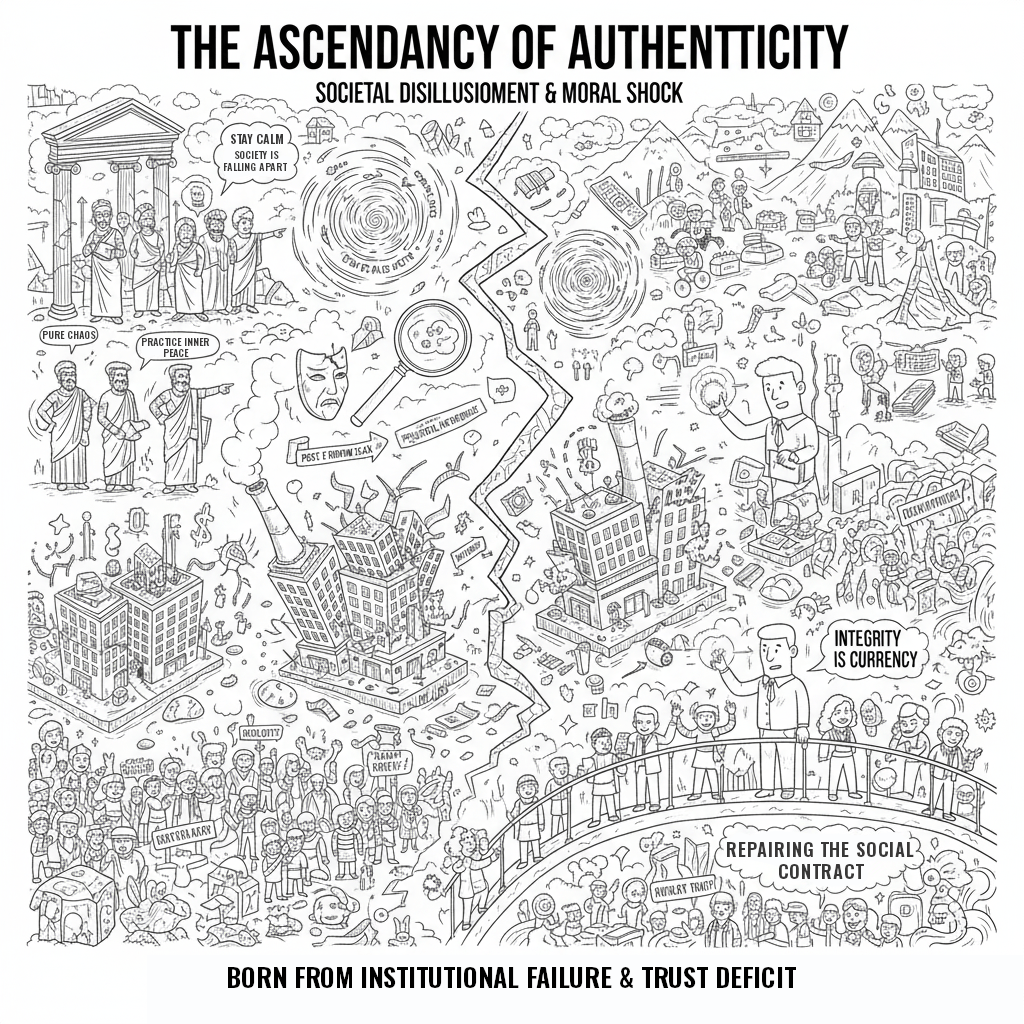
The ascendancy of authentic leadership as a popular ideal is linked to periods of profound societal disillusionment. Authenticity gains cultural salience during times of radical social change, moral shock, or when established civic and religious values decline [10]. The Greek Stoics, for instance, first advocated for authenticity as a moral response to the decay of their society’s traditional structures [10].
In the modern era, this demand has been acute during periods of collapsing public trust. The “post-Enron era” catalyzed the contemporary movement for authentic leadership [10]. Widespread corporate scandals, characterized by corruption, greed, and a lack of transparency, exposed the moral failings of existing leadership paradigms [12]. These events created a public yearning for a new kind of leader: one of substance and integrity, not a performer or manipulator. As one analysis notes, “issues of leader authenticity are always salient – it is just that we accentuate them during the times when major moral shocks occur in the corporate world” [10].
This pattern extends beyond the corporate world. Political instability, financial crises, and the perceived ethical void in public life have consistently fueled a societal cry for “reliable leadership” grounded in honesty, accountability, and transparency [7]. The demand for authentic leadership is not simply a preference for a style. It is a reactionary movement born from institutional failure and a fundamental deficit of trust. It represents an attempt to repair a damaged social contract by proposing a model where integrity is the primary currency.
The World as a Stage: A Goffmanian Framework for Social Interaction
To critically examine the societal impact of the demand for authenticity, a theoretical lens that treats social interaction as analysis is necessary. Sociologist Erving Goffman’s dramaturgical theory provides such a framework. In his 1959 work, The Presentation of Self in Everyday Life, Goffman argues that social life can be understood as a series of theatrical performances, a perspective that challenges the core assumptions of authentic leadership.
The Presentation of Self
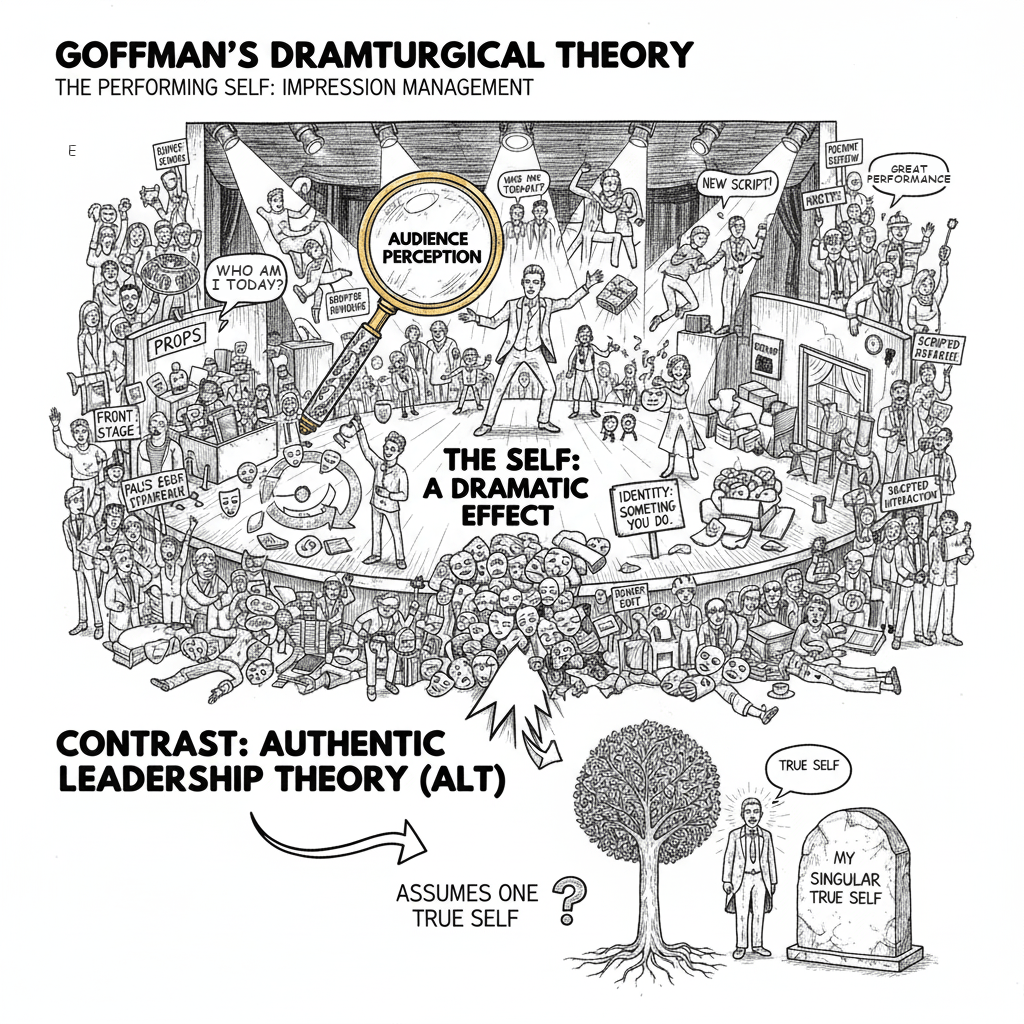
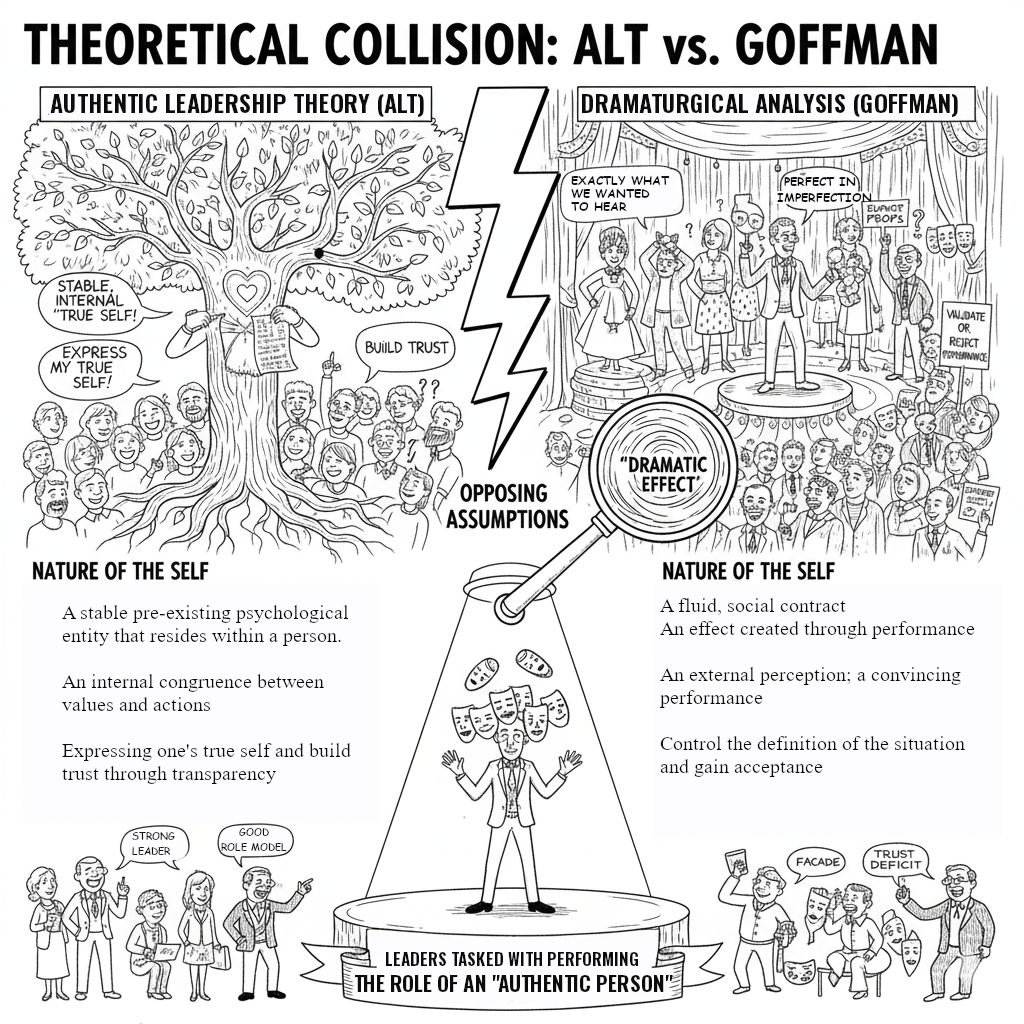
Goffman’s central metaphor posits that individuals are “actors” performing on a “stage” for an “audience” [13]. The “self” is not a stable, pre-existing psychological entity. It is a “dramatic effect emerging from the immediate scene being presented” [16]. A person’s identity is not something they have, but something they do, constantly remade through interactions [16]. This perspective contrasts with ALT, which assumes a singular “true self” that a leader should express [1].
The primary goal of these social performances is impression management: the conscious and unconscious techniques individuals use to guide and control how others perceive them [13]. Like an actor, an individual manages “costume” (clothing), “props” (objects), and the “set” (physical environment) to project an image and define the situation [14]. The aim is to gain acceptance by delivering a convincing performance, ensuring they are seen as they wish to be seen [16].
Front Stage and Back Stage
Goffman’s analysis hinges on a spatial distinction between two regions: the front stage and the back stage [13].
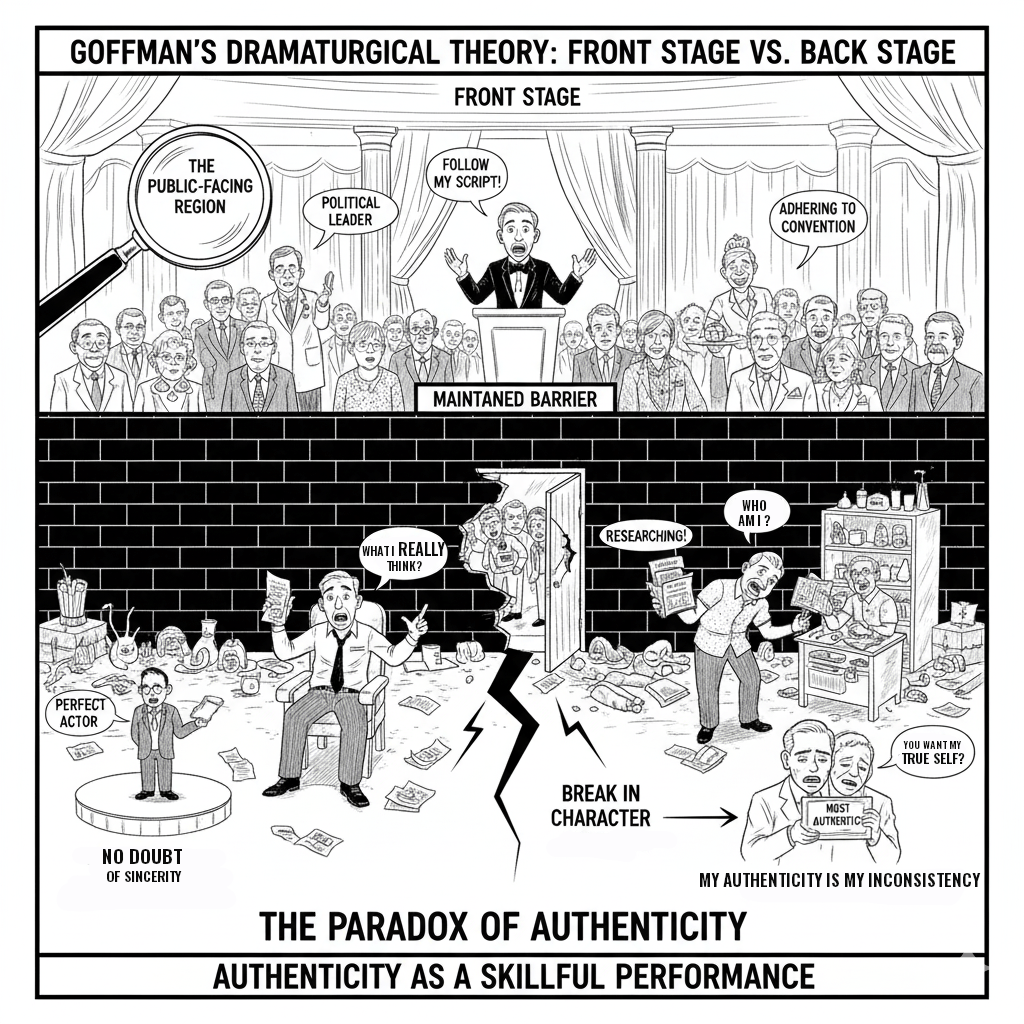
The Front Stage is the public-facing region for the performance. Here, the actor adheres to conventions, follows a script, and maintains a carefully constructed persona or “front” [15]. This front is composed of “appearance,” signaling social status, and “manner,” communicating the performer’s intended role [16]. A political leader giving an address, a doctor consulting a patient, or a server taking an order are all on the front stage, performing roles with established expectations.
The Back Stage is a private region where the actor can “drop the act” [13]. Here, the front stage’s crafted impression is “knowingly contradicted as a matter of course” [16]. The server complaining in the kitchen or the politician rehearsing “spontaneous” remarks are in the back stage. Maintaining a clear barrier between regions is essential for a successful performance; a “break in character” occurs when the audience glimpses the back stage, shattering the illusion [13].
This dramaturgical framework reframes authenticity. From a Goffmanian perspective, “authentic” is not the absence of performance, but a performance so skillful the audience does not question its sincerity. The most “authentic” individual may be the most accomplished actor. This sets the stage for a paradox when society demands leaders reveal their “true selves.”
The Authenticity Paradox: Being Real vs. Performing “Realness”
Confronting Authentic Leadership Theory with Goffman’s analysis reveals a fundamental tension. The societal demand for authenticity does not eliminate the performative nature of leadership; it creates a new, more complex, and demanding script. This creates the “authenticity paradox”: the requirement to be strategically performative while appearing genuinely non-performative.
The Collision of Theories
The frameworks of ALT and dramaturgical analysis operate on opposing assumptions. ALT is built on the premise of a stable, internal “true self” a leader must discover and express [1]. Goffman’s theory dismantles this, arguing the self is a fluid, social construct created through performance [16]. Authenticity in ALT is internal congruence; in Goffman’s world, it is an external perception attributed to a convincing performance. This theoretical collision reveals the demand for authenticity intensifies performance. Leaders are now tasked with performing the role of an “authentic person.”
| Feature | Authentic Leadership Theory (ALT) | Dramaturgical Analysis (Goffman) |
| Nature of the Self | A stable, pre-existing, internal “true self” | A fluid, situational, social construct; a “dramatic effect” |
| Locus of Authenticity | Internal congruence between values and actions | An external perception; a convincing performance attributed by an audience |
| Goal of Interaction | To express one’s true self and build trust through transparency | Impression management; to control the definition of the situation and gain acceptance |
| Role of Audience | Receivers of the leader’s authentic expression | Co-participants who validate or reject the performance, making them essential to the creation of the “self” |
The Performance of Authenticity
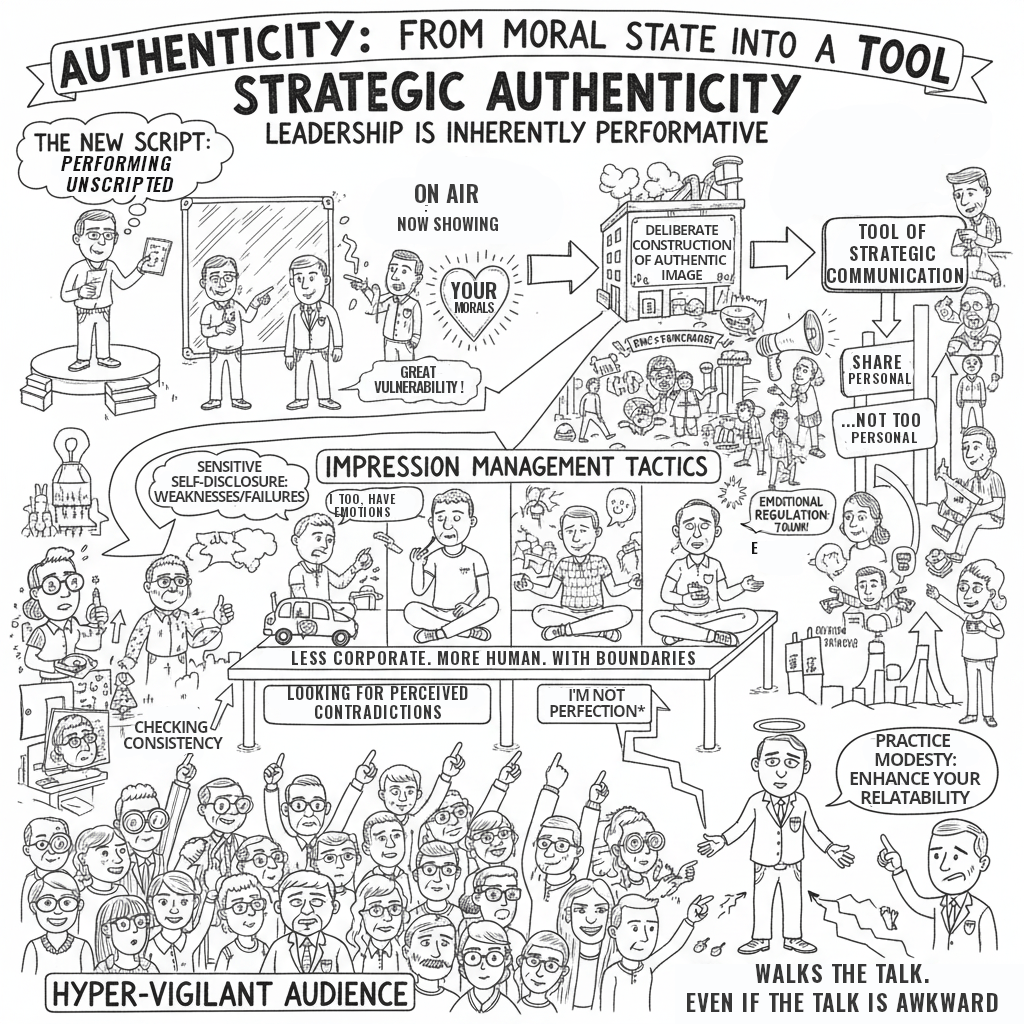
Leadership is often described as “inherently performative” [20]. The public’s desire for authenticity alters the script. Leaders are now expected to perform vulnerability, stage transparency, and enact moral values in ways that appear unscripted [20]. This has given rise to “Strategic Authenticity,” the deliberate construction of an authentic image to achieve specific goals [22]. Authenticity is transformed from a moral state into a tool of strategic communication [25].
Leaders employ impression management tactics to project this authentic image. One of the most effective is sensitive self-disclosure of weaknesses or failures. This act is perceived as authentic because it appears non-strategic; observers infer a person revealing a flaw must be genuine [20]. Other tactics include using informal language, emotional regulation to project calm, and practicing modesty to enhance relatability [20]. This is a high-stakes performance, as the audience is hyper-vigilant for artifice. A perceived contradiction can cause the performance to collapse.
The “Dark Side” of the Authentic Ideal
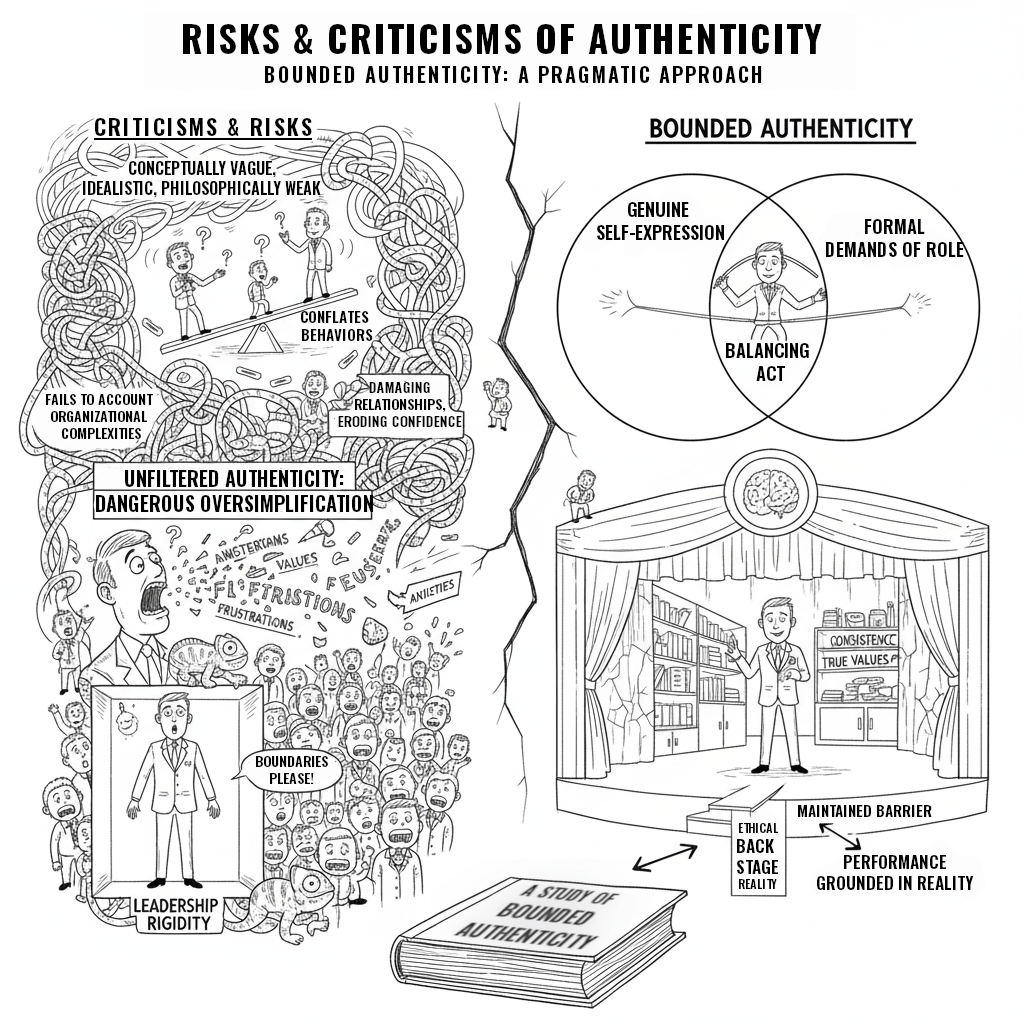
The ideal of authenticity is appealing, but the theory and its application face significant criticism and carry risks. Critics of ALT argue the theory is conceptually vague, idealistic, and philosophically weak [27]. It is accused of conflating leadership antecedents (e.g., positive psychological capacities) with leadership behaviors and outcomes, failing to specify what an authentic leader does [28]. This idealization fails to account for organizational complexities, where leaders must navigate conflicting values and role expectations [28].
A rigid adherence to unfiltered authenticity can be counterproductive. The notion that leaders should “let it all hang out” is a dangerous oversimplification [30]. Leaders who over-share anxieties or unvarnished frustrations risk damaging relationships, eroding confidence, and undermining credibility [31]. This can also lead to leadership rigidity, where a leader’s commitment to “being themselves” prevents adapting their style to different situations [33].
In response, the pragmatic concept of “bounded authenticity” has emerged. This view suggests effective leadership requires balancing genuine self-expression with the formal demands of the leadership role [28]. This approach implicitly concedes Goffman’s central point: leadership requires a managed, curated performance. The goal is not to eliminate the front stage but to ensure the performance is grounded in a consistent, ethical back stage reality.
The Societal Stakes: Trust, Cynicism, and Institutional Legitimacy
The societal demand for authenticity has dramatically raised the stakes. A leader’s ability to successfully perform authenticity can generate immense social capital and fortify public trust. A failed performance is not a neutral event. It acts as a powerful corrosive, accelerating the erosion of trust and fostering deep-seated cynicism that can poison institutional legitimacy.
The Promise: Authentic Leadership as a Foundation for Trust
Robust evidence demonstrates a strong, positive relationship between perceived authentic leadership and follower trust. Studies find that when followers perceive leaders as authentic (self-aware, transparent, ethical, consistent), they are significantly more likely to trust them [8]. This trust is the “cornerstone of any successful team” and the primary mechanism through which authentic leadership achieves positive effects [1].
This foundation of trust leads to a cascade of beneficial outcomes. In organizations, it is linked to higher employee engagement, organizational commitment, psychological safety, creativity, and job performance [8]. Social exchange theory explains this: when leaders demonstrate genuine care, integrity, and support, followers feel obligated to reciprocate with increased loyalty, effort, and commitment [47]. A successful performance of authenticity strengthens the social contract, creating a virtuous cycle of trust and performance.
The Peril: Inauthenticity and the Erosion of the Social Contract
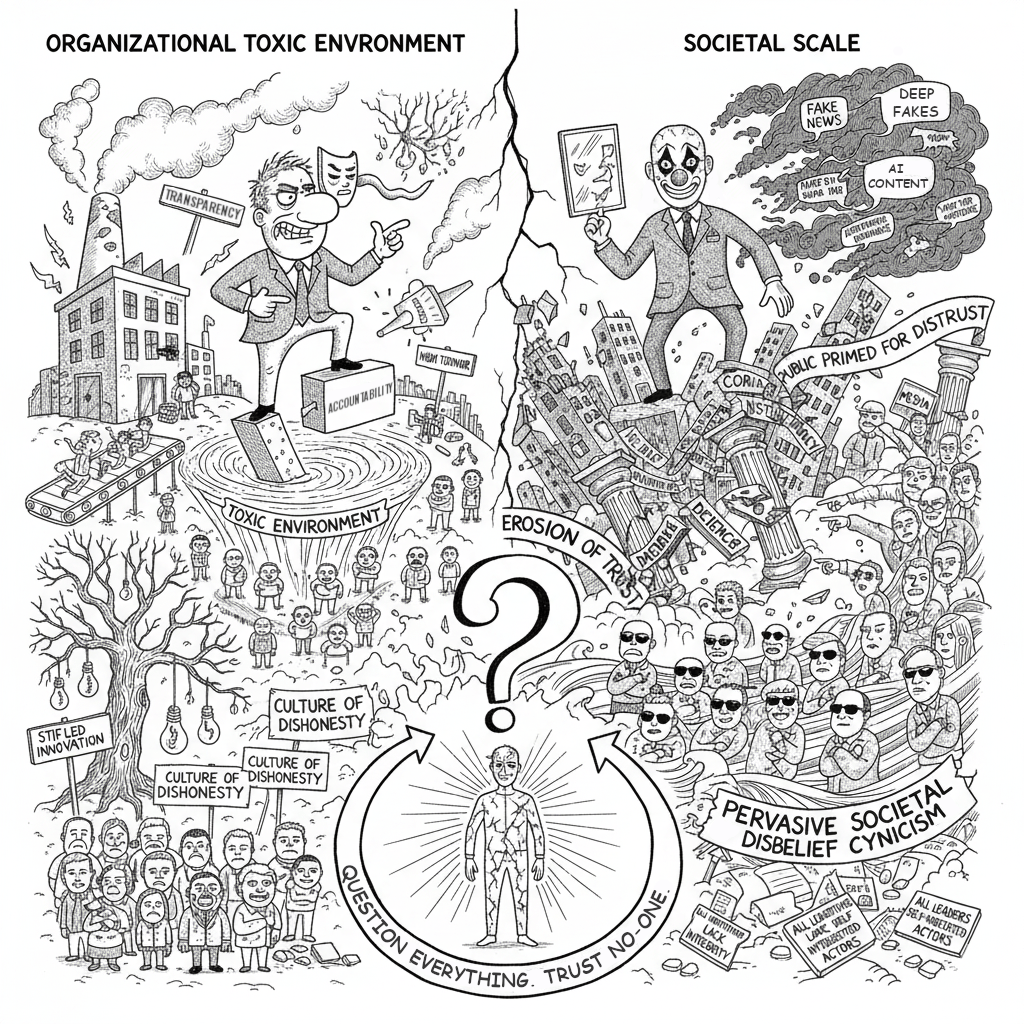
The consequences of failed or inauthentic leadership are equally potent and profoundly negative. Within an organization, a leader perceived as inauthentic (lacking transparency, avoiding accountability, self-serving, or inconsistent) creates a toxic environment [48]. This leads to mistrust, fear, disengagement, low morale, and high turnover [48]. Such an environment stifles innovation and can foster a culture of dishonesty as employees mimic the leader’s behavior [48].
On a societal scale, this dynamic is magnified and more dangerous. When political leaders are exposed as inauthentic, the resulting mistrust metastasizes beyond the individual to infect core institutions. The modern information ecosystem, saturated with “fake news,” deepfakes, and misinformation campaigns, already primes the public for distrust [49]. When a leader who staked their reputation on being “real” is revealed to be performing a charade, it validates the most cynical public views. This erodes faith not only in the political process but also in media, science, and other pillars of a functioning democracy [52].
This erosion of trust cultivates pervasive societal cynicism: a deeply ingrained belief that all institutions lack integrity and all leaders are self-interested actors [55]. Cynicism is more destructive than simple skepticism; it is a pandemic of disbelief making effective governance nearly impossible. Once this shared reality of cynicism takes hold, it becomes a self-fulfilling prophecy, as the public interprets all leadership actions through suspicion, making it difficult for any leader, regardless of intent, to build trust [29].
Navigating the Authentic Stage: Synthesis and Conclusion
The societal quest for authentic leadership presents a complex challenge. A simplistic understanding pitting “authentic” against “inauthentic” leaders fails to capture the reality of social life. Erving Goffman’s dramaturgical framework reveals performance is not an aberration but the essence of social interaction. The critical distinction is not between performance and non-performance, but between an ethical performance that builds trust and a manipulative one that corrodes it.
Beyond the Binary: Leadership as Ethical Performance
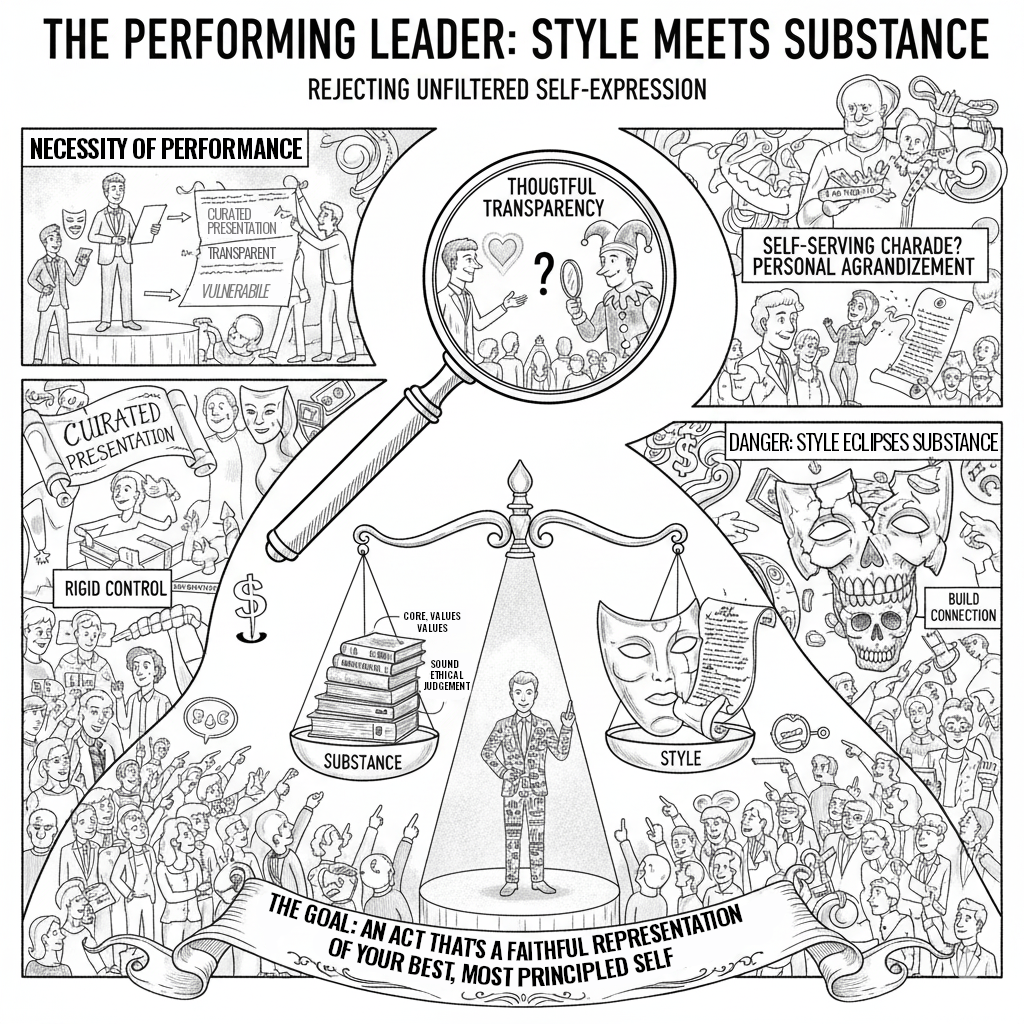
This analysis rejects the ideal that leaders can or should operate with unfiltered self-expression. The responsibilities of leadership necessitate a performance: a curated presentation of self for a specific audience and context [15]. The demand for authenticity has not eliminated this front stage; it has changed the script to one valuing transparency and vulnerability.
The crucial variable is not the presence of a performance but its quality and intent. The central question becomes: is the leader’s performance “thoughtful transparency” aimed at a collective good, or a self-serving charade for personal aggrandizement? [39] This is where the tension between style and substance becomes critical. An effective leader requires both: the substance of core values, sound judgment, and coherent policies, and the stylistic ability to communicate those values in a way that builds connection [57]. The danger arises when style, the polished performance of authenticity, eclipses and replaces ethical substance [60]. The goal is not finding a leader who isn’t acting, but one whose act is a faithful representation of their best, most principled self.
Implications and Future Directions
The implications of this dramaturgical reality are significant.
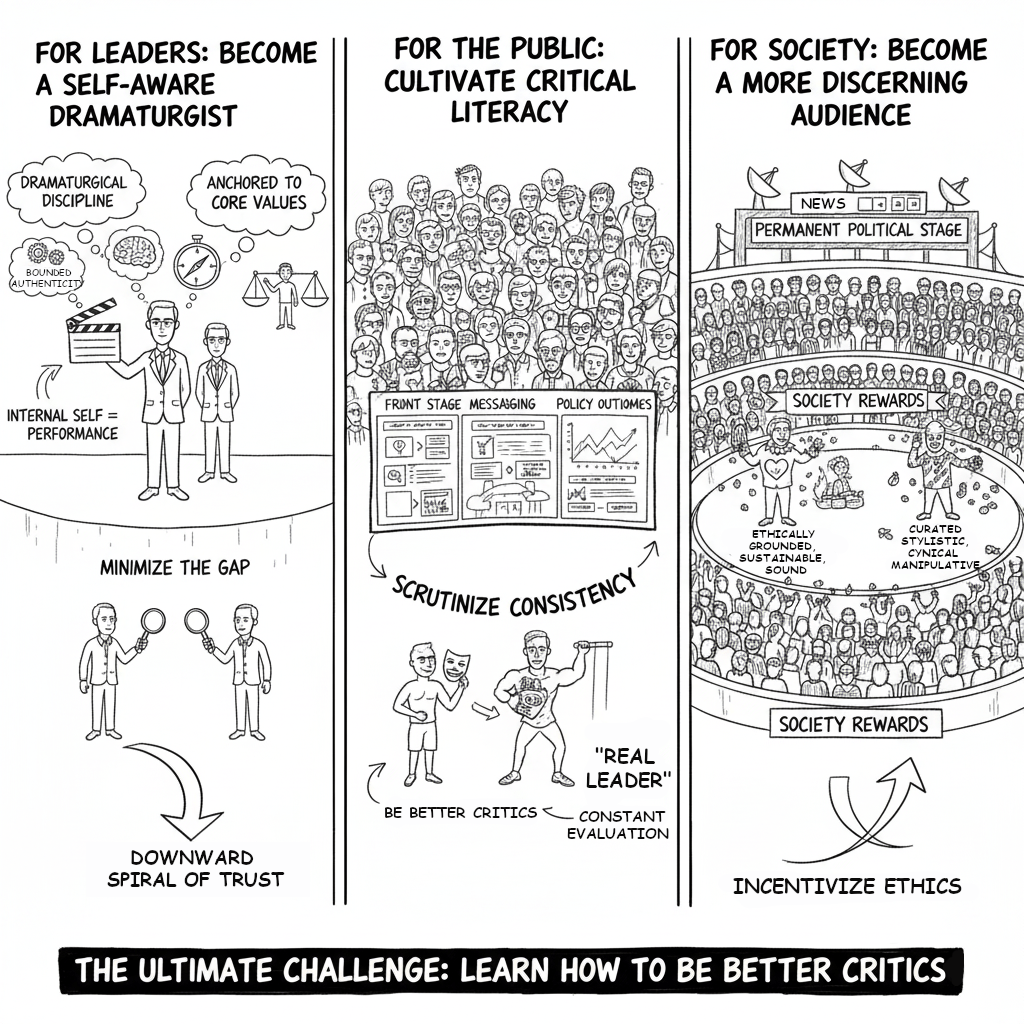
- For Leaders: The modern leader must become a self-aware dramaturgist. This requires “dramaturgical discipline”: consciously managing one’s performance to meet situational demands while ensuring it remains anchored to core values [16]. This is the essence of “appropriate” or “bounded” authenticity, where the gap between the internal self and external performance is minimized by ensuring the performance is an authentic extension of one’s values [20].
- For the Public: The most effective defense against manipulative leadership is cultivating critical literacy. The public must evolve beyond a passive search for a “real” leader, which makes it vulnerable to skillful actors, and develop the capacity to critically evaluate performances. This involves scrutinizing consistency between a leader’s front stage messaging, past actions, and policy outcomes.
- For Society: In a world where the political stage is permanent and the media audience always watching, the health of public institutions depends on our collective ability to become a more discerning audience. The impact of the demand for authenticity will be determined by which performance is rewarded. If society rewards performances that are ethically grounded, substantively sound, and aimed at the public good, it will incentivize more leaders to adopt this approach. If it rewards performances that are purely stylistic, divisive, or cynically manipulative, it will foster more of the same, continuing the downward spiral of trust.
The ultimate challenge is not for leaders to stop performing, but for the public to learn how to be better critics.
References
[1] What Is Authentic Leadership, and Why Does It Matter?, accessed October 11, 2025, https://www.ccl.org/articles/leading-effectively-articles/authenticity-1-idea-3-facts-5-tips/
[2] www.ccl.org, accessed October 11, 2025, https://www.ccl.org/articles/leading-effectively-articles/authenticity-1-idea-3-facts-5-tips/#:~:text=Authentic%20leadership%20means%20bringing%20your,safety%20in%20their%20work%20culture.
[3] What Is Authentic Leadership? Definition, Traits & Benefits – HPWP Group, accessed October 11, 2025, https://hpwpgroup.com/what-is-authentic-leadership-definition-traits-benefits/
[4] Cultivating Trust through Authentic Leadership | Association of Fundraising Professionals, accessed October 11, 2025, https://afpglobal.org/cultivating-trust-through-authentic-leadership
[5] Authentic Leadership: What It Is & Why It’s Important – Harvard Business School Online, accessed October 11, 2025, https://online.hbs.edu/blog/post/authentic-leadership
[6] 10 Characteristics of Authentic Leadership – Indeed, accessed October 11, 2025, https://www.indeed.com/hire/c/info/authentic-leadership-characteristics
[7] Authentic Leadership—A Concept Analysis – PMC – PubMed Central, accessed October 11, 2025, https://pmc.ncbi.nlm.nih.gov/articles/PMC11896828/
[8] Authentic Leadership, Trust (in the Leader), and Flourishing: Does Precariousness Matter? – PMC, accessed October 11, 2025, https://pmc.ncbi.nlm.nih.gov/articles/PMC9012166/
[9] How Authentic Leadership Builds Trust and Transforms Teams – Workhuman Live, accessed October 11, 2025, https://whlive.vercel.app/blog/how-authentic-leadership-builds-trust/
[10] Authentic Leadership: A Historical Perspective – ShareOK, accessed October 11, 2025, https://shareok.org/bitstreams/2f365e19-b8d7-4a82-9c3f-d37a978a8a95/download
[11] Authentic Leadership – Salem Press, accessed October 11, 2025, https://salempress.com/Media/SalemPress/Order%20Forms/leadership_pgs.pdf
[12] (PDF) Authentic Leadership and Societal Transformation: A Review of Literature, accessed October 11, 2025, https://www.researchgate.net/publication/365498890_Authentic_Leadership_and_Societal_Transformation_A_Review_of_Literature
[13] Dramaturgical Analysis | Research Starters – EBSCO, accessed October 11, 2025, https://www.ebsco.com/research-starters/drama-and-theater-arts/dramaturgical-analysis
[14] Dramaturgy in Sociology | Analysis, Theory & Approach – Lesson – Study.com, accessed October 11, 2025, https://study.com/academy/lesson/dramaturgical-analysis-in-sociology-definition-examples-quiz.html
[15] Erving Goffman’s Dramaturgical Approach – Madhura Joshi – Doing Sociology, accessed October 11, 2025, https://doingsociology.org/2022/05/11/erving-goffmans-dramaturgical-approach-madhura-joshi/
[16] Dramaturgy (sociology) – Wikipedia, accessed October 11, 2025, https://en.wikipedia.org/wiki/Dramaturgy_(sociology)
[17] Goffman’s dramaturgical approach | Intro to Performance Studies Class Notes – Fiveable, accessed October 11, 2025, https://fiveable.me/introduction-to-performance-studies/unit-4/goffmans-dramaturgical-approach/study-guide/mFnzv0K9Q7PQ5KAx
[18] Impression management – Wikipedia, accessed October 11, 2025, https://en.wikipedia.org/wiki/Impression_management
[19] Erving Goffman’s The Presentation of Self in Everyday Life, accessed October 11, 2025, https://web.pdx.edu/~tothm/theory/Presentation%20of%20Self.htm
[20] Impression Management: How Effective Leaders Balance Perception and Reality, accessed October 11, 2025, https://www.leadingsapiens.com/impression-management/
[21] Leading Without Losing Yourself: Goffman, Huizinga, Höpfl, and the, accessed October 11, 2025, https://thehubler.com/nl/blog/leading-without-losing-yourself-goffman-huizinga-hopfl-and-the-leadership-mask/
[22] (PDF) STRATEGIC AUTHENTICITY: THE PARADOX OF BEING REAL WHILE PLAYING ROLES IN LEADERSHIP – ResearchGate, accessed October 11, 2025, https://www.researchgate.net/publication/391662385_STRATEGIC_AUTHENTICITY_THE_PARADOX_OF_BEING_REAL_WHILE_PLAYING_ROLES_IN_LEADERSHIP
[23] Strategic political authenticity: How populists construct an authentic image. – CRIS – FAU, accessed October 11, 2025, https://cris.fau.de/publications/285644332/
[24] Political Authenticity: Conceptualization of a Popular Term, accessed October 11, 2025, https://www.db-thueringen.de/servlets/MCRFileNodeServlet/dbt_derivate_00054069/10.1177_1940161220948013.pdf
[25] The ‘real deal’: Strategic authenticity, politics and social media – First Monday, accessed October 11, 2025, https://firstmonday.org/ojs/index.php/fm/article/download/4985/4197
[26] Fostering Perceptions of Authenticity via Sensitive Self-disclosure Li Jiang – Harvard Business School, accessed October 11, 2025, https://www.hbs.edu/ris/download.aspx?name=JiangEtAlForthcoming.pdf
[27] Authentic leadership theory: The case for and against – ResearchGate, accessed October 11, 2025, https://www.researchgate.net/publication/349121989_Authentic_leadership_theory_The_case_for_and_against
[28] Authentic leadership: 20-Year review editorial | Journal of …, accessed October 11, 2025, https://www.cambridge.org/core/journals/journal-of-management-and-organization/article/authentic-leadership-20year-review-editorial/114043491BCD7F1E6AB3658944E1944B
[29] The Inauthenticity of Authentic Leadership Theory, accessed October 11, 2025, https://ilaglobalnetwork.org/the-inauthenticity-of-authentic-leadership-theory/
[30] The Dark Side of Authentic Leadership – CommsMasters, accessed October 11, 2025, https://commsmasters.com/the-dark-side-of-authentic-leadership/
[31] Being on the Wrong Side of Authentic Leadership – TechTello, accessed October 11, 2025, https://www.techtello.com/authentic-leadership/
[32] These are the dangers of being authentic – The World Economic Forum, accessed October 11, 2025, https://www.weforum.org/stories/2016/06/these-are-the-dangers-of-being-authentic/
[33] www.wevalgo.com, accessed October 11, 2025, https://www.wevalgo.com/know-how/manager-excellence/leadership/authentic-leader#:~:text=3.2%20Criticisms%20or%20shortcomings%20of%20Authentic%20Leadership&text=Difficulty%20adapting%20to%20different%20situations,to%20themselves%20and%20their%20values.
[34] Myths of Authentic Leadership – The Top 4! – Anne Koopmann, accessed October 11, 2025, https://annekoopmann.com/myths-of-authentic-leadership/
[35] Opinion: New Zealand PM Jacinda Ardern an authentic leader who rewrote the rules, accessed October 11, 2025, https://ausi.anu.edu.au/news/opinion-new-zealand-pm-jacinda-ardern-authentic-leader-who-rewrote-rules
[36] The Case for a New Generation of Leaders: Jacinda Ardern – Harvard Political Review, accessed October 11, 2025, https://harvardpolitics.com/ardern-new-leaders/
[37] Theorizing compassionate leadership from the case of Jacinda Ardern: Legitimacy, paradox and resource conservation – Center for Positive Organizations, accessed October 11, 2025, https://positiveorgs.bus.umich.edu/articles/theorizing-compassionate-leadership-from-the-case-of-jacinda-ardern-legitimacy-paradox-and-resource-conservation/
[38] Jacinda Ardern and the Challenges of Leadership – International …, accessed October 11, 2025, https://ilaglobalnetwork.org/jacinda-ardern-and-the-challenges-of-leadership/
[39] Building Trust, Engagement and Motivation as Leader: The Power of Authenticity – LSE, accessed October 11, 2025, https://www.lse.ac.uk/study-at-lse/executive-education/insights/articles/building-trust-engagement-and-motivation-as-leader-the-power-of-authenticity
[40] How Zelensky Has Changed Ukraine | Journal of Democracy, accessed October 11, 2025, https://www.journalofdemocracy.org/articles/how-zelensky-has-changed-ukraine/
[41] Cyber warfare: a study of Zelenskyy’s social media political performance strategies and effects – Frontiers, accessed October 11, 2025, https://www.frontiersin.org/journals/psychology/articles/10.3389/fpsyg.2024.1478639/full
[42] Leadership Lessons from President Zelensky – Blogs, accessed October 11, 2025, https://blogs.illinois.edu/view/8605/1836137519
[43] Volodymyr Zelenskyy, heroic leadership, and the historical gaze | Request PDF, accessed October 11, 2025, https://www.researchgate.net/publication/364441662_Volodymyr_Zelenskyy_heroic_leadership_and_the_historical_gaze
[44] Authentic Leadership Perception, Trust in the Leader, and Followers Emotions in Organizational Change Processes | Request PDF – ResearchGate, accessed October 11, 2025, https://www.researchgate.net/publication/285386219_Authentic_Leadership_Perception_Trust_in_the_Leader_and_Followers_Emotions_in_Organizational_Change_Processes
[45] Authentic Leadership, Trust, and Social Exchange Relationships under the Influence of Leader Behavior – MDPI, accessed October 11, 2025, https://www.mdpi.com/2071-1050/14/10/5883
[46] Authentic Leadership: Commitment to Supervisor, Follower Empowerment, and Procedural Justice Climate – Regent University, accessed October 11, 2025, https://www.regent.edu/journal/emerging-leadership-journeys/authentic-leadership/
[47] Authentic Leadership and Improved Individual Performance: Affective Commitment and Individual Creativity’s Sequential Mediation – PMC, accessed October 11, 2025, https://pmc.ncbi.nlm.nih.gov/articles/PMC8139621/
[48] Inauthentic Leaders: 5 Red Flags of Inauthentic Leadership: Are You Following a False Leader? – Stoic Matchmaker, accessed October 11, 2025, https://stoicmatchmaker.com/5-red-flags-of-inauthentic-leadership-are-you-following-a-false-leader/
[49] India’s innovations are about transforming lives: Pemmasani Chandra Sekhar, accessed October 11, 2025, http://www.uniindia.com/india-s-innovations-are-about-transforming-lives-pemmasani-chandra-sekhar/business-economy/news/3605220.html
[50] The Impact of Fake News on Public Trust in Traditional Media Outlets – ResearchGate, accessed October 11, 2025, https://www.researchgate.net/publication/381276966_The_Impact_of_Fake_News_on_Public_Trust_in_Traditional_Media_Outlets
[51] India Innovates to Empower – Using AI to Save Lives and Secure Citizens: Union Minister of State for Communications Dr. Pemmasani Chandra Sekhar – Orissa Diary, accessed October 11, 2025, https://orissadiary.com/india-innovates-to-empower-using-ai-to-save-lives-and-secure-citizens-union-minister-of-state-for-communications-dr-pemmasani-chandra-sekhar/
[52] “AI for Humanity” Conference Discusses Ways to Integrate AI into Missions, Discipleship – Milton Quintanilla | Crosswalk.com, accessed October 11, 2025, https://www.crosswalk.com/headlines/contributors/milton-quintanilla/ai-for-humanity-conference-discusses-ways-to-integrate-ai-into-missions-discipleship.html
[53] The Role Of Fake News And Blackouts In Escalating The Crisis Within Azad Kashmir, accessed October 11, 2025, https://www.google.com/search?q=https://www.fridaytimes.com/08-Oct-2025/role-fake-news-blackouts-escalating-crisis-within-azad-kashmir
[54] You Can Learn A Lot About Someone’s Mind From The Way They Talk – Scoop, accessed October 11, 2025, https://www.google.com/search?q=https://www.scoop.co.nz/stories/WO2510/S00052/you-can-learn-a-lot-about-someone-s-mind-from-the-way-they-talk.htm
[55] Is cynicism the next workforce pandemic? – University of Toronto, accessed October 11, 2025, https://www-2.rotman.utoronto.ca/insightshub/leadership-career-development/workplace-cynacism
[56] (PDF) Authentic Leadership as a Mediator in the Relationship between Psychological Contract Breach and Organizational Cynicism among Nurses – ResearchGate, accessed October 11, 2025, https://www.researchgate.net/publication/381003862_Authentic_Leadership_as_a_Mediator_in_the_Relationship_between_Psychological_Contract_Breach_and_Organizational_Cynicism_among_Nurses
[57] Leadership in Crisis. High on Style or Substance? | IE Insights, accessed October 11, 2025, https://www.ie.edu/insights/articles/leadership-in-crisis-high-on-style-or-substance/
[58] Leading with Style and Substance – PeopleBest, accessed October 11, 2025, https://peoplebest.com/leading-with-style-and-substance/
[59] Lessons in leadership… style vs. substance | Moxie Insights, accessed October 11, 2025, https://moxie-insights.com/people/lessons-in-leadership-style-vs-substance/
[60] Many Leaders Opt for Style Over Substance | Psychology Today, accessed October 11, 2025, https://www.psychologytoday.com/us/blog/transforming-toxic-leaders/202108/many-leaders-opt-style-over-substance
[61] All the School’s a Stage: Using Erving Goffman’s dramaturgical analysis as a framework for teacher professionalism – Mr Jones’ Whiteboard, accessed October 11, 2025, https://mrjoneswhiteboard.blog/2022/01/20/all-the-schools-a-stage-using-erving-goffmans-dramaturgical-analysis-as-a-framework-for-teacher-professionalism/